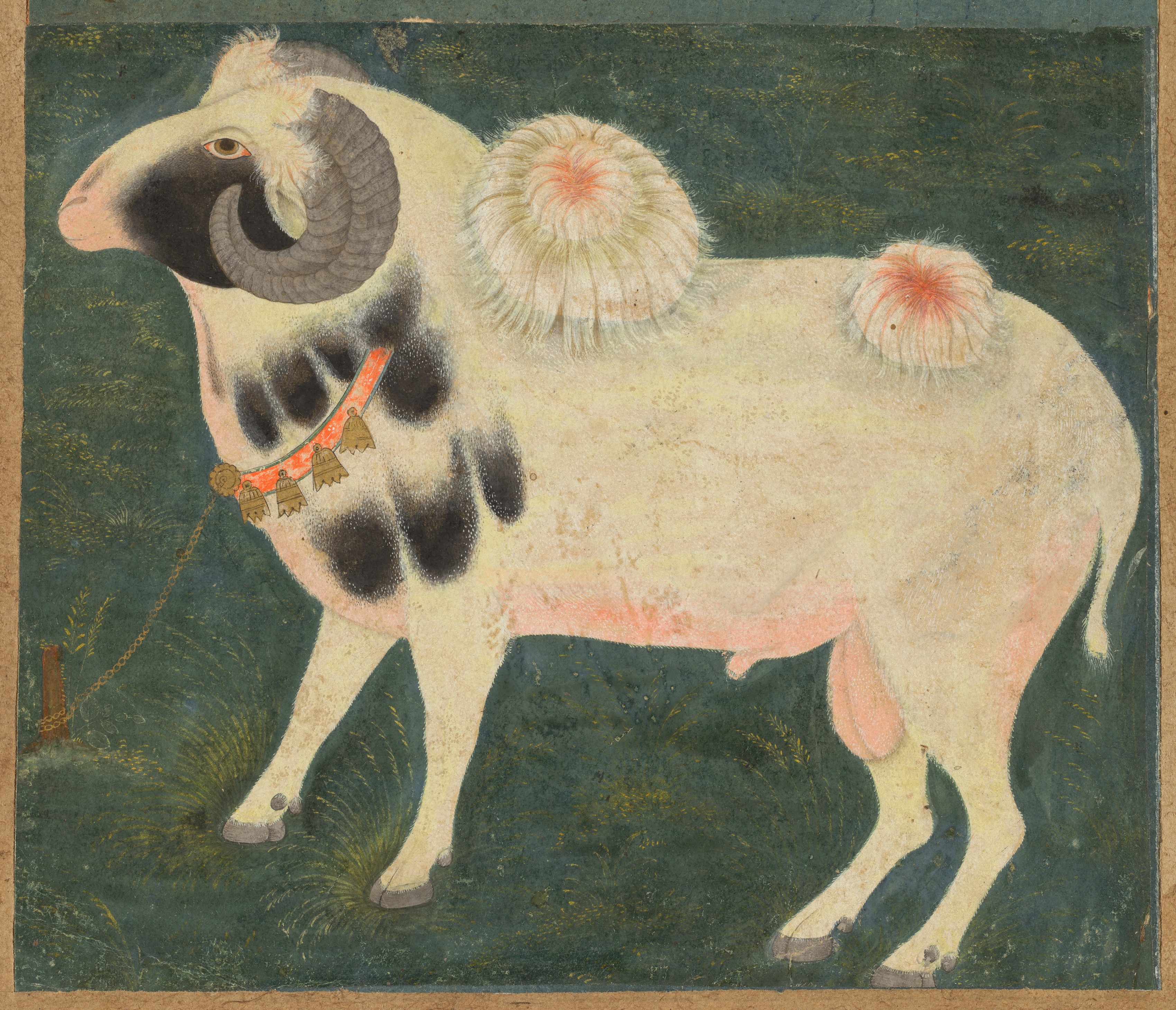
Deconstructing the Imperial Ram: A Study in Contradiction
At Zoey Fashion Lab, we do not merely observe artifacts; we interrogate them. We strip away the patina of history to expose the raw structural and conceptual fibers that bind an object to its time—and, more importantly, to our own. Our latest subject, a Mughal-era painting of a royal ram adorned with a gold chain, executed in gum tempera and gold on paper, presents a fascinating paradox. On the surface, it is a portrait of regal animality, a symbol of power and sacrifice. Yet, beneath that gilded surface lies a complex dialogue between permanence and fragility, ornamentation and brutality, which we have chosen to analyze through an avant-garde lens. This analysis will deconstruct the piece’s technical, symbolic, and material contradictions, drawing a parallel to the archival resonance of a silver mirror with split-leaf ornamentation versus a stone sarcophagus with narrative reliefs.
Technical Dissection: The Alchemy of Tempera and Gold
The technical execution of this work is our first point of entry. Gum tempera, a medium that binds pigment with a water-soluble adhesive, is inherently a medium of control and immediacy. Unlike oil, which allows for blending and revision, tempera demands precision. Each stroke is a commitment, a dry, deliberate act that builds form through cross-hatching and layering. This technique mirrors the Mughal court’s obsession with order and exactitude. The artist did not paint the ram; he constructed it, hair by hair, sinew by sinew, using a brush as a scalpel. This is not a spontaneous expression but a calculated performance of skill.
Contrast this with the application of gold leaf. Gold is not a pigment; it is a material presence. It does not simulate light; it reflects it. In this painting, the gold chain is not merely depicted; it is a physical intrusion of the precious metal onto the page. The chain’s links are rendered with a metallic intensity that breaks the illusionistic plane. It is a moment where the painting ceases to be a window and becomes an object itself. This duality—the matte, absorbent quality of the tempera against the reflective, hard surface of the gold—creates a tactile tension. The ram’s fleece, rendered in soft, matte tones, feels almost organic, while the chain is alien, cold, and manufactured. This is not an accident. The artist is consciously juxtaposing the living with the artificial, the natural with the courtly imposition.
Symbolic Dismantling: The Chain as Narrative Device
Symbolically, the ram occupies a liminal space. In a pastoral context, a ram is a leader, a breeder, a creature of rugged independence. In the Mughal royal menagerie, however, it becomes a specimen, a trophy of the hunt, and a potential sacrifice. The gold chain is the fulcrum of this transformation. It is not a crude rope or a leather strap; it is an ornament of subjugation. The chain signifies that this ram’s power is derivative—it exists only because the emperor permits it. The gold elevates the animal from livestock to a jewel, but it also imprisons it. This is a profound commentary on the nature of imperial favor: to be chosen is to be controlled.
Furthermore, the chain can be read as a line of descent, a genealogical marker. It connects the ram to the throne, to the divine right of the ruler. The animal becomes a living heraldic device, a physical manifestation of the king’s dominion over nature. But in our avant-garde deconstruction, we ask: who is truly chained? The ram is bound by gold, but the emperor is bound by the need to display this power. The chain is a symbol of mutual dependency. The ram’s majesty is a reflection of the emperor’s glory, but the emperor’s glory is contingent upon possessing such a magnificent beast. This circular logic creates a structural instability within the image, a subtle crack in the facade of absolute authority.
Archival Resonance: Mirror vs. Sarcophagus
Our reference archives provide a crucial counterpoint. The first, a silver mirror with split-leaf ornamentation in gold, represents the surface. The mirror is a tool of vanity and self-reflection, its beauty lying in its immediate, superficial splendor. The split-leaf pattern is a motif of growth and organic fracturing, yet it is frozen in precious metal. It speaks to the ephemeral nature of beauty—one glance, and it is gone. The second, a stone sarcophagus with narrative reliefs, represents the substrate. It is heavy, permanent, and concerned with the afterlife. Its carvings tell a story, a linear progression from life to death, from flesh to bone.
Our royal ram painting sits precisely between these two poles. The gold chain is the mirror—it dazzles, it reflects the viewer’s own desire for opulence, and it is ultimately superficial. It is the ornament that catches the eye first. But the ram’s body, rendered in tempera, is the sarcophagus. It is the vessel, the physical container of the soul (or in this case, the spirit of the hunt). The painting’s narrative is not linear like the sarcophagus, nor is it instantaneous like the mirror. Instead, it is a suspended animation. The ram is alive, yet it is already a relic. The chain suggests it is being led to a destination—perhaps the sacrificial altar, perhaps the royal stable. The painting captures that moment of transition, the breath held between the mirror’s reflection and the tomb’s finality.
Avant-Garde Interpretation: Deconstructing the Gilded Cage
For Zoey Fashion Lab, this artifact is not a historical curio but a blueprint for a new aesthetic. We propose a design philosophy we call “Gilded Subjugation.” This concept involves taking symbols of luxury and deliberately subverting their function. Imagine a garment where a structural cage is made of gold-plated chainmail, but the fabric within is a fragile, biodegradable muslin. The chainmail is the Mughal chain—it defines the silhouette, it adds weight and value. But the muslin is the ram’s fleece—it is organic, it breathes, and it will eventually decay. The wearer is simultaneously the emperor and the ram, the one who displays power and the one who is trapped by it.
We further deconstruct the color palette. The gold is not used for its brilliance but for its weight. We would print the gold chain pattern in a heavy, metallic foil that cracks and peels over time, revealing the raw canvas beneath. This mimics the tempera’s fragility, acknowledging that all power structures are ultimately ephemeral. The ram’s form would be abstracted into a geometric pattern—a series of intersecting lines that suggest horns and fleece but never resolve into a clear image. This fragmentation mirrors the split-leaf motif, suggesting a natural world that is constantly breaking apart and reforming.
Finally, we consider the viewer’s role. The original painting demands a single, frontal gaze—the viewer is the emperor, inspecting his property. Our avant-garde reinterpretation disrupts this. We would construct a garment that is asymmetrical, with the chain pattern wrapping around the back, forcing the viewer to circle the wearer to understand the full design. This creates a kinetic experience, moving from the mirror’s surface (the front) to the sarcophagus’s narrative (the back). The wearer becomes a living archive, carrying both the glittering present and the weighty past on their body.
Conclusion: The Eternal Chain
In conclusion, the royal ram with a gold chain is a masterpiece of controlled contradiction. It is a technical marvel that uses the precision of tempera to highlight the coldness of gold. It is a symbolic statement that uses the image of a powerful animal to expose the mechanics of imperial control. And it is an archival nexus, connecting the fleeting beauty of a mirror to the enduring narrative of a tomb. For Zoey Fashion Lab, this artifact is a challenge: to create work that is both beautiful and critical, both ornamental and structural. The chain is eternal, but its meaning is not. It is our duty to forge new links, to re-imagine what it means to be adorned, and to question who, ultimately, holds the other end of the line.