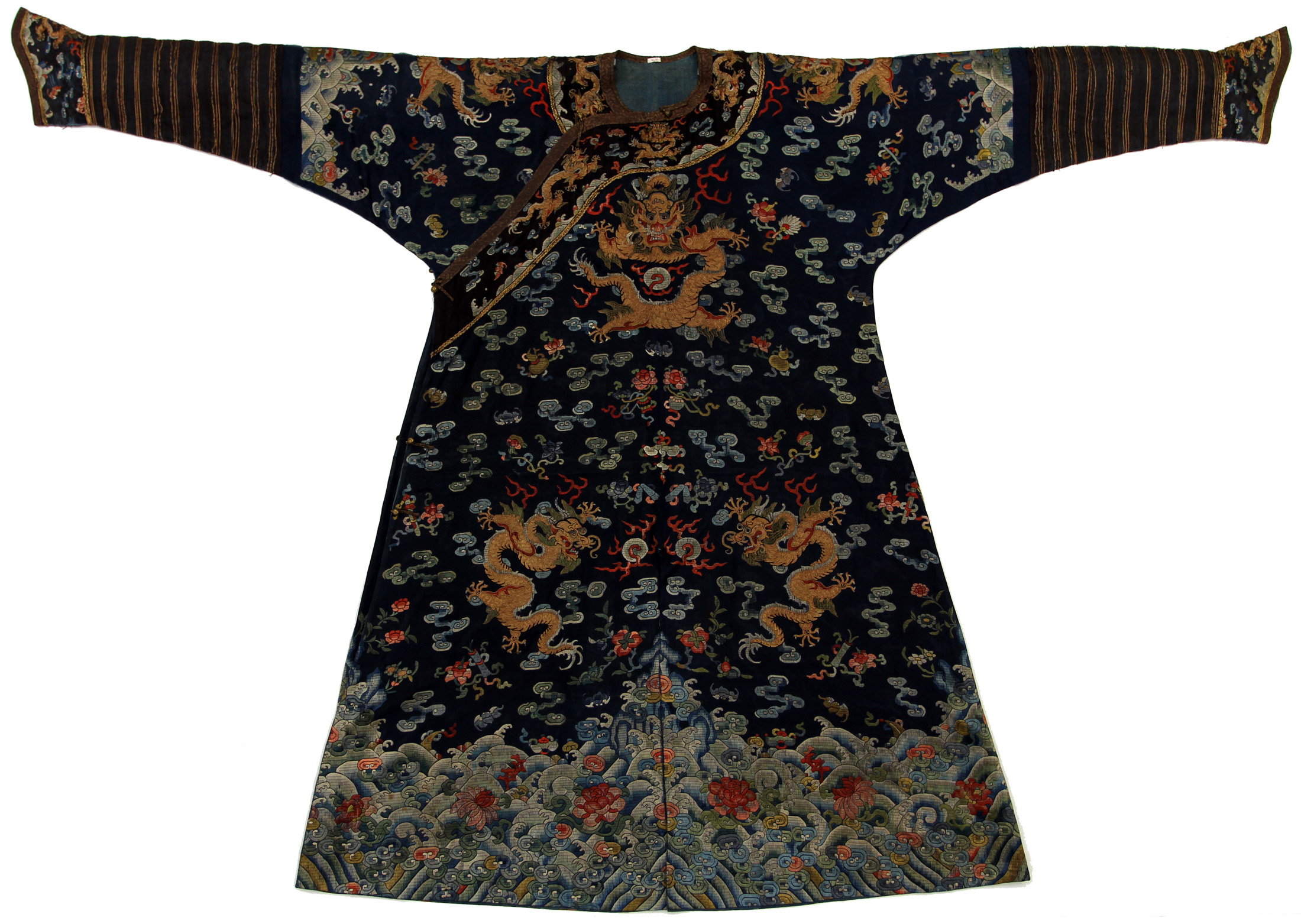
Deconstructing the Mandate: An Avant-Garde Exegesis of the Imperial Court Robe
The Imperial Court Robe, a sartorial lexicon of cosmic order and terrestrial authority, presents not a relic but a radical blueprint. For Zoey Fashion Laboratory’s SS26 inquiry, this is not an artifact to be replicated but a genetic code to be spliced. Our analysis discards historical reverence in favor of speculative deconstruction, treating its silk and metallic thread as data streams waiting to be corrupted and reconfigured. The objective is to extract its core principles—hierarchical geometry, symbolic cosmology, and restrained power—and project them through the lens of structural innovation and futuristic silhouettes, creating a standalone study in wearable architecture.
Architectural Deconstruction: From Ceremonial Plane to Volumetric Field
The traditional robe operates on a two-dimensional plane of woven silk, its significance mapped through surface embroidery. Our SS26 intervention initiates a dimensional shift. The foundational silks are not treated as fabrics but as tensile structural membranes. Imagine thermo-formed silk organza, laminated into rigid, curved planes that recall the sweeping, upturned eaves of imperial architecture. These planes become exoskeletal supports, creating a silhouette that is both shelter and exoskeleton. The robe’s iconic wide sleeves are abstracted into “momentum baffles”—articulated, hinged segments of technical silk and translucent polymer that extend from the shoulder in kinetic, fan-like formations. They do not drape; they articulate, moving with a precise, mechanized grace that echoes the ritualized gestures of court ceremony.
The central closure, once a modest axis of alignment, is reimagined as a structural fault line. Here, a magnetic or pneumatic closure system allows the garment to be reconfigured along this central seam, shifting the volumetric distribution from symmetrical monumentality to asymmetrical, dynamic imbalance. This embodies a futuristic dialogue between rigid order and adaptive fluidity—a core tenet for the SS26 individual navigating fluid identities.
The Semiotic Circuit: Metallic Thread as Data Stream
In the original robe, metallic thread embroidering dragons and cosmic symbols narrated a fixed mythos of power. Zoey Fashion Laboratory transposes this narrative language into a dynamic, interactive system. Metallic thread is liberated from its decorative role and integrated as a functional, conductive circuitry. Woven in parallel with optically clear monofilament, these threads form capillary-like networks across the structural silk planes.
These circuits connect to minimalist, sub-dermal LED nodes or shape-memory alloy patches. The result is a biomimetic, responsive garment surface. Instead of a static dragon, a cascade of light or a wave of textural change can flow across the body in response to biometric input (heart rate, breath) or environmental data streams. The symbolism becomes alive, personal, and ephemeral. The "mandate of heaven" is reinterpreted as a personal data mandate, where authority is derived from internal biometrics rather than celestial decree. For SS26, this represents the ultimate luxury: a garment that is a true interface, visualizing the unseen self.
Silhouette as Social Algorithm: Hierarchies Re-coded
The imperial silhouette was a walking social pyramid. Our avant-garde study recodes this hierarchy not through opulence, but through computational silhouette generation. Using parametric design principles, the garment’s volume and complexity are algorithmically determined. Imagine a base garment—a sleek, minimalist bodysuit of matte technical silk. Over this, a series of interlocking, 3D-printed "ceremonial modules" are attached via silent robotic fasteners.
These modules, crafted from recycled acrylic resin infused with shattered silk fibers, create the dramatic outer silhouette. Their arrangement is not fixed; it is modular and customizable, allowing the wearer to assemble their own "court" from geometric, armor-like pieces that suggest pauldrons, exaggerated hip architecture, or trailing spine elements. The silhouette thus becomes a user-defined social algorithm—a personal hierarchy of form that can be built up for performative moments and stripped down to a streamlined core. This speaks directly to the SS26 demand for configurable, multi-context identity tools.
Material Palimpsest: Silk as a Chrono-Sensitive Medium
Finally, we challenge the permanence of the court robe. Our SS26 study proposes chrono-sensitive materials. The silk is treated with photo-chromic and thermo-chromic coatings, allowing sections of the garment to change hue or transparency in response to light and body heat. The metallic circuitry may be designed to undergo controlled oxidation over the season, creating a living patina that records the garment’s journey—a modern, material autobiography.
This approach transforms the garment from a static symbol of eternal power into a document of temporal experience. It embraces decay and change as integral to its narrative, a stark and poetic contrast to the imperial desire for immutable legacy. The standalone study thus concludes not with a definitive form, but with a proposition: that true future-facing couture is an evolving system, a dialogue between the permanent and the perishable, the inherited structure and the individual’s data. For Zoey Fashion Laboratory, the Imperial Court Robe is disassembled, and from its components, we do not build a new throne, but a profoundly personal, architecturally resonant, and dynamically intelligent habitat for the body of SS26 and beyond.