Deconstructing the Divine: Translating Medieval Glass into SS26 Structural Language
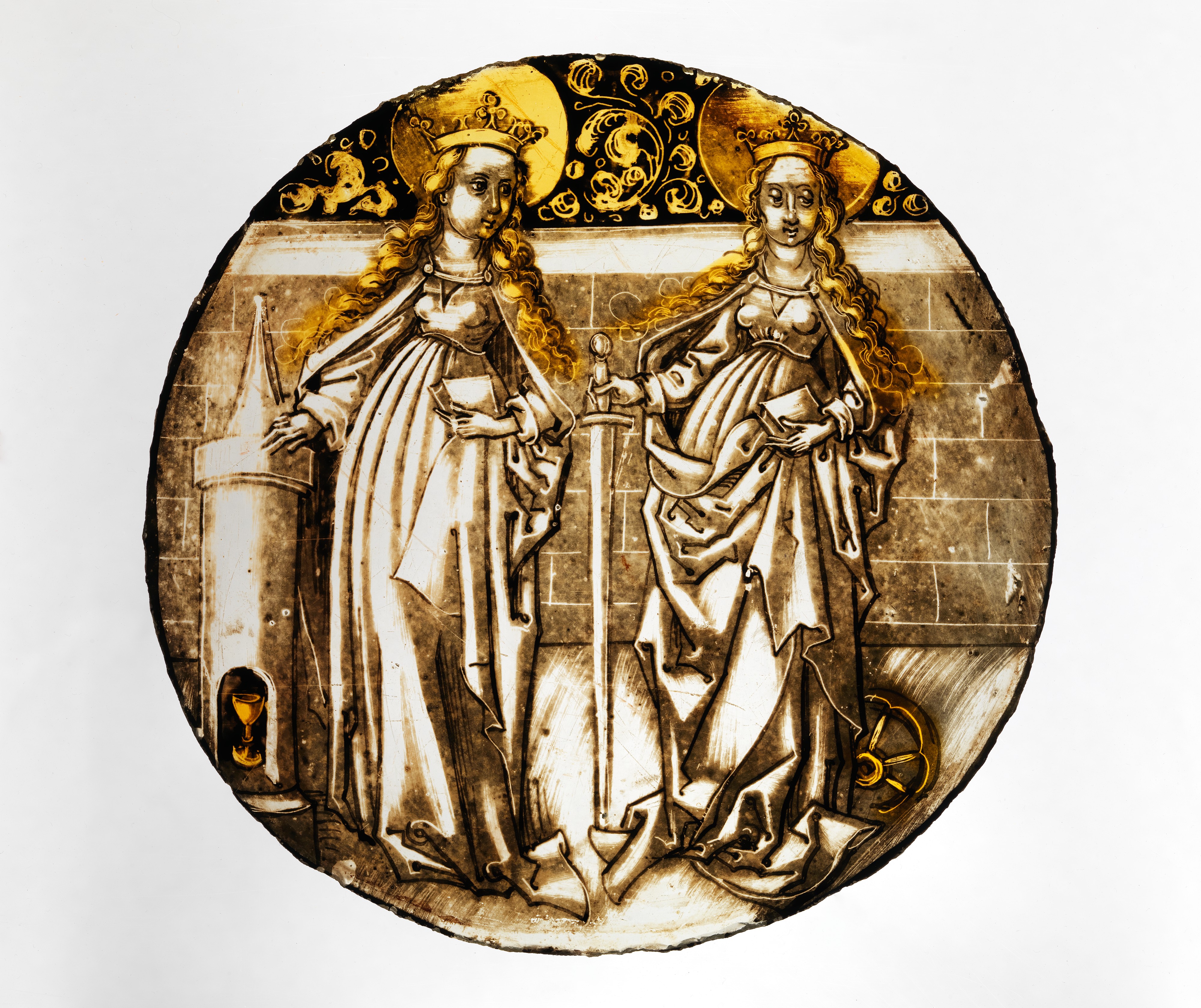
The stained glass roundel, traditionally a vessel for hagiographic narrative, is rarely considered within the lexicon of avant-garde couture. Yet, for Zoey Fashion Laboratory’s SS26 investigation, the German Roundel with Saints Barbara and Catherine—executed in colorless glass, vitreous paint, and silver stain—presents a radical departure from pictorial interpretation. We do not seek to replicate the imagery, but to extract its material ontology and structural logic. This analysis posits that the roundel’s intrinsic properties—its radial symmetry, its translucent stratification, and its chiaroscuro of stained light—offer a blueprint for a new generation of architectural garments that challenge the binary of opacity and exposure.
I. The Vitreous Silhouette: From Flat Disc to Kinetic Armature
The most immediate translation lies in the silhouette. The roundel is a perfect, self-contained circle, yet its internal composition—the figures of Barbara and Catherine framed by architectural canopies—creates a dynamic, non-linear tension. For SS26, we reject the static circumference. Instead, the silhouette emerges as a fragmented mandala, a series of interconnected, pivoting panels that mimic the lead cames of the original window. These are not soft drapes; they are rigid, cantilevered forms that jut from the body at acute angles, creating negative space that is as intentional as the positive form.
Consider a jacket constructed from recycled technical organza, heat-bonded into a lattice structure. The shoulders are not padded but sculpted into asymmetric corbels, referencing the architectural niches that house the saints. The hem is not straight but serrated, echoing the fractured edges of a damaged panel. The wearer becomes a living reliquary, but one that is futuristic and cyborgian, not nostalgic. The key is the deformation of the circle: we take the roundel’s geometry and stretch it vertically, creating a silhouette that is elongated, almost Gothic, yet punctuated by horizontal bands of rigid material that stop the eye, mimicking the structural ironwork of a cathedral window.
Translucent Stratification: Layering as a Metaphor for Vitreous Paint
The material palette is paramount. The roundel’s colorless glass is a misnomer; its genius is its ability to transmit and refract light without inherent hue. In our SS26 capsule, this is translated through layered, semi-transparent polymers. We propose a three-tier system: a base layer of nude micro-mesh (the ground glass), a middle layer of laser-cut, iridescent PVC (the vitreous paint, which becomes visible only when light passes through at a specific angle), and a top layer of hand-applied silver metallic foil (the silver stain).
This is not mere decoration. The silver stain in the original roundel was used to create yellow halos and details. In our construction, we use flexible, brushed aluminum plates that are affixed to the garment via magnetic closures. These plates are not static; they are positioned to catch and redirect light, creating a mobile, kinetic effect that changes with the wearer’s movement. The garment is thus a light-modulating device, not just a covering. The opacity is never total; it is a dialogue between the wearer’s skin, the garment’s internal layers, and the external environment. This is the structural innovation of transparency—not as exposure, but as a controlled, architectural reveal.
II. Deconstructive Iconography: The Saints as Modular Components
We must address the figures themselves. Barbara and Catherine are not subjects for romantic reinterpretation. Instead, we treat them as structural archetypes. Saint Barbara’s tower is reimagined as a cylindrical, collapsible bustier that can be detached and worn as a standalone corset. Saint Catherine’s wheel, her primary attribute, becomes a radial, rotating shoulder piece—a functional, kinetic joint that allows for a 360-degree range of motion while maintaining a sharp, architectural profile.
This is a deconstructive approach to iconography where the symbols are broken down into their geometric essences and then rebuilt as functional garment components. The wheel is not a print; it is a spoked, carbon-fiber frame that the sleeve passes through. The tower is not a motif; it is a telescoping, high-collar panel that can be raised to obscure the neck or lowered to create a dramatic, sloping shoulder line. The narrative is not told through imagery but through ergonomic possibility.
Structural Grammar: The Lead Came as Seam
In stained glass, the lead came is the structural skeleton that holds the fragile glass together. In our couture, the seam becomes the primary structural element, not a hidden construction detail. We propose exposed, industrial-grade zippers and metallic grommets that function as the lead cames. These are not placed for convenience but for visual rhythm and load-bearing integrity. A seam runs down the spine, but it is widened and reinforced with a flexible metal channel, allowing the garment to bend and flex while maintaining a rigid, panelized appearance.
This is a futuristic, exoskeletal approach. The garment is not a soft shell; it is a wearable architecture where every seam is a joint, every panel is a load-bearing surface. The color palette is deliberately monochromatic—optic white, graphite, and silver—to emphasize the play of light and shadow rather than chromatic narrative. The only accent is the silver stain, applied as a liquid metal coating on the edges of the panels, creating a sharp, reflective outline that delineates the silhouette against any background.
III. Futuristic Materiality and the SS26 Manifesto
For SS26, Zoey Fashion Laboratory declares that garments are not passive coverings but active, environmental interfaces. The roundel, in its original context, was a device to tell a story through light. Our garments are devices to manipulate the perception of the body through light and structure. We utilize smart glass technology—electrochromic films embedded within the polymer layers—that can shift from transparent to opaque with a small electrical charge. This is the ultimate evolution of the vitreous paint: the ability to dynamically control transparency in real-time.
The final silhouette is a hybrid of the medieval and the cyborg. It is a high-collared, sharp-shouldered, asymmetrical form that is at once authoritative and ethereal. The pieces are heavy in concept but surprisingly light in weight, utilizing aerospace-grade aluminum and honeycomb-structured composites. The collection is not for the faint of heart; it is for the futuristic individual who sees clothing as a form of personal architecture—a way to construct one’s own space, control one’s own light, and define one’s own narrative. The roundel is not a historical artifact; it is a catalyst for a new structural grammar, one that merges the precision of medieval craft with the limitless potential of futuristic material science. This is not a reference; it is a reconstruction of reality.