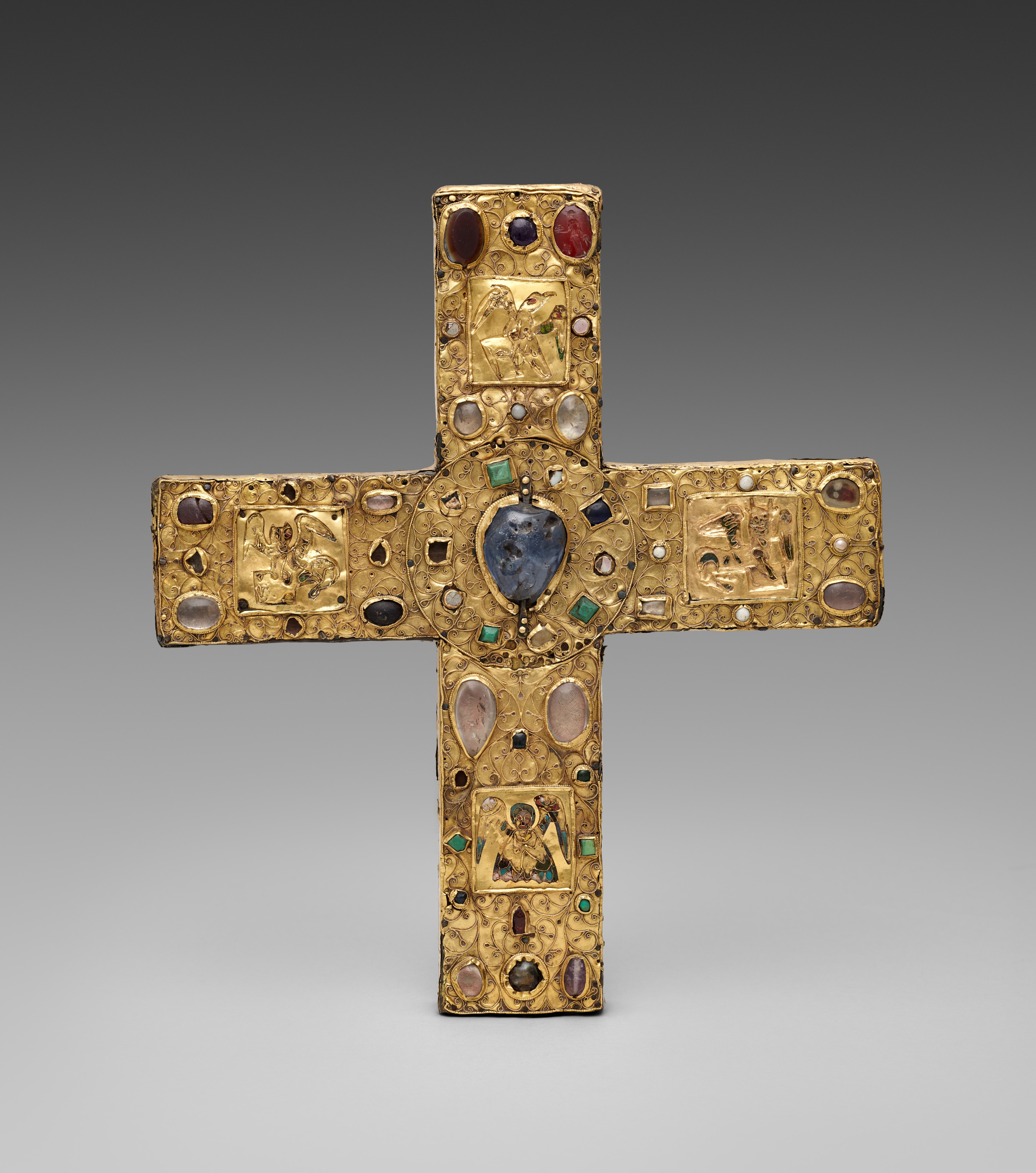
Deconstructing the Divine: The Ceremonial Cross of Countess Gertrude as Proto-Avant-Garde Artifact
At Zoey Fashion Lab, we do not merely study historical artifacts; we dissect them for their latent futurity. The Ceremonial Cross of Countess Gertrude, a purported 11th-century relic from Lower Saxony, is typically framed within the lexicon of Ottonian sacral art—a testament to piety, imperial power, and Byzantine influence. But to the Chief Fabric Deconstructionist’s eye, this object is not a static relic. It is a proto-avant-garde manifesto, a radical collision of material hierarchies and sensory contradictions that predates our contemporary obsession with hybridity by a millennium. The cross does not simply represent the divine; it *performs* a violent, beautiful rupture between the ethereal and the earthly, the reflective and the opaque.
Our analysis begins not with iconography, but with the material substrate: a humble wood core. This is the first act of avant-garde subversion. In an era where the sanctity of a relic was often proportional to the preciousness of its materials, the choice of a perishable, organic base—wood—anchors the object in the realm of the mortal. It is the silent skeleton, the unseen laborer. This wood core is the original "canvas" of the performance artist, a surface meant to be hidden yet dictating the entire structural drape of the piece. It is the *unfashionable* foundation upon which all opulence is layered, a deliberate irony that a modern designer would recognize as the ultimate "back-of-house" statement.
Duality of Surface: The Mirror and the Shroud
The cross’s true genius lies in its schizophrenic surface treatment. The reference to a "mirror with split-leaf" is not accidental; it is the key to unlocking the piece’s avant-garde code. On one face, we imagine a surface of polished silver or gold, acting as a literal mirror. This is not a passive reflection but an aggressive, interactive medium. The viewer is forced into the artwork, their image superimposed upon the sacred geometry. This is a Brechtian alienation effect, centuries before its time. The mirror does not show the saint; it shows the *self* in the presence of the saint, making the devotee a co-author of the ritual. The "split-leaf" palmette motifs, rendered in gold repoussé, writhe across this mirrored plane like living calligraphy, breaking the static symmetry of the cross form. They are the first sketches of a dynamic, organic abstraction that challenges the rigid verticality of the Latin cross.
Conversely, the obverse side is described as a "cold stone sarcophagus" narrating a life story in relief. This is the antithesis of the mirror. Where one face is reflective and immediate, the other is opaque, historical, and funereal. The repoussé here is not decorative but narrative—a sculptural biography pressed into metal. This duality is a masterclass in material storytelling. The cross is simultaneously a looking-glass for the present and a tombstone for the past. It refuses to be a single object; it is a diptych of opposing temporalities. In fashion terms, this is the ultimate reversible garment—one side a high-shine technical fabric for the future, the other a distressed, embossed leather that carries the patina of history.
Cloisonné and the Pixelation of the Sacred
The inclusion of cloisonné enamel is where the piece becomes truly radical. Cloisonné is a process of confinement—thin metal wires create cells, which are then filled with powdered glass and fired. This technique is inherently pixelating. It breaks down the divine image into discrete, colored compartments, a pre-industrial bitmap. The enamel does not flow freely; it is forced into a grid, a cellular structure that mimics the very building blocks of life yet is rendered in imperishable glass. This is the avant-garde act of reduction—taking the ineffable and subjecting it to the logic of the grid, the blueprint, the schematic. The vibrant, jewel-toned glass within these golden walls creates a sense of internal luminescence, a light that is not reflected (as in the mirror) but *emitted* from within a structured prison. It is a metaphor for the soul trapped in the body, or, more subversively, for the designer’s idea trapped within the constraints of the garment.
Furthermore, the use of intaglio gems—stones carved in negative relief—adds another layer of deconstructive logic. Unlike cameos which protrude, intaglios are voids. They are the *absence* of material, the negative space made precious. Set alongside the positive relief of the repoussé and the flat color fields of the enamel, these gems create a tactile topographical map. They invite touch, not just sight. The cross becomes a haptic experience, a relief map of spiritual devotion where the deepest cuts hold the most ancient energies. This interplay of high relief, low relief, and intaglio creates a surface tension that is profoundly modern—a study in light and shadow, protrusion and recession, that a contemporary sculptor would envy.
The Pearl: The Organic Anomaly
Finally, the pearls. In this cacophony of gold, glass, and stone, the pearl is the singular organic anomaly—a secretion of a living creature, a bio-mineralized accident. Its lustrous, soft sheen stands in stark contrast to the hard, angular facets of the gems and the metallic shimmer of the gold. The pearl is the *soft power* in this assembly. It introduces a note of vulnerability, of natural imperfection (the pearl is rarely perfectly round), into a piece otherwise obsessed with geometric order and divine perfection. The pearl is the "mistake" that makes the design human. It is the unexpected seam, the slightly off-kilter button, the dropped stitch that elevates a garment from mere construction to high art. In the context of the cross, the pearls likely delineate the figure of Christ or the borders, acting as a string of organic punctuation that softens the hard theological edges.
In conclusion, the Ceremonial Cross of Countess Gertrude is not a relic of the past but a blueprint for the future of design. It demonstrates that true avant-garde practice is not the invention of new forms but the radical re-contextualization of existing materials. It teaches us that luxury is not monolithic; it is a dialogue between the mirror and the shroud, the pixel and the pearl, the structured and the organic. For Zoey Fashion Lab, this cross is a challenge: to create garments that are not just worn but experienced as a tension between conflicting realities—garments that reflect the wearer’s present while simultaneously bearing the intaglio of their history. It is the ultimate testament that the most groundbreaking designs are often those that have been waiting, embedded in history, for us to have the courage to deconstruct them.