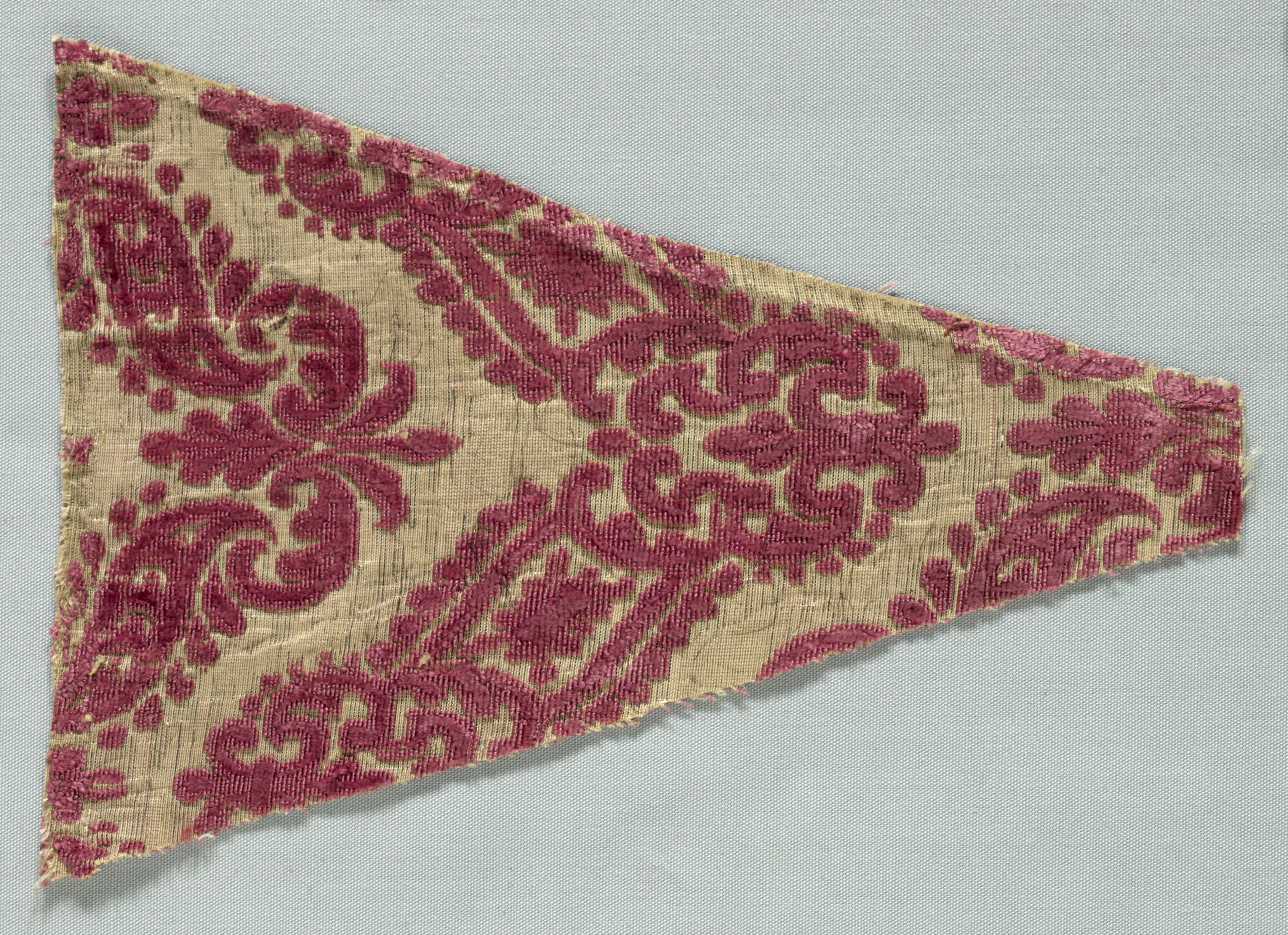
Deconstructing the Baroque: The Velvet Fragment as Proto-DNA
At Zoey Fashion Lab, our mandate transcends the mere cataloging of historical textiles. We engage in a form of material archaeology, extracting the latent genetic code embedded within fibers, weaves, and dyes to inform the next generation of avant-garde construction. The subject of this analysis—a velvet fragment originating from Italy in the second half of the 17th century—presents a paradox of opulence and entropy. On the surface, it is a relic of Baroque excess. Beneath the microscope, however, it reveals itself as a primitive, chaotic DNA strand, a biological blueprint whose structural logic can be re-engineered for radical, contemporary silhouettes. This report dissects the fragment’s technical anatomy and proposes a speculative framework for its translation into the Zoey Fashion Lab’s “New DNA Strand” collection.
Technical Autopsy: The Anatomy of Italian Baroque Velvet
The fragment’s physical properties demand a rigorous, multi-scalar examination. The weave structure is a classic voided velvet, a technique perfected in Genoa and Florence, where a pile warp is selectively cut to create a raised, lustrous pattern against a ground weave. The technical mastery is immediately evident in the density: approximately 20 to 24 pile threads per centimeter, a figure that speaks to the immense labor and material cost of the era. The silk filament itself is a continuous, reeled thread, unbroken by spinning, which imparts an almost liquid sheen. This is not a fabric; it is a solidified beam of light.
Structural Tension: Pile vs. Ground
The core of the fragment’s genetic potential lies in its binary structural tension. The raised pile—the “positive” space—creates a topography of light absorption and reflection. The cut loops, once severed, splay open, catching light at unpredictable angles. Conversely, the ground weave—the “negative” space—is a taut, flat plane of twill or satin, offering a matte, recessive counterpoint. This is not a decorative contrast; it is a dialectical system of hard and soft, raised and recessed, shiny and dull. For the avant-garde, this duality is a ready-made language of deconstruction. We can isolate the pile as a “fur” of light, or excise the ground to create a skeletal, transparent lattice.
Chromatic Instability: The Dye as a Time Signature
Color analysis reveals a deep, oxidized crimson, likely derived from kermes or cochineal, mordanted with alum. Yet, the fragment’s true color is not its original hue but its patina of decay. The dye has undergone a centuries-long photochemical degradation, creating a gradient from a deep, sanguine burgundy at the folds to a faded, desaturated peach at the exposed edges. This is not a flaw; it is a temporal layer. The fragment records its own history of light exposure, handling, and chemical drift. This chromatic instability is a crucial asset. In the new design, we do not replicate the original color; we amplify its fading, treating the garment as a living organism that will continue to evolve with wear.
From Relic to Blueprint: The “New DNA Strand” Translation
The velvet fragment is not a template to be copied but a genetic sequence to be spliced. The “New DNA Strand” concept at Zoey Fashion Lab operates on three principles: extraction, mutation, and re-integration. The fragment provides the raw nucleotide—the velvet’s structural logic—which we then mutate through digital fabrication and unconventional material handling.
Principle One: Extraction of the Weave Code
We begin by 3D-scanning the fragment at 0.1mm resolution, capturing not just the surface color but the topographic relief of the pile. This digital elevation model becomes the foundation for a generative design algorithm. The algorithm does not render a flat print; it interprets the pile’s height variations as a data field. We then output this data as a series of laser-cut, rigid panels in a bio-plastic composite. These panels are not shaped like the original fabric; they are shaped by its data. The result is a sculptural exoskeleton—a breastplate or a shoulder cage—that mimics the velvet’s undulating surface but in a hard, translucent material. The softness is translated into structure; the drape becomes architecture.
Principle Two: Mutation of the Pile
The traditional velvet pile is a static element. We mutate it. Using a technique of selective thermal bonding on a modern silk-cotton blend, we create a “programmable velvet.” A robotic arm applies heat to specific zones, causing the pile to collapse and fuse, creating permanent, rigid creases and pleats. This is a form of controlled entropy. Where the 17th-century weaver used a metal wire to cut loops, we use a laser to collapse them. The result is a garment that has the tactile richness of velvet but possesses a new, aggressive geometry—sharp, angular folds that hold their shape without internal boning. The fragment’s organic, flowing patterns are replaced by a fractured, digital aesthetic, echoing the instability of the original’s decay.
Principle Three: Re-integration of the Temporal Layer
The final principle addresses the fragment’s chromatic aging. We do not attempt to restore the color; we accelerate and redistribute it. Using a process of sublimation dyeing, we print the fragment’s fade gradient onto a sheer, deconstructed mesh. However, we invert the gradient. The deepest crimson is placed at the hem and cuffs—the areas of highest wear in a modern garment—while the faded, pale zones are positioned at the core. This creates a reverse patina, a garment that appears to be aging backwards. Furthermore, we embed a micro-encapsulated dye within the mesh that activates upon body heat, causing the garment to slowly deepen in color at the points of maximum contact. The garment is not a static object; it is a living chemical reaction, a direct descendant of the fragment’s own slow, centuries-long transformation.
Conclusion: The Velvet as a Living System
The 17th-century Italian velvet fragment is not a dead artifact. It is a fossilized intelligence, a system of structural and chromatic responses to time and light. By treating it as a DNA strand rather than a decorative motif, Zoey Fashion Lab unlocks a new design vocabulary. The future garment is not a velvet dress; it is a wearable algorithm—a rigid, translucent exoskeleton born from the pile’s topography, a mesh that breathes and changes color, a silhouette that combines the opulence of the Baroque with the cold precision of the digital age. The fragment’s true legacy is not its beauty, but its structural logic of contradiction: soft yet hard, light yet shadow, ancient yet perpetually new. This is the New DNA Strand—a synthesis of history and speculation, where the past is not preserved but re-engineered for a future of radical, living fashion.