Deconstructing the Anomaly: The Milanese Foot Tournament Half Armor as Proto-Avant-Garde
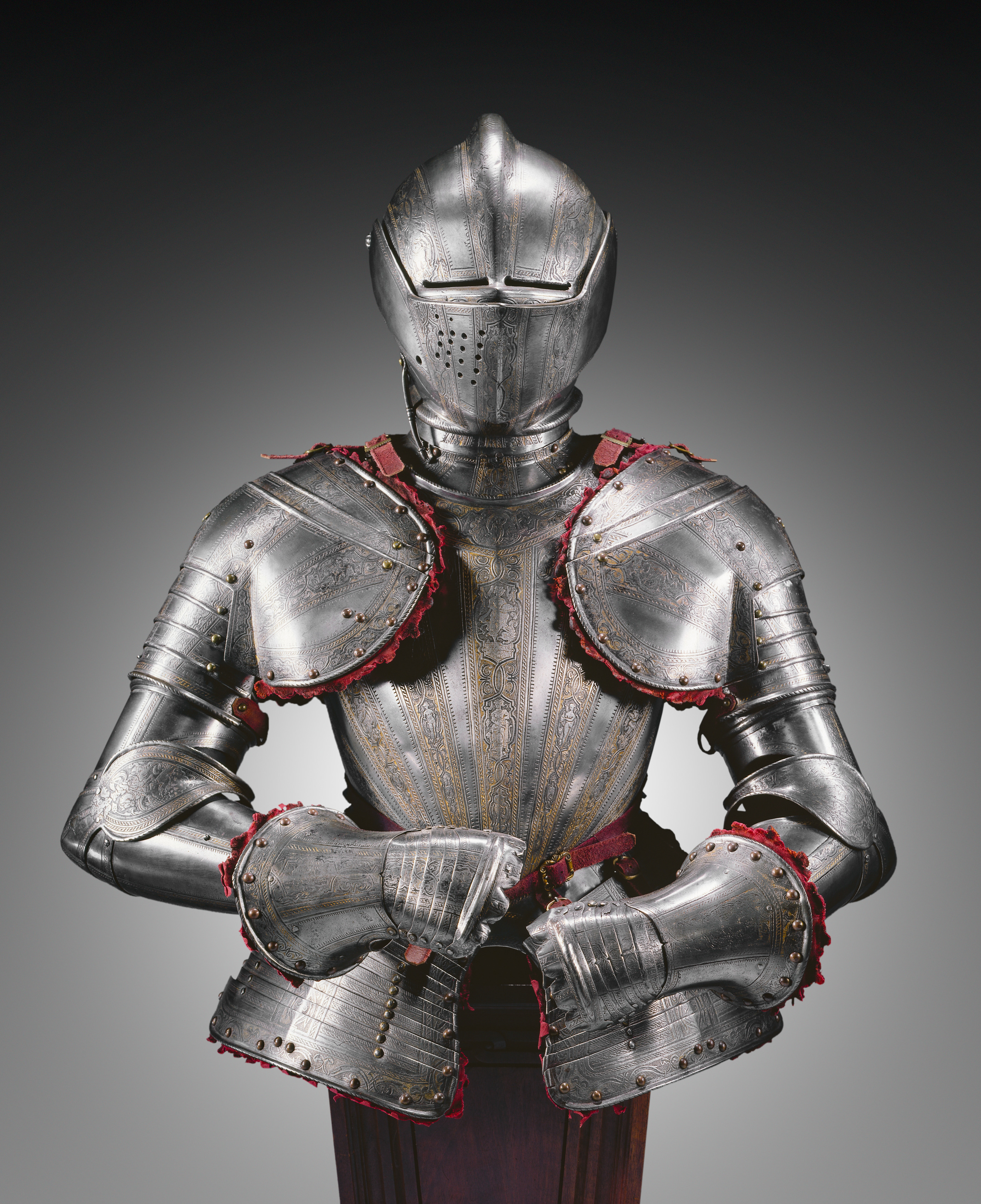
At Zoey Fashion Lab, our mandate extends beyond the mere cataloging of garments; we dissect the very DNA of style, tracing the genetic mutations that give rise to avant-garde expression. Today, our subject is not a couture gown or a streetwear silhouette, but a paradox forged in steel: a Half Armor for the Foot Tournament, originating from the master armories of Milan, circa the late 16th century. Constructed from etched and gilded steel, secured with brass rivets, and lined with supple leather and velvet, this object is typically relegated to the annals of military history. Yet, when we apply our forensic lens, we uncover a startling thesis: this piece is not merely protective equipment; it is a proto-avant-garde manifesto, a three-dimensional sketch of concepts that would not fully bloom for another four centuries.
The Milanese Crucible: Context as Catalyst
To understand the radical nature of this armor, we must first acknowledge its birthplace. Milan was the undisputed epicenter of European metallurgy, a city whose artisans operated as the haute couture houses of their era. The production of armor was not a utilitarian trade but a high-stakes performance of technical mastery and aesthetic ambition. The foot tournament—a choreographed, often ceremonial combat on foot—was the runway of its day. It was a spectacle designed for the elite, where martial prowess was indistinguishable from sartorial display. Within this crucible, the armor ceased to be purely functional. It became a site for artistic experimentation, a canvas where the boundaries of material, form, and identity were tested under the guise of tradition. The Milanese armorer was not a blacksmith; he was a sculptor, an engineer, and a stylist, and this Half Armor is his signature piece.
Material Dialectics: Steel, Brass, and the Velvet Touch
The technical choices in this artifact reveal a sophisticated understanding of material semiotics. The etched and gilded steel is not a single surface but a dialogue. The etching—typically acid-applied to create intricate, often mythological or floral patterns—serves to break the visual monotony of the metal, introducing a texture that mimics the intricate embroidery of contemporary silks. The gilding, or gold-leaf application, elevates the piece from a weapon to a jewel, catching torchlight in a way that would render the wearer almost supernatural. This is not camouflage; it is hyper-visibility, a deliberate strategy of optical seduction.
Contrast this with the brass rivets. Where gold suggests divinity, brass speaks to mechanical precision. The rivets are not hidden; they are exposed as functional punctuation, marking the joints and articulations. This is an early acknowledgment of the beauty of structural necessity, a principle that modern avant-garde designers like Rei Kawakubo or Yohji Yamamoto would later champion by exposing seams, unfinished edges, and internal boning. The brass is the honest skeleton, while the gilded steel is the idealized skin.
Finally, the leather and velvet fittings introduce a third, contradictory layer. Velvet—soft, plush, and deeply associated with courtly luxury—is placed in direct opposition to the cold, hard steel. This is a deliberate tactile juxtaposition. The armor is designed to be felt as much as seen. The wearer experiences a constant oscillation between the rigid exterior and the yielding interior, a physical metaphor for the duality of the courtier: the polished public facade and the vulnerable private self. This interplay of hard and soft, metallic and organic, is a foundational tactic in avant-garde fashion, used to challenge the wearer's and the viewer's sensory expectations.
Redefining the Silhouette: The Armor as Wearable Architecture
From a purely structural standpoint, the Half Armor for the Foot Tournament is a radical departure from the full suits of plate armor used in cavalry. By removing the leg defenses and the heavy helm, the armorer has fragmented the body's coverage. This is not a limitation but a liberation. The exposed lower body—clad only in hose and soft boots—creates a dynamic tension between the armored torso and the agile legs. This asymmetry was a shock to the classical system of protection, which demanded total encapsulation. In fashion terms, this is the equivalent of a designer cutting a jacket in half, or removing a sleeve—a deliberate act of deconstruction to expose the kinetic potential of the human form.
The articulation of the steel plates, particularly at the shoulders and elbows, is a marvel of ergonomic engineering. These overlapping lamés function like the scales of a mythical creature, allowing for a full range of motion while maintaining an unbroken visual line. This is kinetic sculpture. The armor is not a static object; it is designed for movement, for the specific choreography of the tournament—the lunge, the parry, the pivot. This focus on the body in motion, rather than the body at rest, predates the modern obsession with athleisure and performance wear by centuries. The Milanese armorer understood that true elegance is not a pose but a fluid sequence of gestures.
The New DNA Strand: Connecting the Anomaly to the Avant-Garde
When we map the genetic markers of this artifact onto the contemporary avant-garde, the connections are undeniable. The first strand is Material Transgression. Just as the armor mixes gilded steel with velvet, modern designers mix latex with silk, PVC with cashmere, or 3D-printed polymers with hand-woven wools. The goal is identical: to create a cognitive dissonance that forces a re-evaluation of the material's inherent value.
The second strand is Historical Appropriation. The avant-garde does not exist in a vacuum; it constantly raids the past for forms to subvert. Think of Alexander McQueen’s armor-inspired shoulder pads or Iris van Herpen's skeletal, exoskeletal structures. This Milanese half-armor is the original source code for that aesthetic. It provides the visual vocabulary of protective glamour—the idea that clothing can be both a fortress and a fetish object.
The third and most critical strand is Narrative Disruption. The foot tournament armor was a tool for a ritualized performance of masculinity and power. By deconstructing it, by focusing on the half rather than the whole, the armorer introduced a narrative of incompleteness. This incomplete form is more provocative than a finished one. It begs questions: What is missing? Why is it missing? This is the essence of the avant-garde—to present the viewer with an unresolved question, a garment that is a thesis rather than a conclusion. The exposed leg is not a flaw; it is a statement about the vulnerability that underlies all power.
Conclusion: The Armor as a Mirror
In our laboratory, we do not see a relic. We see a prophecy. The Half Armor for the Foot Tournament is a testament to the fact that the impulse to challenge, to distort, and to re-contextualize is not a modern invention. It is a fundamental strand of the fashion DNA, present in the very earliest expressions of wearable art. The Milanese armorer, working with fire, steel, and velvet, was the first true avant-garde designer. He understood that clothing is never just protective; it is communicative, provocative, and transformative. This artifact is not a museum piece; it is a mirror in which we see the radical potential of our own craft, reminding us that the future of fashion is always, in part, a re-forging of its most brilliant past. It is, in every sense, a masterpiece of wearable dissent.