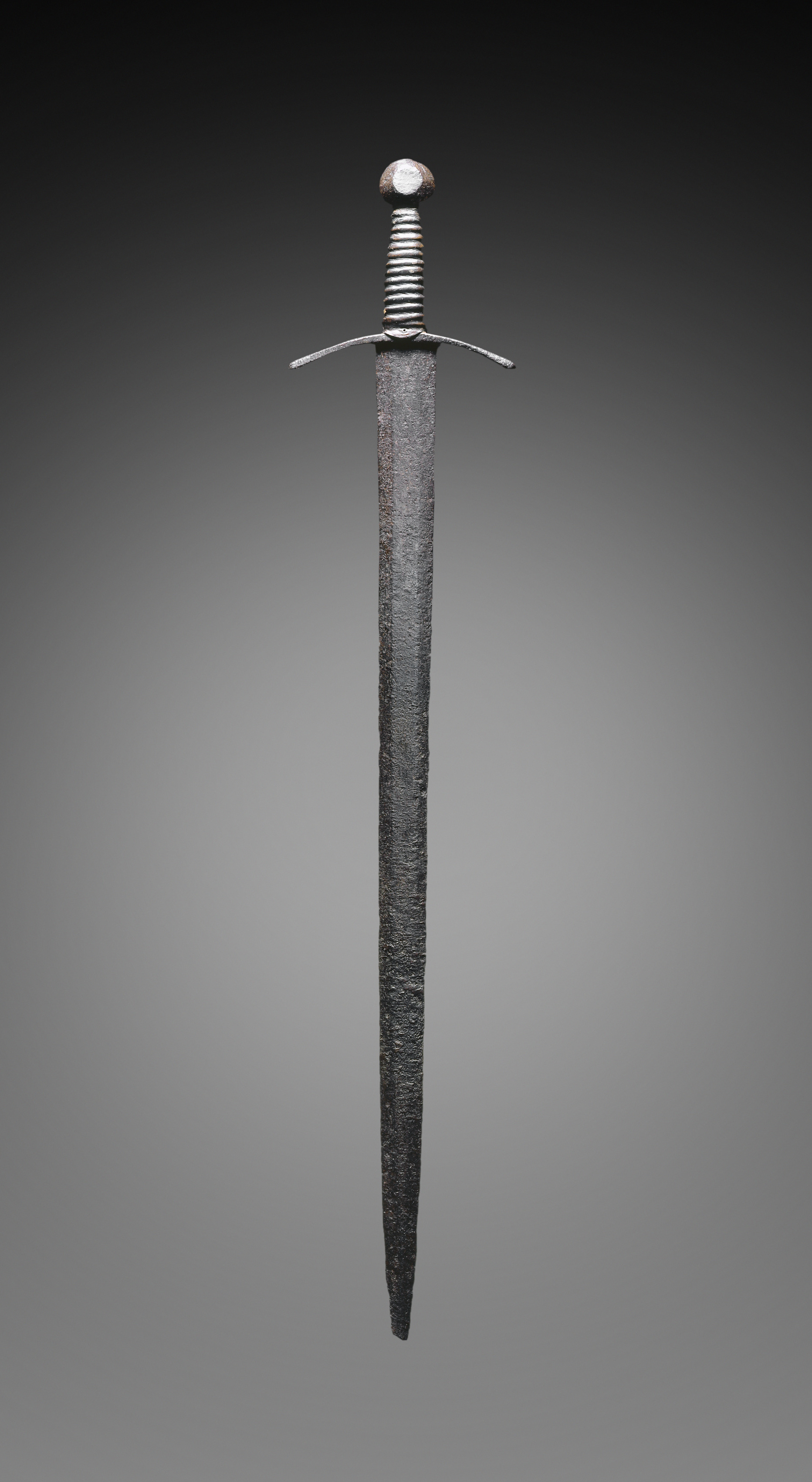
Deconstructing the Blade: An Avant-Garde Analysis of the Early 15th-Century European Sword
At Zoey Fashion Lab, our mandate is not to preserve history but to interrogate it. We do not see artifacts as static relics; we see them as raw material, as proto-textiles, as coded structures awaiting translation into a new language of form. The subject of this analysis—a European sword from the early 15th century, composed of steel, leather, and wire—presents a uniquely potent challenge. This is not a garment, yet it is a profound sartorial statement: a weaponized extension of the body, a rigid exoskeleton of intent, and a repository of medieval material logic. Our task is to deconstruct its physical and conceptual architecture and re-synthesize it through an avant-garde lens, using the New DNA Strand as our guiding design framework.
I. Material Taxonomy: The Steel, The Leather, The Wire
The sword’s primary mass is steel, a material of immense tensile strength and unforgiving rigidity. In fashion terms, we might classify this as a ‘hard textile’—a structural element that dictates silhouette rather than draping. The blade’s form is a study in negative space and linear tension. Its taper is not decorative; it is a functional calculus of balance and piercing power. For our purposes, the steel blade is the primary bone structure of the design, a spine that demands the body conform to its geometry.
Subordinate yet critical is the leather—typically found wrapped around the grip. This is the interface between human flesh and cold metal. Leather is a secondary skin, a porous, organic membrane that absorbs sweat and friction. In our deconstruction, leather represents the transitional zone, the point where the hard exterior meets the soft interior. It is the original ‘technical lining,’ providing grip and tactile feedback. Its organic texture, often dyed in deep oxblood or black, introduces a chromatic counterpoint to the steel’s metallic sheen.
Finally, the wire—often copper or silver, wound tightly around the leather grip—is the connective tissue. It is both functional (preventing slippage) and decorative (adding a glint of light). The wire is a linear accent, a metallic thread that binds the organic to the inorganic. In our design vocabulary, wire becomes the suture, the visible stitching that holds disparate elements together. It is also a conduit of energy, a literal line of force that travels from the wielder’s hand to the blade’s tip.
Deconstructive Translation: From Weapon to Wearable
Our avant-garde methodology rejects the literal reproduction of a sword. Instead, we isolate its core tensions: rigidity versus flexibility, mass versus line, and protection versus aggression. The New DNA Strand concept allows us to treat these materials not as fixed entities but as mutable sequences. We can re-code steel as a laser-cut, rigid polymer that mimics its structural memory but is feather-light. Leather can be re-imagined as a bio-fabricated mycelium composite, retaining its tactile warmth but grown to zero waste. Wire can be transformed into a flexible, conductive fiber optic thread, capable of emitting light and transmitting data.
The silhouette is the first casualty of our deconstruction. We abandon the sword’s vertical thrust. Instead, we fragment it. Imagine a jacket where the blade’s taper becomes a dramatic, asymmetric shoulder panel that extends into a sharp point at the cuff. The leather grip is re-coded as a corseted waistband, segmented into overlapping scales that mimic the hand’s grip, providing both compression and articulation. The wire wrapping is liberated from its grip and allowed to spiral up the arm as a series of exposed, metallic conduits, reminiscent of couture embroidery but with a brutalist, industrial edge.
II. The New DNA Strand: A Framework of Non-Linear Construction
The New DNA Strand is our proprietary design philosophy at Zoey Fashion Lab. It posits that a garment should not be constructed from a single, linear pattern but from a series of modular, self-similar units that can be reconfigured, layered, and interlocked. It is a fractal approach to fashion. Applying this to the sword, we break its monolithic form into a sequence of genetic markers.
Marker 1: The Edge (Razor Sharpness)
This marker represents the blade’s cutting potential. In our design, this translates to extreme, knife-pleated panels that radiate from the body’s core. These are not soft gathers; they are engineered to stand away from the body, creating a silhouette of aggressive angularity. The fabric itself is a bonded technical weave with a metallic finish, catching light like a honed edge. The hem is not finished but laser-cut to a microscopic sharpness, creating a literal ‘cutting edge’ in the garment’s terminus.
Marker 2: The Crossguard (Protection & Balance)
The crossguard is the sword’s point of equilibrium, a horizontal bar that protects the hand. In our re-coding, this becomes a sculptural shoulder yoke or a detachable collar. It is constructed from a rigid, molded composite—perhaps carbon fiber or a high-density resin—that sits on the shoulders like an architectural frame. Its function is not to block a blow but to create a commanding presence, to alter the wearer’s posture, forcing a proud, upright carriage. It is the garment’s ‘control center,’ from which all other lines flow.
Marker 3: The Pommel (Counterweight & Origin)
The pommel is the sword’s terminus, a weighted counterbalance that anchors the entire kinetic chain. In our avant-garde interpretation, this becomes the garment’s train or back panel. It is a heavy, dense mass of draped fabric—perhaps a double-faced wool fused with a metallic foil—that provides visual and physical weight to the rear of the ensemble. It is not a flowing train but a solid, grounded block, suggesting the gravitational pull of history and tradition. The pommel’s often-ornate engraving is translated into a digital print of intricate circuitry, mapping the sword’s lineage onto the fabric’s surface.
III. Synthesis: The Sword as a Second Skeleton
The final design is not a costume; it is a wearable exoskeleton. It is a garment that imposes its own ergonomics, demanding a specific gait and gesture from the wearer. The wearer becomes a living sculpture, a human hilt from which the garment extends as a phantom blade. The steel is no longer a weapon, but a memory of strength. The leather is no longer a grip, but a second skin of intimacy. The wire is no longer a binding, but a nervous system of light.
This analysis has moved from the specific (a 15th-century sword) to the abstract (a design language). The sword’s true value to Zoey Fashion Lab lies not in its historical accuracy but in its structural DNA. It is a masterclass in how to balance opposing forces: aggression and elegance, mass and line, history and futurism. By deconstructing its materials and re-coding its form through the New DNA Strand, we have created a blueprint for a garment that is both a tribute and a transgression—a piece that honors the past by violently reshaping it for the future. The sword is dead; long live the sword.