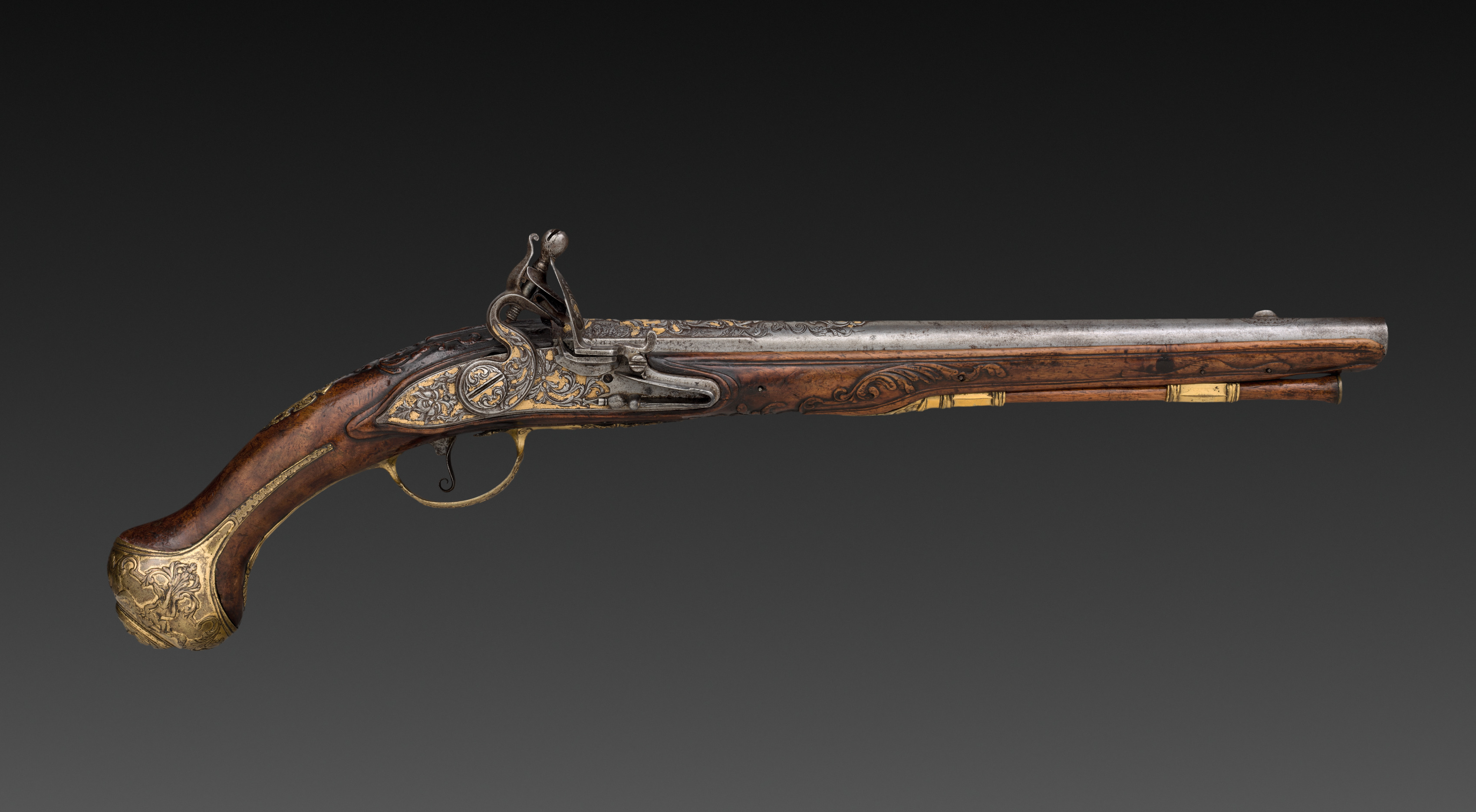
Deconstructing the Flintlock Pistol (2 of 2): A Blueprint for Avant-Garde Materiality
At Zoey Fashion Lab, our mandate extends beyond the conventional draping of fabric. We are fabric deconstructionists, excavating the latent narratives embedded within historical artifacts to translate them into a new sartorial lexicon. The Flintlock Pistol (2 of 2), a Franco-Flemish masterpiece from early 18th-century Liège, presents a formidable challenge and an extraordinary opportunity. This is not merely a weapon; it is a dense matrix of metallurgical precision, ornamental excess, and ergonomic intent. For our avant-garde design studio, this object serves as a radical blueprint—not for violence, but for a new architecture of the body, a study in controlled tension, and a celebration of hyper-ornamentation.
I. The Metallurgical Skeleton: From Steel to Structural Silhouette
The pistol’s core is forged steel, a material signifying rigidity, resilience, and lethal purpose. In our deconstruction, steel is not translated literally but conceptually. We reinterpret its structural integrity as a series of engineered seams and support systems within a garment. The long, slender barrel becomes a metaphor for a continuous, unbroken vertical line—a spine-like seam running from the nape of the neck to the hem, creating an elongated, imposing silhouette. This is not a soft drape; it is a statement of architectural confidence.
The gold inlay, however, disrupts this monolithic steel. It represents a fault line, a moment of precious interruption. In our avant-garde approach, we translate this into a technique of metallic filigree appliqué on high-tensile technical fabrics. Imagine a black, carbon-fiber-weave bodice where thin, almost liquid lines of gold-hued metal thread are fused onto the surface. These lines do not follow the body’s natural curves; instead, they chart the trajectory of the pistol’s internal mechanisms—the sear, the tumbler, the mainspring—creating a chaotic yet deliberate cartography of internal pressure. The garment becomes a visible diagram of its own structural tension, a wearable blueprint where strength and preciousness coexist in a state of dynamic equilibrium.
Translating Gilt-Brass Mounts into Articulated Joints
The gilt-brass mounts, which secure the wood to the steel, are our key to understanding articulation. These are not static connectors; they are the pivot points, the hinges that allow the pistol to function. We translate this into a system of articulated joints in our garments. Instead of simple seams, we employ custom-cast, brass-toned alloy hardware at the shoulders, elbows, and hips. These are not mere buckles or clasps; they are sculptural, almost robotic exoskeletal elements that allow for a new range of motion.
Consider a sleeve that is not sewn to the bodice but attached via a series of these ornate, jointed plates. The movement of the arm becomes a mechanical ballet, a visible performance of the garment’s internal logic. The gilt finish is not polished to a high shine; rather, it is given a satin, slightly aged patina, echoing the historical artifact while remaining undeniably futuristic. This creates a dialogue between the antique and the speculative, a core tenet of our avant-garde philosophy.
II. The Organic Counterpoint: Walnut Burl and the Fluidity of Form
The walnut burl stock is the pistol’s organic heart, a counterpoint to the cold precision of its steel. Burl wood is characterized by its chaotic, swirling grain—a natural, unpredictable pattern formed by tree growth. For us, this represents the antithesis of the engineered steel. It is the body itself: unpredictable, fluid, and deeply organic. We translate this not through literal wood, but through a revolutionary approach to texture and bio-mimicry.
We envision a fabric that mimics the tactile and visual complexity of burl. This could be achieved through a combination of 3D-printed silicone scales, hand-embellished with micro-sequins in varying shades of umber, chestnut, and deep chocolate, or through a complex jacquard weave that recreates the whorls and eddies of the wood grain in a luxurious, pliable wool. The garment’s primary fabric would have a topographical surface, a landscape of ridges and valleys that invites touch and challenges the eye. This is not a print; it is a three-dimensional representation of natural chaos, a wearable sculpture that honors the pistol’s most human element.
Chiseled High-Relief Decoration: Sculpting the Surface Narrative
The most intellectually stimulating element is the chiseled high-relief decoration on the steel. This is not surface engraving; it is a sculptural act, a violent removal of material to create form. Figures, foliage, and mythological scenes emerge from the metal, demanding to be seen from multiple angles. Our translation abandons flatness entirely. We propose a technique of draped high-relief, where multiple layers of fabric are manipulated, padded, and stitched to create a sculptural bas-relief directly on the garment’s surface.
This is achieved through a process of structured quilting and trapunto, but elevated to an extreme. Imagine a jacket where the chest panel features a swirling, three-dimensional vortex of fabric, echoing the pistol’s floral scrollwork. The folds are not random; they are meticulously engineered to catch light and shadow, creating a living, breathing sculpture that changes with the wearer’s movement. This decoration is not applied; it is integral to the garment’s construction. It is a narrative of excess, a deliberate rejection of minimalist restraint in favor of a baroque, maximalist expression of form.
III. The New DNA Strand: An Avant-Garde Synthesis
The reference to a “New DNA Strand” is the final, crucial piece of our deconstruction. We are not replicating the pistol; we are extracting its genetic code—its principles of tension, articulation, organic contrast, and sculptural excess—and splicing it into a new, unprecedented form. The result is a collection that is neither historical costume nor pure science fiction, but a third entity entirely.
Our garments will possess a dual personality: the hard, metallic, engineered elements (the steel and brass) will form a protective, external shell, while the soft, organic, burl-inspired layers will function as a second skin beneath. The gold inlay will appear as erratic, conductive threads that could theoretically power embedded sensors. The articulated joints will allow for a new, staccato movement vocabulary, turning the wearer into a living automaton. The high-relief decoration will serve as a map of the wearer’s own internal energy, a visual representation of their kinetic and emotional state.
Ultimately, the Flintlock Pistol (2 of 2) is not a weapon of destruction but a catalyst for creation. It has provided us with a masterclass in the marriage of function and ornament, of strength and delicacy. By deconstructing its physical and conceptual components, we have unearthed a radical new design language—one that is unapologetically complex, structurally audacious, and deeply rooted in a historical understanding of material mastery. This is not fashion as clothing; this is fashion as a wearable, kinetic, and sculptural manifesto.