Technical Deconstruction & Material Resonance
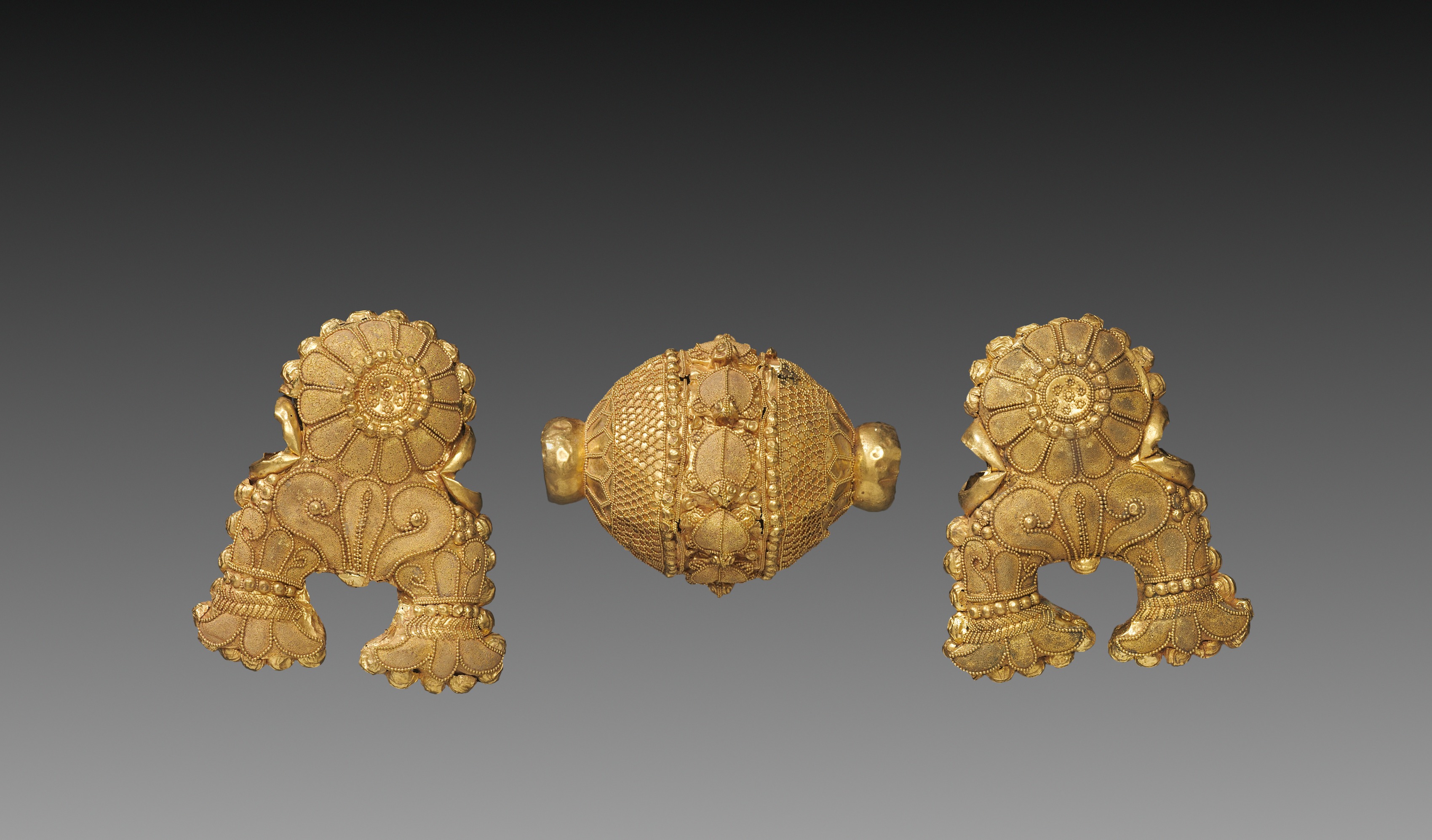
The provided objects—a necklace bead and a pair of pendants—are not merely gold; they are chronological condensates. Forged in the Shunga period (185–78 BCE), their primary technical assertion is one of authoritative metallurgy. The use of gold, a material signifying not just wealth but permanence and celestial association in the subcontinent’s symbology, is our first datum. The craftsmanship required to form, hollow, and finish these small-scale objects in a pre-industrial era speaks to a specialized, likely court-sanctioned, workshop. The technical narrative is one of control: over a precious, malleable element, and over form. However, the "Avant-garde" directive compels us to look beyond the artifact's intrinsic history. We must interrogate how this ancient technical confidence can be destabilized and re-contextualized. The gold is not a finish; it is a core sample from a timeline. In a contemporary lab, this technique would be translated not into replication, but into a dialogue between ancient hand-forming and digital fabrication—perhaps 3D-printing in lost-wax cast gold, but deliberately leaving the digital "seams" visible, creating a hybrid artifact that confesses its multi-era construction.
Form & Symbolic Architecture
The auspicious symbol—likely a kalpavriksha (wish-fulfilling tree), a srivatsa, or a potent floral motif—is the conceptual keystone. In its original context, this form was a compact, wearable talisman, a battery of protective and prosperous intent. Its shape is its function. Our avant-garde methodology demands a semiotic split. We must honor the form's inherent power while dismantling its monolithic meaning. The "pair" of pendants is critical; it suggests duality, balance, or mirrored purpose. This directly resonates with the provided archive reference: "Mirror with Split-Leaf Palmette..." and the described duality of a polished silver mirror versus a cold stone sarcophagus.
This is our conceptual blueprint: one side is reflection, the other is inscription. Imagine a pendant where one face is a flawless, hyper-reflective gold surface, mirroring the wearer's present moment. The opposite face is not smooth; it is a textured, almost archaeological relief of the original auspicious symbol, but fractured, as if excavated from stone. The symbol is not presented as whole belief, but as a fragment of narrative. This creates a permanent dialogue on the body: the gaze outward (the mirror) and the imprint of history (the relief). The necklace bead could act as the conceptual hinge between these two pendants, its form deconstructed into an abstract, porous cage containing a miniature, moving gold element—a symbol not static, but in perpetual, contained motion.
Archive Resonance & Narrative Re-sequencing
The archive reference is not a background note; it is the methodological engine. The "纷繁棕叶纹" (luxuriant palmette patterns) in gold on a silver mirror speak to an aesthetic of curated complexity and reflection—beauty as a polished, ordered system. The "冰冷石棺板上以浮雕诉说的生命叙事" (life narratives told through relief on cold stone coffin boards) speak to raw, mortal storytelling etched into a terminal surface. The Shunga period itself, straddling the Mauryan decline and cultural re-articulation, was a moment of narrative flux.
Our avant-garde interpretation must fuse these two archival states. The final piece is not a necklace in a traditional sense. It is a wearable archive. We propose a articulated collar or harness. Sections are composed of mirrored gold panels, laser-engraved with dizzying, fragmented palmette patterns that only cohere when reflected onto the skin. Interstitial elements are matte, stone-like gold clay, impressed with distorted, sequential reliefs that suggest a narrative—not of divine auspice, but of human making, wearing, and decay. The "pair of pendants" becomes a central clasp mechanism: clicking together, they complete a circuit of pattern or align the narrative fragments; separated, they reveal dissonance and gap. The work questions: Is adornment a mirror to the present, or a relief narrative of the past? Is it a shield of belief (the auspicious symbol) or a confessional of its own construction?
Avant-Garde Synthesis: The Zoey Fashion Lab Proposition
The collection, titled "Shunga Reflex", manifests this analysis. It moves beyond homage into critical re-engagement.
Material Process: We use reclaimed gold, subjecting it to contrasting finishes: nano-coated mirror polish and acid-etched stone patina. Techniques of ancient granulation are studied via digital microscopy, then their structural logic is used to inform algorithmic patterns for laser welding on modern titanium substrates, creating a technical palimpsest.
Form Language: The auspicious symbol is disassembled into its geometric constituents—circles, spirals, stems. These become modular components in a kinetic jewelry system. Pieces can be configured by the wearer as a symmetrical talisman (echoing traditional intent) or an asymmetrical, deconstructed harness (expressing contemporary fragmentation).
Conceptual Wearability: The work challenges the passive wearing of symbols. It is an interactive dialectic. The mirrored surfaces capture and distort the environment; the textured "relief" panels are designed to imprint temporarily on the skin, leaving a ghost of the ancient symbol as a personal, ephemeral trace after the piece is removed. The body becomes the sarcophagus board and the living canvas.
In conclusion, the Shunga gold objects provide a profound launch point. Their technical mastery informs a new material rigor. Their symbolic form provides an architecture for deconstruction. The archive reference supplies the core tension between eternal reflection and mortal narrative. For Zoey Fashion Lab, the outcome is a collection that does not reproduce history, but stage a critical encounter with it, producing avant-garde artifacts that are as much about questioning the nature of adornment, belief, and time as they are about aesthetic statement. The piece is no longer a bead or a pendant; it is a speculative probe into the very resonance of form across millennia.