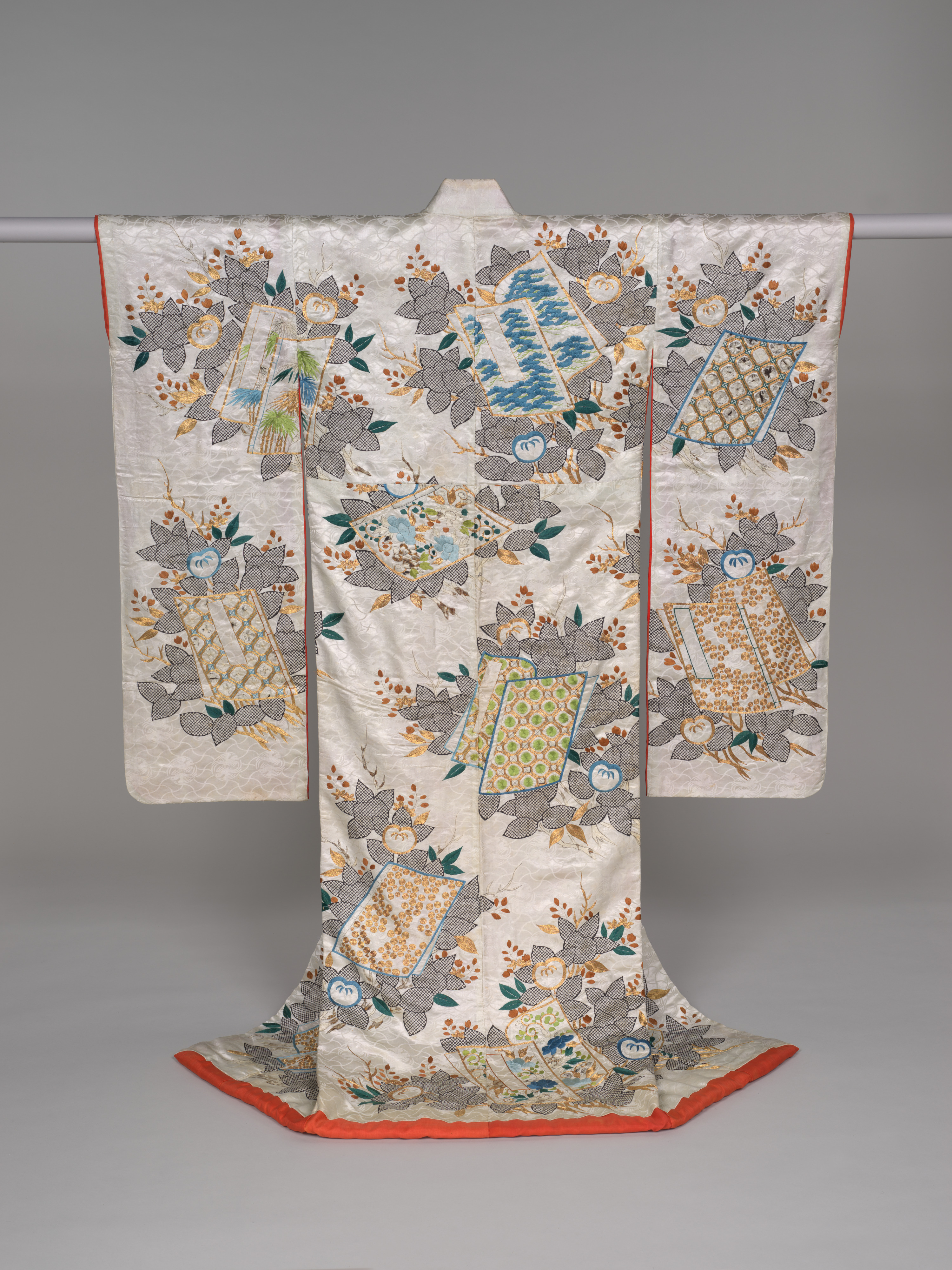
Deconstructing the Heirloom: The Uchikake as a Blueprint for Temporal Collision
In the relentless churn of seasonal fashion cycles, the avant-garde designer’s true adversary is not the competitor, but the tyranny of the new. At Zoey Fashion Laboratory, we do not seek novelty; we seek temporal collision—the violent, beautiful friction where historical artifact meets speculative future. Our latest standalone study, the Over Robe (Uchikake) with Mandarin Orange Branches and Books, is not a relic to be preserved under glass, but a dormant architectural blueprint. This Japanese garment, a masterpiece of figured satin-weave silk, stencil-dyed dots, silk embroidery, and couched gold thread, is dissected here not for its nostalgia, but for its radical potential as the foundational chassis for SS26 structural innovation.
To the untrained eye, this Uchikake is a wedding garment—a symbol of auspiciousness and permanence. To the Laboratory, it is a proto-exoskeleton, a wearable volume that predates contemporary sculptural fashion by four centuries. Its construction logic—the horizontal seam lines, the deliberate weight distribution, the padded hem—offers a masterclass in self-supporting silhouette. We are not interested in replicating its floral motifs; we are harvesting its engineering principles to build garments that move beyond the body’s passive envelope.
Silhouette Architecture: From Flat Plane to Inflated Volume
The traditional Uchikake’s silhouette is deceptively simple: a flat, T-shaped expanse designed to be worn over other layers, its volume created by the sheer mass of fabric pooling at the feet. For SS26, we re-engineer this horizontal datum line. The garment’s trailing hem—historically a symbol of bridal subservience—becomes our primary site of aerodynamic disruption. We propose a silhouette where the Uchikake’s floor-sweeping length is inverted, lifted, and inflated. Using thermally bonded, high-tensile technical silks, we recreate the robe’s distinctive "waterfall" back panel as a rigid, cantilevered shell that floats 15 centimeters off the ground, propelled by internal carbon-fiber struts inspired by the garment’s original padding.
The stencil-dyed dots (komon) are not mere surface decoration; they are a tessellated data system. In our SS26 translation, these dots are scaled up to 300% and laser-cut into the fabric, creating a grid of perforations that allows for modular attachment points. The Uchikake’s sleeves, traditionally long and sweeping (tamotoyuki), are reimagined as detachable, inflatable pods. When deflated, they lie flat against the torso, honoring the original’s linearity. When activated via micro-compressed air pumps, they expand into spherical, cellular volumes, transforming the wearer’s profile from a ceremonial rectangle into a futuristic, bioluminescent orb. This is not costume; this is transformative architecture.
Material Alchemy: The Gold Thread as Conductive Circuitry
The Uchikake’s couched gold thread is the most potent element for our deconstruction. Historically, this was a display of immense wealth and labor, a static symbol of status. In our Laboratory, we read it as an early form of conductive circuitry. The thread’s continuous, unbroken lines—following the branches of the mandarin orange tree—form a natural, organic circuit map. For SS26, we replace the gold with a flexible, self-healing conductive polymer. The mandarin branches, traditionally symbols of longevity and good fortune, are reinterpreted as energy pathways that power embedded micro-sensors.
The embroidered books scattered across the robe are the most intellectually provocative motif. They are not just decorative; they are archival memory chips. We propose a garment that "reads" its environment. The books, rendered in raised, 3D-printed silicone, become tactile interfaces. When the wearer presses a specific book, the gold-thread circuitry activates a localized thermal response or a change in the fabric’s opacity. The Uchikake ceases to be a static object of reverence and becomes a responsive, interactive exoskin. The wearer is no longer merely adorned; they are in a dialogue with their own garment, a symbiosis of human and textile intelligence.
Structural Innovation: The "Inverted Obi" and Zero-Gravity Draping
The Uchikake’s lack of a defined waistline—its reliance on the obi (sash) worn separately—is its most liberating structural feature. We exploit this absence. Our SS26 design eliminates the waist entirely, creating a continuous, fluid column from shoulder to floor. However, we introduce a magnetic skeletal system embedded within the silk. Small, powerful neodymium magnets, placed along the interior seams, allow the wearer to "sculpt" the garment’s volume in real-time. A simple gesture—pressing the forearms against the hips—can cinch the fabric into a hyper-tailored, wasp-waisted silhouette. Releasing the pressure allows the robe to expand back into its full, architectural glory.
This is kinetic deconstruction. The garment is never in a fixed state. It is a fluid system that oscillates between the historical Uchikake’s voluminous modesty and a futuristic, skin-tight second layer. The stencil-dyed dots, now perforated, allow for airflow and visual transparency, creating a moiré effect as the layers shift over each other. The result is a garment that embodies the SS26 ethos: perpetual metamorphosis.
Futuristic Silhouette: The "Bibliotech" Silhouette
We name this primary SS26 silhouette the Bibliotech. It is defined by a high, structured collar that fans out behind the head like a peacock’s tail, directly referencing the Uchikake’s stiffened neckline. This collar is constructed from a memory-retention alloy woven with the conductive gold-thread polymer. It can be shaped by hand, locking into any position—from a severe, face-framing arc to a flat, minimalist plane. The "books" from the original embroidery are now functional pockets, sealed with magnetic closures, designed to hold data chips or personal devices.
The mandarin orange branches are abstracted into a lattice of exoskeletal ribbing that runs down the back, visible through the sheer outer layer. This ribbing provides the structural support for the inflatable sleeves and the floating hem, eliminating the need for any internal corsetry. The garment is entirely self-supporting, a true feat of textile engineering. It does not cling to the body; it hovers around it, creating a negative space that is as important as the positive form.
Conclusion: A Future Woven from History
The Over Robe with Mandarin Orange Branches and Books is not a costume to be revived. It is a catalyst. By stripping it of its ceremonial context and analyzing its core DNA—its volume, its material logic, its symbolic depth—we unlock a new vocabulary for SS26. We move beyond the binary of traditional vs. futuristic, crafting a third path: speculative heritage. The garment of the future will not be born from a vacuum; it will be a deliberate, violent, and beautiful mutation of the past. This Uchikake, with its silent books and gilded branches, has spoken. We are listening, and we are building.