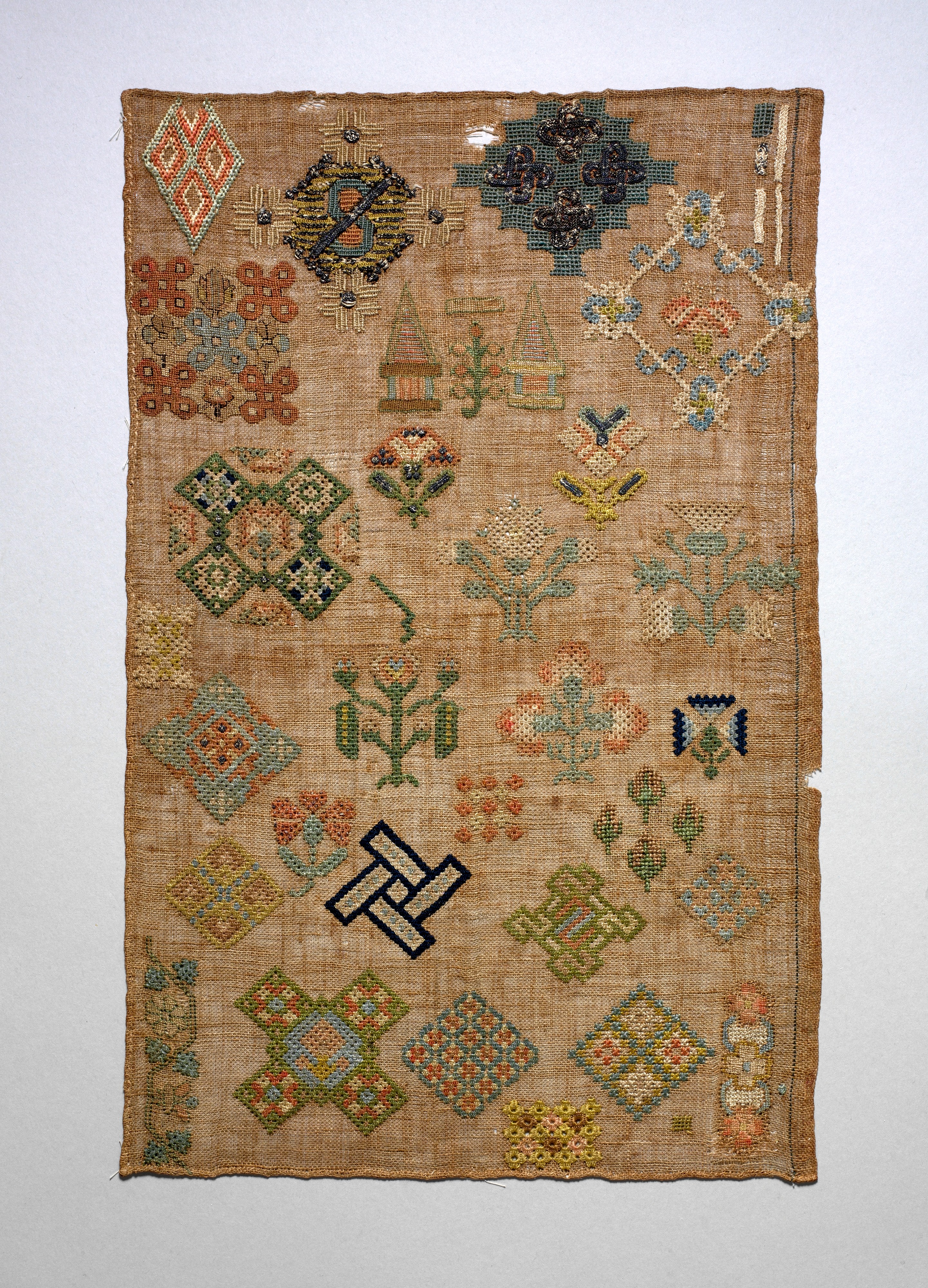
The Embroidered Spot Sampler: A Cartography of Future Silhouettes
The embroidered spot sampler, traditionally a humble record of technique, is undergoing a radical ontological shift within the ateliers of Zoey Fashion Laboratory. No longer a mere archival footnote, it emerges for the SS26 season as a primary architectural blueprint—a microcosmic cartography of structural possibility. Sourced from the Global Frontier, this particular specimen, rendered in lustrous silk and tensile metal thread upon a rigid linen canvas, is not an artifact of the past but a transmission from a future we are only now learning to inhabit. Its grid, its punctures, its metallic scars—these are not decorative flourishes; they are load-bearing data. For the avant-garde eye, this sampler is a manifesto in thread, demanding a re-reading of the body's relationship to fabric, volume, and motion.
Deconstructing the Grid: From Flat Archive to Three-Dimensional Armature
The initial confrontation with the sampler is one of disciplined geometry. Yet, within this strict Cartesian field lies the seed of its own dissolution. The silk threads, in their varying tensions and densities, create a topographical map of potential stress points. The metal threads, conversely, act as exoskeletal joints—rigid, conductive, and unyielding. In our SS26 analysis, we reject the passive interpretation of this grid as a flat, decorative plane. Instead, we read it as an exploded technical drawing of a garment that exists in a state of perpetual becoming. Each stitch is a hinge; each cluster of embroidery, a node of articulation.
This perspective informs a new silhouette language. We are not cutting fabric along traditional seams; we are folding the canvas along the lines of its own embroidery. The sampler’s inherent stiffness, a byproduct of dense metallic thread on linen, ceases to be a limitation and becomes a generative force. It allows for the creation of sharp, cantilevered forms that defy gravity. Imagine a shoulder pad that is not padded but architecturally woven, jutting forth like a structural corbel, its surface a literal embroidery sampler. The garment is no longer draped over the body; it is constructed around an internal scaffold of stitched data, with the wearer’s form serving as the central pylon.
Structural Innovation: The Metallic Exoskeleton and Kinetic Tension
The metal thread is the critical protagonist in this narrative of structural innovation. It introduces a property foreign to conventional couture: conductive rigidity. This is not a material for soft, romantic draping. It is a material for creating defined, almost mechanical volumes. We posit a silhouette where the metal thread is used to create a self-supporting collar that rises not from the neckline but from the sternum, spiraling outwards in a helix of stitched filigree. The linen canvas, when treated as a composite with the metal, can be scored, folded, and heat-set to hold a crease with uncompromising permanence. This is the genesis of the “fossilized drape”—a look that suggests fabric caught in a moment of geological upheaval, frozen in a state of dynamic torsion.
Furthermore, the varying densities of the embroidery create a system of differential tension. Areas of dense, tight stitching become rigid plates; areas of sparse silk become flexible membranes. This allows for a garment that is simultaneously armored and fluid. A jacket, for instance, could feature a fully embroidered, rigid back panel—a literal canvas of the sampler—while the front and sleeves are constructed from a lighter, deconstructed version of the same pattern, allowing for a kinetic interplay between the static architecture of the back and the fluid motion of the front. The silhouette is thus not a single shape, but a sequence of shifting volumes that respond to the wearer’s kinetic energy.
Reframing the “Spot”: The Punctum as a Portal for SS26
The individual “spots” of the sampler—the discrete motifs that punctuate the field—are not mere decorative details. In our deconstructive reading, each spot is a potential aperture, a negative space waiting to be activated. We propose a technique of “reverse embroidery”, where the fabric is cut away from within the stitched perimeter, leaving a web of silk and metal thread as a translucent, lace-like barrier. This creates a series of strategic windows in the garment, offering glimpses of skin or of an under-layer of contrasting material. The body is no longer a concealed form but a fragmented visual event, revealed in a staccato rhythm of stitched frames.
This concept evolves into a silhouette of layered transparency. An outer shell, its surface a literal reproduction of the sampler’s grid, is slashed and cut away at the embroidered spots. Beneath it, a second skin of iridescent technical silk, itself embroidered with a complementary pattern, is revealed. The result is a complex, three-dimensional collage where depth is not achieved through padding but through stratified visual information. The eye is invited to traverse the garment, moving from the rigid, metallic surface of the outer layer to the softer, more fluid under-layer, creating a perceptual experience akin to navigating a dense, architectural model.
Silhouette as a System: The Wearable Blueprint
Ultimately, the embroidered spot sampler from the Global Frontier is not a source of motifs but a source of systems. It teaches us a new logic of construction, one where decoration and structure are inseparable and where the surface is the skeleton. For SS26, we are not designing clothes; we are engineering wearable environments. The silhouette is defined by its internal logic, its points of tension, and its apertures of revelation. We see a future of garments that are part sculpture, part instrument, and part architectural model—pieces that are assembled, not sewn, and that exist in a state of dynamic equilibrium with the human form. The sampler, in its humble, rigorous beauty, has provided the definitive proof of concept for a new era of couture, one where the needle is a drafting tool and the thread is our primary structural material. The future of fashion is not woven; it is built, one spot at a time.