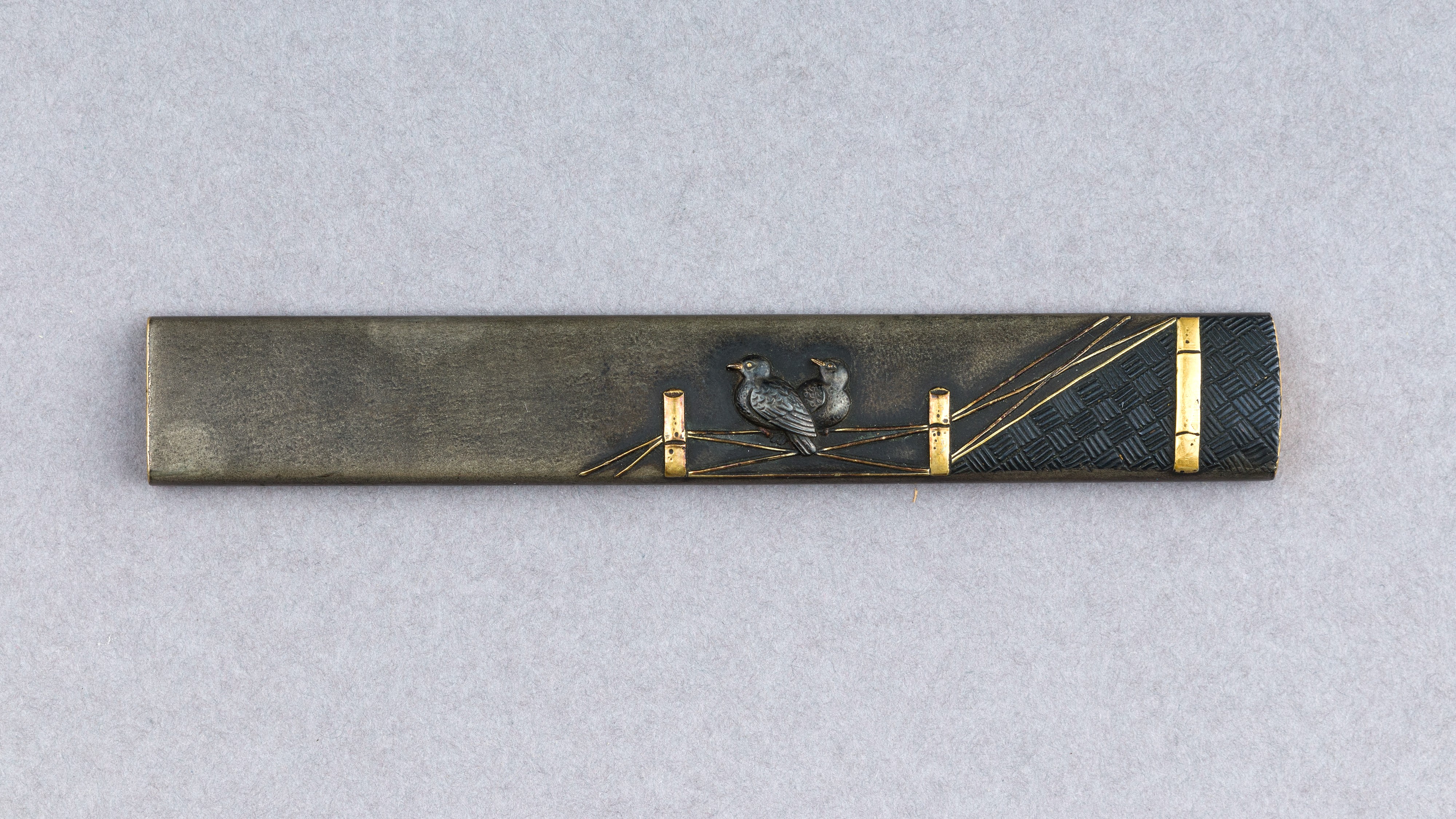
The Kozuka Deconstructed: Blueprinting SS26 Through the Metallurgy of the Blade's Shadow
In the lexicon of avant-garde fashion, the most provocative catalysts are rarely garments. They are, instead, the overlooked artifacts of utility—objects whose functional purity has been calcified by history. The Japanese kozuka, the utilitarian knife handle tucked into the scabbard of a samurai sword, is one such artifact. At first glance, it is a paradox: a weapon's grip designed for concealment, yet often adorned with the most intricate metalwork in Edo-period craft. For Zoey Fashion Laboratory's SS26 thesis, we divorce the kozuka from its martial context, extracting its structural logic, its chromatic alchemy, and its silent ergonomics to propose a silhouette language that is less about clothing the body and more about armoring the ephemeral self against the velocity of the coming decade.
I. The Metallurgical Palette: Shibuichi and Shakudō as Chromatic Disruption
The material science of the kozuka is our first point of departure. The alloys shibuichi (copper-silver) and shakudō (copper-gold) are not mere metals; they are pre-industrial patination laboratories. Shibuichi, when treated with rokushō, yields a spectrum from silvery grey to deep graphite—a mutable, cloudy surface that refuses flatness. Shakudō, conversely, produces a near-black, violet-tinged lacquer depth that absorbs light rather than reflecting it. In an era of digital glare and hyper-saturated screens, SS26 proposes a counter-luminous palette: not black, but anti-light. Garments will be developed in bonded micro-fiber textiles that replicate shakudō's obsidian undertone—a surface that seems to swallow photons, creating a void around the wearer's form.
Yet the true innovation lies in the gradient of alloys. Traditional kozuka often juxtaposed shibuichi's pale silver against shakudō's dark expanse, with pure gold inlaid as a single, decisive accent—a lightning strike of wealth against twilight. For SS26, we translate this into a chromatic sequencing system across panels. A jacket's torso may be shakudō-black; its sleeves, shibuichi-grey; and a single, architectural collar blade—sharpened to a 15-degree angle—rendered in a metallic gold laminate. This is not decoration; it is directional signaling. The gold element acts as a structural hinge, guiding the eye and, more critically, the garment's kinetic balance toward a singular focal point, mimicking the way a kozuka's gold highlights draw the grip into the hand.
II. Ergonomics of Concealment: The Asymmetric Scabbard Silhouette
The kozuka's primary architectural feature is its extreme flatness. It is a blade handle that is almost two-dimensional, designed to slide invisibly into a slot on the scabbard's spine. This compression of volume is the antithesis of traditional couture's three-dimensional draping. SS26's silhouette will embrace a planar compression—garments that read as folded metal sheets when static, but which unfurl into kinetic sculpture upon movement. Consider a coat cut with a single, continuous seam that runs from the left shoulder to the right hip, creating a hidden internal pocket that runs the length of the torso. This is not a pocket for storage; it is a negative-space channel, a void that suggests the presence of an unseen implement, an invisible weapon of intellect or intent.
The asymmetry is not random but functional. The kozuka's handle was often slightly curved to fit the thumb's natural arc during a draw. This micro-curve informs our sleeve heads and collar stands: a biomorphic, off-axis cant that shifts the garment's center of gravity. A blazer for SS26 will not sit squarely on the shoulders. Instead, its right shoulder pad is extended and tapered to a razor edge, while the left side is entirely removed, exposing the collarbone. This creates a dynamic imbalance, a perpetual state of "about to draw." The wearer becomes a living diagram of potential energy, their posture dictated by the garment's own internal tension.
III. Structural Innovation: The Grip as a Modular Frame
Beyond the flat silhouette, the kozuka's handle wrapping—typically a ray-skin (same) base overlaid with tight silk or metal wire—offers a radical textural language. This is a study in micro-topography. The handle is not smooth; it is a grid of diamond-shaped nodes that provide friction and grip. For SS26, we propose tactile armor panels constructed from a new, 3D-printed flexible polymer that replicates this same-grip texture at a macro scale. These panels are not sewn but mechanically locked onto the garment's base layer via a magnetic or interlocking rail system. This allows for real-time modularity: the wearer can reconfigure the garment's structure—adding a grip-panel to the forearm for a sleeve that cinches, or removing a panel from the sternum to open a ventilation void.
This modular frame is the ultimate expression of the kozuka's duality: a tool that is simultaneously hidden and ready. The garment becomes a wearable chassis, a system of attachable components that respond to environmental and social pressures. The base layer is a whisper-thin, high-tensile knit—the "blade" itself—while the panels are the "handle," offering the wearer control points. The future of couture, as posited by this analysis, is not in bespoke tailoring but in bespoke configuration. The designer's role shifts from cutting cloth to engineering parameters.
IV. Futuristic Silhouette: The Inverted Crescent
Synthesizing these elements, the definitive SS26 kozuka-inspired silhouette is the Inverted Crescent. The garment—a full-length duster or a structural bodysuit—is cut with a severe, concave curve along the spine. The front of the garment is practically flat, hugging the torso like a shibuichi plate. The back, however, flares outward from the lower lumbar region, creating a crescent-shaped volume that mimics the curved edge of the kozuka's blade. This is achieved not with padding but with pre-stressed carbon-fiber boning that is heat-set into a permanent arc. When the wearer stands, the back panel floats two inches off the body, creating a shadowy void. When they move, it swings with a pendulum-like precision, a counterweight to the asymmetric front. This is not a garment for sitting. It is a garment for decisive action.
The final flourish is the golden edge. Every SS26 piece will feature a single, unbroken, hand-applied metallic piping—a line of pure gold leaf—that traces the garment's most aggressive angle. It is the kozuka's gold inlay, writ large. It is not an accent; it is a declaration of terminal precision. In a world of soft, formless athleisure, the kozuka's legacy is a sharp, metallic, and unapologetically structural rebuke. The future, we argue, is not soft. It is a beautifully engineered, flat, and deadly sharp edge.