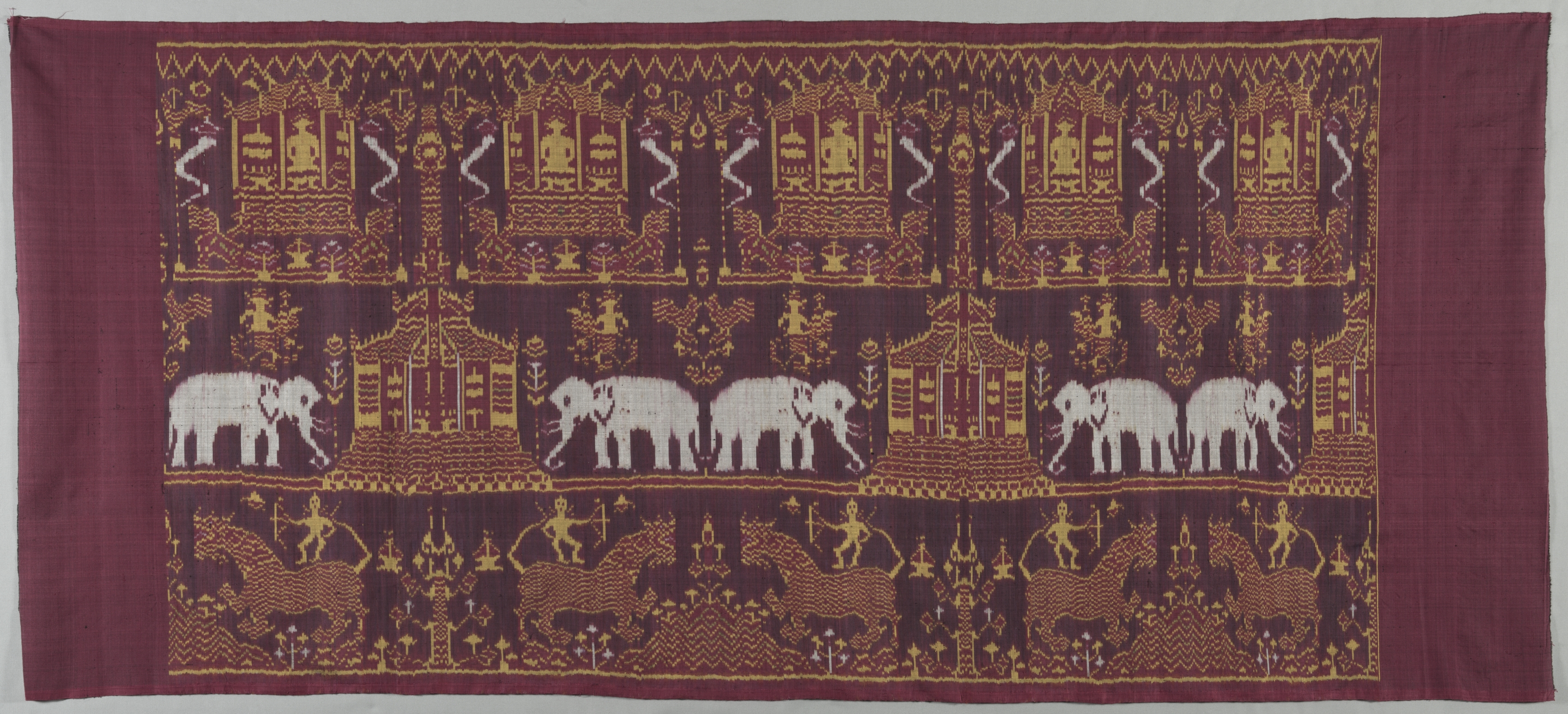
Deconstructing the Silent Echo: A Wall Hanging as a Temporal Collision
At Zoey Fashion Lab, we do not merely observe textiles; we interrogate them. We dissect their physicality to reveal the philosophical underpinnings of their creation. The subject of this analysis—a Cambodian wall hanging or ceiling canopy from the early 20th century—presents a profound paradox. It is a utilitarian object of sacred space, yet its technical execution speaks to a level of abstract genius that predates Western modernism by centuries. This is not a relic; it is a blueprint for avant-garde expression, a silent echo that demands to be heard in the contemporary cacophony of fast fashion.
Our deconstruction begins not with nostalgia, but with a forensic examination of its materiality. The fabric is a tabby weave, the most elementary of interlacing structures. In this simplicity lies a radical honesty. The warp and weft intersect in a plain, unadorned grid, creating a surface of absolute clarity. This is not a canvas for embroidery or a ground for supplementary patterning. Instead, the structure is the neutral territory upon which a more complex, internal drama unfolds. The avant-garde designer recognizes this as a rejection of superfluous ornamentation—a precursor to the minimalist ethos of the 20th and 21st centuries. The power here is not in the addition of threads, but in the manipulation of their inherent color and rhythm.
The Ikat Principle: Chaos Disciplined by Geometry
The true genius of this artifact lies in its weft ikat technique. This is a process of resist-dyeing the weft threads before they are ever woven. The artisan must visualize the final pattern in reverse, calculating the precise lengths of thread to bind and dye to achieve a desired image once the threads are beaten into place. This is not a process of painting on a surface; it is a process of engineering color through time and tension. The resulting edges are not sharp or clean; they are soft, feathered, and slightly blurred—a phenomenon known as the halo effect.
For the avant-garde sensibility, this blur is not a flaw. It is the very essence of the work’s modernity. It represents a deliberate relinquishing of control, an acceptance of the unpredictable interaction between dye, fiber, and human error. This is the antithesis of the sterile, pixel-perfect digital prints that dominate contemporary textiles. The ikat halo is an organic, analog form of glitch art, pre-empting our current obsession with digital distortion. The pattern appears as a memory of itself, a vibration between intention and reality. In a fashion context, this translates to garments that do not shout, but whisper; that suggest form without defining it, allowing the wearer’s movement to complete the visual narrative.
Silk as a Conduit of Light and Shadow
The choice of silk as the primary fiber elevates this piece from craft to high art. Cambodian silk, historically, is not just a thread; it is a repository of cultural memory. The sericin-rich, hand-reeled filaments possess an irregular, slubby texture that machine-spun silk can never replicate. This irregularity creates a surface that interacts with light in a dynamic, almost kinetic way. As the canopy shifts with air currents, or as the wall hanging is viewed from different angles, the light catches the high points of the silk, while the ikat-dyed recesses fall into a subtle, velvety shadow.
This interplay is a masterclass in tactile dimensionality. The fabric is not a flat plane; it is a topographical map of light and dark. For the avant-garde designer, this suggests a move away from two-dimensional pattern-making toward a three-dimensional, architectural approach to cloth. We are not designing a print; we are designing a lightscape. The silk becomes a living membrane, filtering and reflecting its environment. This is the antithesis of the opaque, heavy synthetics of fast fashion. It demands a slow, considered interaction between the object and its observer.
Furthermore, the use of silk for a ceiling canopy is a deliberate act of spatial redefinition. It transforms a hard, architectural boundary into a soft, permeable threshold. The canopy does not enclose; it suggests. It creates an intimate zone within a larger space, a floating island of calm. This concept is directly translatable to avant-garde fashion through the idea of the negative space garment—clothing that defines the body not by what it covers, but by what it frames and reveals.
Archive Resonance: The Ghost in the Loom
The provided reference, Archive Resonance, speaks of objects as "silent witnesses" to cultural collision and aesthetic fusion from the 16th to 17th centuries. This Khmer textile is precisely such a witness. Cambodia's history is one of immense cultural exchange, from the Angkorian empire to French colonial influence. This early 20th-century piece sits at a crossroads. It retains the ancient, indigenous knowledge of silk cultivation and ikat dyeing, yet it may also reflect shifts in color palette or scale influenced by trade and external aesthetics.
This resonance is not a static echo from the past; it is a live frequency. For Zoey Fashion Lab, this artifact is not to be copied, but to be translated. We must listen to the ghost in the loom. The ghost speaks not of geography or ethnicity, but of a universal human impulse to create order from chaos, to use time as a material, and to communicate complex ideas through abstract means. The weft ikat is a language of patience; the tabby weave is a language of structure; the silk is a language of sensitivity. Our task is to learn this language and speak it in a contemporary dialect.
The avant-garde interpretation of this piece therefore rejects cultural appropriation in favor of cultural resonance. We are not borrowing motifs or symbols. We are extracting the underlying principles—the disciplined chaos of ikat, the luminous tactility of silk, the spatial poetry of the canopy—and re-engineering them into new forms. This might manifest as a knitted textile that mimics the halo effect through structural manipulation, or a garment cut to create its own internal architecture of shadow, much like the canopy defines a room.
In conclusion, this early 20th-century Khmer wall hanging is a radical document of proto-modernist thought. It proves that the impulse toward abstraction, textural depth, and the deconstruction of the pictorial plane is not a Western invention. It is a global, human language. At Zoey Fashion Lab, we honor this artifact not by placing it in a museum case, but by allowing its silent logic to deconstruct our own preconceptions of what fabric can be. It is a challenge to move beyond the surface, to weave with time, and to design with the humility of the artisan who understands that true perfection lies in the beautiful, inevitable blur of the human hand.