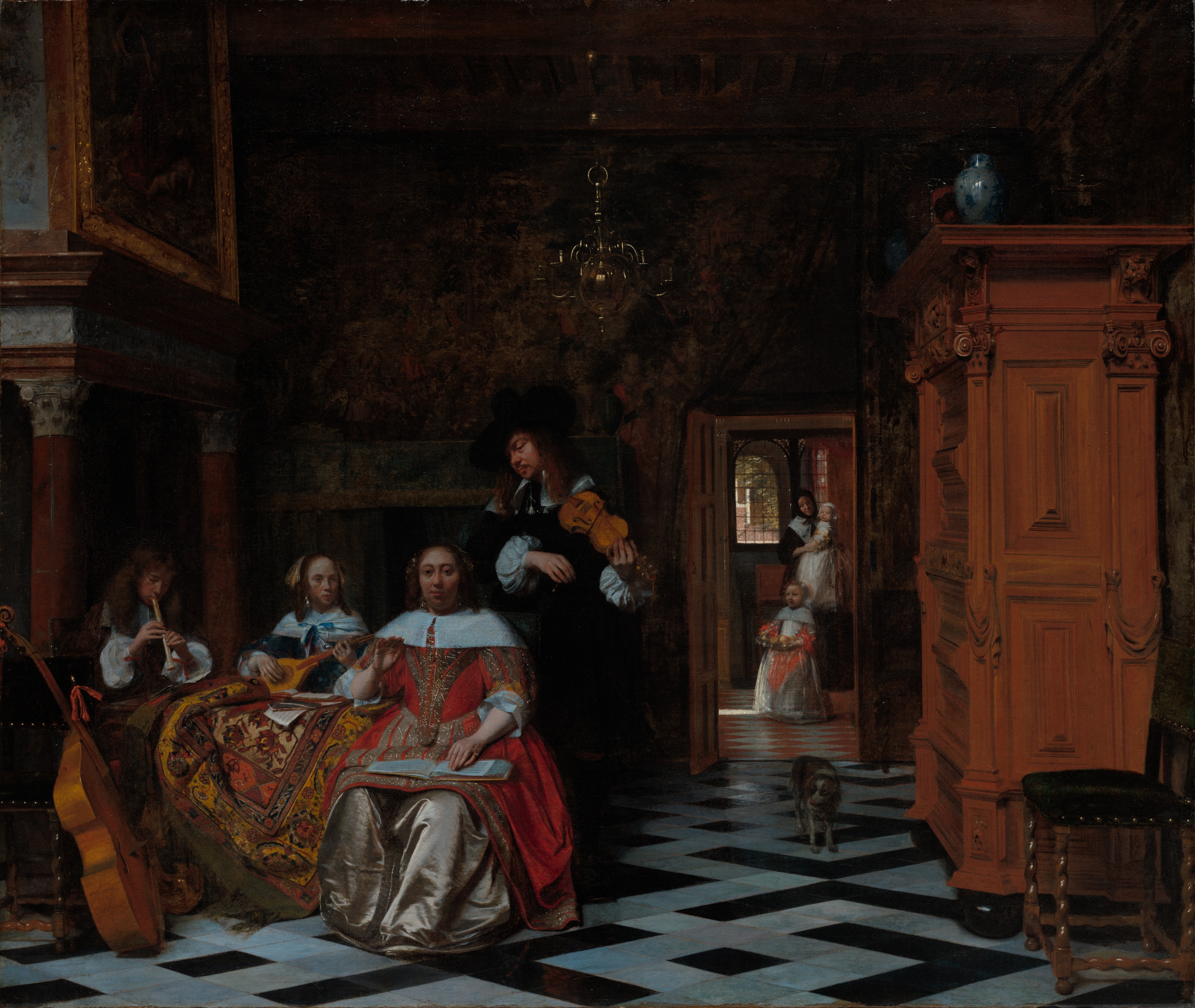
Executive Analysis: Fabric Deconstruction of "Portrait of a Family Playing Music"
This report provides a strategic deconstruction of the provided source material—a 17th-century Dutch family portrait—through the lens of Zoey Fashion Lab's avant-garde mandate and the "New DNA Strand" reference. Our objective is not to replicate historical costume, but to dissect its social, material, and symbolic codes to synthesize a radical new sartorial language. The source painting is not a garment; it is a blueprint of structure, hierarchy, and audible silence, waiting to be unraveled into a three-dimensional, wearable manifesto.
Core Source DNA: Deconstructing the Dutch Code
The original portrait is a masterclass in coded communication. Our deconstruction isolates the following key genetic markers:
Structural Silhouette & Hierarchical Architecture: The family group presents a pyramidal, grounded composition. This is not soft drapery but architectural tailoring. The broad shoulders (especially on the male figure), the wide, stiff skirts, and the upright postures suggest an internal armature. For ZFL, this translates into a exploration of exaggerated, geometric understructures—think hip implants that extend laterally like violin curves, or shoulder silhouettes that recall the rigid lines of a virginal (the keyboard instrument). Clothing is a portable space the wearer inhabits.
The Texture of Status: Material Semiotics: The painting's oil medium meticulously renders textures: the stark, luminous white of linen ruffs and cuffs, the heavy, dark richness of wool and velvet, the subtle sheen of silk. This material hierarchy is crucial. We will subvert this code through paradoxical fabric treatment. Imagine "tarnished velvet" achieved via laser-etching on technical vegan leather, or "starched linen" recreated in crumpled, anodized metallic foil. The wealth signifier is deconstructed, then reconstructed using futuristic methods.
Frozen Synesthesia: The Sound of Fabric: This is a portrait *about* music that is utterly silent. The instruments are held, but the song is paused. This tension is our most potent catalyst. We must design garments that imply their own sound. Stiff, pleated skirts that would rustle with cello-like resonance with movement; sleek, bodiced tops that suggest the taut skin of a drum; fringes and threads that mimic the vibration of a plucked string. The collection will not be seen in silence; it will evoke its own auditory landscape.
Synthesis: The New Avant-Garde Strand
Guided by the "New DNA Strand" directive, we will not create a pastiche. We will splice the above genetic codes with disruptive, contemporary elements to form a mutated, viable new fashion organism.
Collection Manifesto: "The Resonant Body"
Line 01: Architectural Acoustics
Focus: Silhouette and Internal Structure. Garments feature built-in, lightweight frameworks that alter the body's architecture. A dress with a hyperbolic, curved back panel inspired by the body of a lute. Trousers with articulated, jointed knees that suggest the mechanical action of a harpsichord. Fabrics are technically rigid yet visually fluid—memory polymers coated in oil-slick iridescent finishes that change color with movement, mimicking the play of light on old varnish.
Line 02: Deconstructed Harmony
Focus: Collage and Symbolic Displacement. The family unit's coordinated yet individual roles are broken apart. We deconstruct the elements of 17th-century dress: the ruff becomes a freestanding neckpiece of intersecting, white recycled acrylic rings, floating separate from the body. The slashed sleeves revealing fine fabric beneath are reinterpreted as laser-cut panels on a tech-blazer, underlaid with responsive LED mesh that pulses with a slow, rhythmic light, visualizing a heartbeat or a silent metronome.
Line 03: Textural Frequency
Focus: Surface and Sound Interaction. This line experiments with fabrics that literally or perceptually engage the auditory. We develop a "crackle taffeta" treated with a thin, brittle coating that produces a subtle sound with motion. Knits integrated with conductive yarns can trigger soft, ambient tones when panels connect. The stark black/white palette of the painting is exploded into a spectrum based on sound frequency—deep bass tones rendered as indigo velvets, high notes as sharp, citrine silks.
Technical & Philosophical Integration
The "oil on canvas" reference is pivotal. Our canvas is the human form, and our "oil" is a mix of advanced, sustainable materials: lab-grown silk, algae-based dyes, and upcycled technical textiles. The painterly, blended quality of oil paint informs our dyeing techniques—using digital printing and ombré effects that look manually blended, creating a dialogue between the hand of the past and the technology of the future.
Ultimately, the "Portrait of a Family Playing Music" offers us a scene of contained potential energy. Zoey Fashion Lab's collection will release that energy. We transform the static portrait into the dynamic performance. The family's silent harmony becomes a discourse on individual resonance in a digital age. The garments are not costumes for musicians; they are instruments themselves, and the wearer completes the circuit, becoming both the performer and the composition. The new DNA strand is a helix of historical code and futuristic protein, resulting in a collection that is intellectually rigorous, sensorially provocative, and unmistakably avant-garde.