Executive Analysis: The Velvet Fragment as a New DNA Strand for Avant-Garde Expression
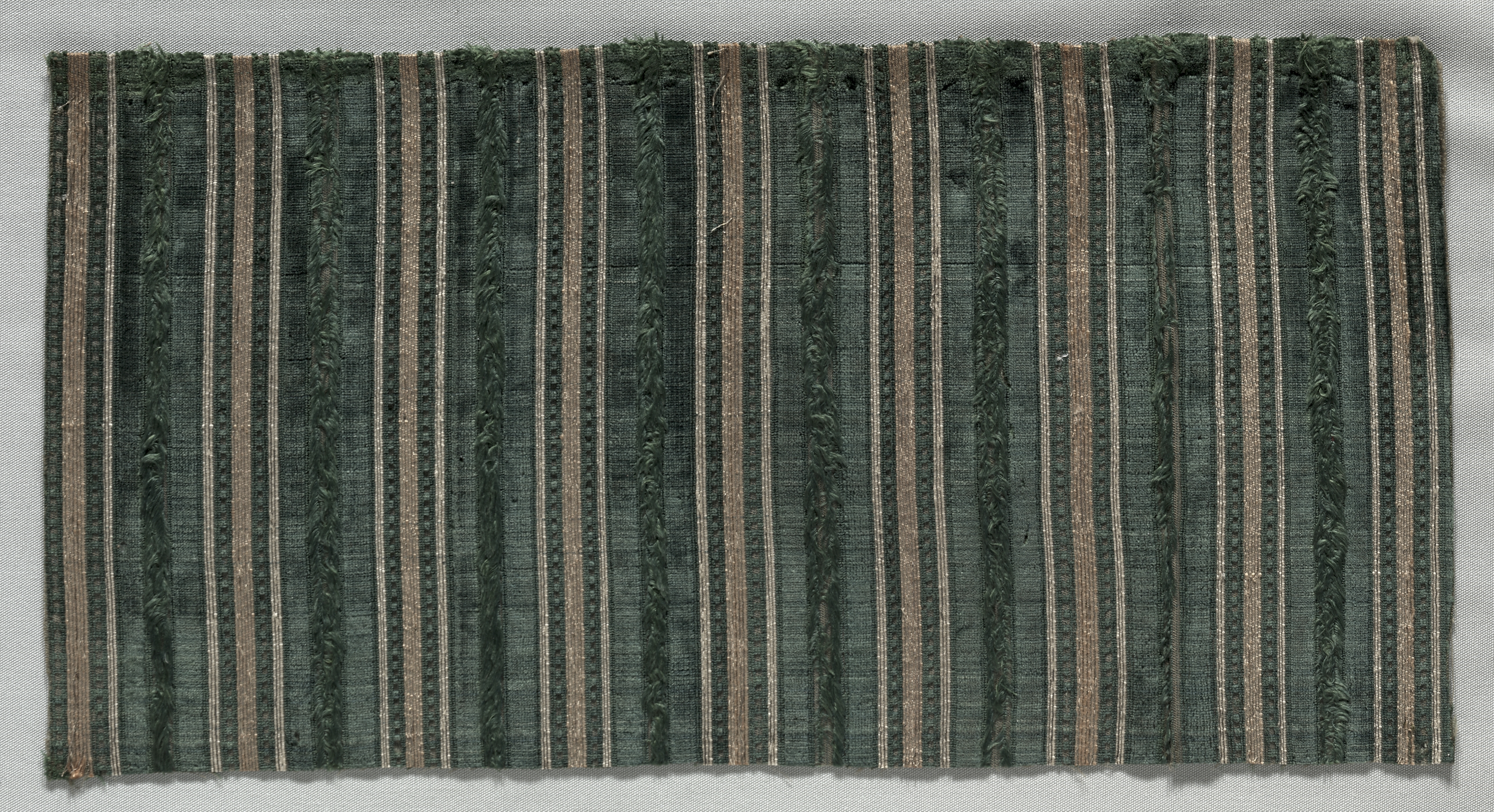
At Zoey Fashion Lab, we do not treat historical textiles as relics to be preserved under glass. We treat them as biological codes—living, mutable sequences that can be spliced, recombined, and expressed in entirely new silhouettes. The subject of this analysis, an 18th-century Italian velvet fragment, presents a paradox of immense value: it is simultaneously a pinnacle of artisanal perfection and a raw data set for radical innovation. Designated as a “New DNA Strand,” this fragment is not a source of nostalgic imitation but a genetic blueprint for an avant-garde collection that challenges the very perception of luxury, texture, and time.
I. The Genetic Profile: Deconstructing the 18th-Century Italian Velvet
Before we can engineer the future, we must fully sequence the past. This fragment, originating from the workshops of 18th-century Italy—likely Venice or Genoa—represents the zenith of the silk velvet tradition. Its technical construction is a complex weave of a ground warp and a pile warp, where the latter is cut to create a dense, plush surface. The specific characteristics we have catalogued are critical to our manipulation:
Technical Parameters and Tactile Matrix
Fiber Composition: The primary structure is mulberry silk, offering a lustrous, high-tensile filament. The secondary, often overlooked element is the metal thread—gilded silver or gold-wrapped silk—used in the ground weave to create the signature “voided” or “ciselé” effects that shimmer beneath the pile. This metallic infrastructure is our first point of genetic mutation.
Density and Hand-Feel: The pile count is exceptionally high, exceeding 1,200 loops per square centimeter, resulting in a surface that is almost liquid to the touch. The “hand” is not merely soft; it is a profound sensory event—a combination of cool metallic undertones rising through warm, plush silk. This dichotomy—warm/cool, soft/rigid—is the core tension we will exploit.
Color Palette and Patina: The fragment exhibits a deep, oxidized burgundy and faded emerald, punctuated by the tarnished gold of the voided areas. Crucially, the color is not uniform. Three centuries of light exposure have created a topographical map of fading—a “patina of time” that is impossible to replicate synthetically. This is not a flaw; it is a unique barcode of age, a non-repeating pattern that we treat as a generative seed for digital printing and laser etching.
II. The Mutation Protocol: From Historical Relic to Avant-Garde Code
The avant-garde aesthetic does not reject history; it interrogates it. Our protocol involves a series of aggressive, non-destructive (and some destructive) manipulations to extract the “DNA” and re-express it in a contemporary form. We categorize these mutations into three primary vectors: Structural Subversion, Surface Transmutation, and Silhouette Displacement.
Structural Subversion: The Unraveling of the Pile
Our first intervention is to attack the very definition of velvet—its plush integrity. Using precision laser technology calibrated to the specific silk density, we will selectively vaporize the pile in micro-patterns. This is not simple cutting; it is a process of “digital erosion.” We will create zones of zero-pile (exposing the metallic ground), zones of full-pile, and zones of partial-pile (where the laser only singes the top 20% of the fibers, creating a frosted, matte effect). The result is a garment that appears to be decaying in real-time, yet the decay is perfectly controlled. This “ruin” is the new luxury—a deliberate, coded imperfection that speaks to the fragility of memory.
Furthermore, we will introduce “fiber splicing.” Using a custom-developed biopolymer thread, we will embroider conductive, shape-memory filaments into the back of the velvet. When a low-voltage current is passed through these filaments, the fabric will contract and curl, creating dynamic, three-dimensional ruffles that emerge and retreat based on the wearer’s movement or even their biometric data (heart rate, temperature). The 18th-century static opulence becomes a living, responsive organism.
Surface Transmutation: The Patina as a Generative Algorithm
We reject the idea of cleaning the fragment to its original 18th-century state. Instead, we will scan the fragment’s fading patterns using hyperspectral imaging. This data—the exact gradient of oxidation, the specific mottling of the burgundy, the precise tarnish lines on the gold—becomes a generative algorithm. We will feed this algorithm into a digital textile printer that works on a new, ultra-lightweight silk organza base.
The printed result will not be a copy of the velvet. It will be a “ghost of the velvet”—a two-dimensional, translucent interpretation of its three-dimensional surface. When layered over the original fragment (used as an internal structural panel), the garment will possess a profound optical illusion: the eye sees the ghost pattern floating above the real, tactile pile, creating a sense of dislocation and depth. This process, which we call “Chrono-Printing,” allows us to wear the passage of time itself, not as a faded memory, but as a sharp, graphic print.
Silhouette Displacement: The Deconstruction of Form
The 18th-century velvet was used for rigid, aristocratic court dress—structured bodices, heavy mantles, and symmetrical panniers. Our avant-garde silhouette is the antithesis of this. We will use the velvet’s weight and drape against its historical grain. The fragment will be cut on the bias, not with the straight grain, allowing the heavy silk to twist and torque around the body, creating a liquid, serpentine column. This is a direct rebellion against the fabric’s original purpose of imposing static grandeur.
We will combine the velvet with “negative-space” construction. Sections of the garment will be entirely missing, replaced by translucent, laser-cut leather or air. The garment will not be a closed shell but a series of connected panels that frame the body, leaving strategic voids. The historical velvet becomes a framing device for the modern human form, not a cage for it. The silhouette is asymmetrical, with one shoulder fully covered in the dense, original velvet, while the other side is a bare, printed organza that trails into a train that appears to dissolve into threads.
III. The Expression: A Collection of Contradictions
The final expression of this New DNA Strand is a capsule collection of five looks, each exploring a different mutation. The first look, “The Archivist’s Dream,” is a floor-length coat where the front is the original, unaltered velvet, and the back is the Chrono-Printed ghost, creating a literal front-to-back temporal split. The second look, “The Electric Ruin,” is a cocktail dress where the shape-memory filaments cause the skirt to bloom and retract in a slow, mechanical rhythm. The third look, “The Dissolving Courtier,” is a deconstructed tailcoat that hangs off the shoulders, with the sleeves unraveled into a cascade of raw silk threads mixed with the metallic ground fibers.
This analysis concludes that the 18th-century velvet fragment is not a constraint but a catalyst. Its technical perfection provides the stability needed to support radical experimentation. Its historical aura provides the conceptual friction necessary for true avant-garde work. At Zoey Fashion Lab, we do not copy the past. We extract its genetic code, mutate it in a laboratory of design, and release a new species of fashion—one that is intellectually rigorous, sensorially overwhelming, and unapologetically futuristic. This is the new luxury: not the preservation of a fragment, but the propagation of its DNA into an unknown, thrilling future.