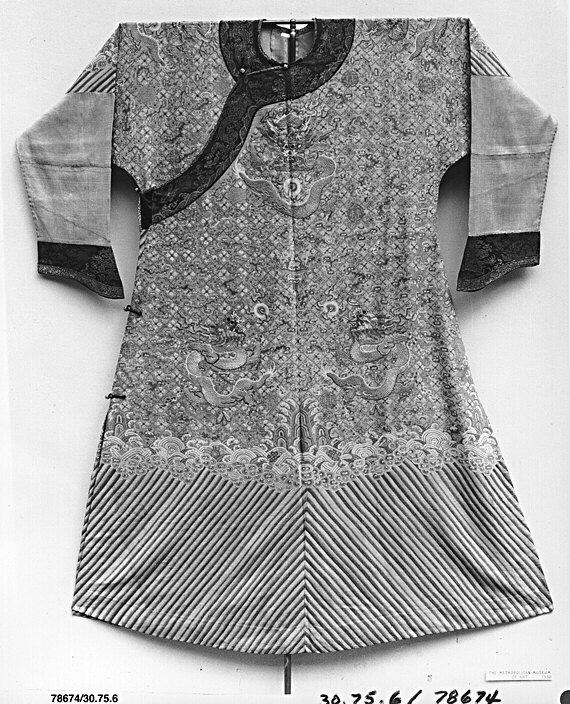
The Imperial Court Robe: Deconstructing Dynastic Silhouettes for the SS26 Frontier
The Imperial Court Robe of China, with its resplendent silk and intricate metallic thread, is often relegated to the dusty vitrine of historical costume—a relic of ceremonial stasis. For Zoey Fashion Laboratory’s SS26 avant-garde analysis, we reject this archival passivity. We perceive not a garment of the past, but a proto-architectural blueprint for the future. The robe’s voluminous, rectilinear form, its rigidly structured collar, and its gravity-defying train are not merely decorative; they are early experiments in negative space, kinetic weight, and the subjugation of the human form to the garment’s own ideological geometry. Our task is to dissect this dynastic armor and reassemble its DNA into a speculative, post-humanist silhouette for the coming season.
I. The Silhouette as Sovereign Territory: Reinterpreting the A-Line and the Train
Traditional analysis fixates on the robe’s opulent embroidery. We instead fixate on its territorial volume. The historical court robe, particularly the chaofu or jifu, was engineered to erase the organic contours of the body, replacing them with a monolithic, columnar presence. The sleeves, often shaped like horseshoe hooves, terminated in rigid cuffs that visually severed the hands from the arms, transforming the wearer into an abstract icon of authority. For SS26, we extrapolate this into a “suspended monolith”—a garment that does not drape but rather hovers around the body via an internal, carbon-fiber substructure. The silk is treated not as a soft textile but as a tensile membrane stretched over a framework of bioplastic and recycled aluminum. The result is a silhouette that maintains the robe’s historical width at the shoulders but abruptly truncates the hem at the mid-thigh, creating a stark, brutalist horizon line.
The train, historically a symbol of terrestrial dominion, is reimagined as a detachable, inflatable pneumatic appendage. Activated by a micro-sensor, it unfurls only during moments of performative movement—a runway walk, a gesture of power—then retracts with a hiss of compressed air. This is not mere theatricality; it is a commentary on the ephemerality of authority in the digital age. The robe’s historical permanence is subverted into a fleeting, responsive architecture, challenging the very notion of ceremonial timelessness.
II. Material Alchemy: Silk as a Conductive Conduit
The specified materials—silk and metallic thread—are typically celebrated for their luster and historical value. In our laboratory, we treat them as conductive and reactive elements. The silk is not woven but 3D-printed in a continuous filament, using a bio-engineered silk protein that mimics the original’s tensile strength but allows for variable opacity. The metallic thread, traditionally gold or silver, is replaced with a liquid gallium-indium alloy embedded within the silk’s matrix. This transforms the robe’s surface into a living, mutable skin capable of shifting its reflective properties in response to ambient electromagnetic fields.
This is a radical departure from the static, symbolic iconography of dragons and clouds. Instead of embroidered narratives, the robe’s surface becomes a real-time data visualization. The metallic threads are programmed to illuminate in patterns that correspond to the wearer’s biometrics—heart rate, galvanic skin response—effectively rendering internal, invisible states as external, luminous ornament. The historical robe was a mask of imperial stoicism; our SS26 iteration is a confessional, broadcasting vulnerability and physiological flux as the new luxury. The craftsmanship lies not in the hand-stitching, but in the algorithmic choreography of light and current.
III. Structural Innovation: The Collar and the Sleeve as Cybernetic Joints
The iconic standing collar of the court robe, known for its stiff, encircling form, is our primary site of deconstruction. Historically, it was a cage that held the head aloft, a physical reminder of unyielding protocol. For SS26, we transform this into a modular, articulated exoskeletal ring. Hinged at the clavicle, the collar can be adjusted in real-time, expanding to a wide, disc-like halo that frames the face in a futuristic aureole, or contracting to a high, protective cowl that obscures the jawline. This is not a decorative choice but a functional one, integrating haptic feedback sensors that guide the wearer’s posture through gentle vibrations—a silent, technologically mediated form of courtly discipline.
The sleeve, once a symbol of concealment and gestural restraint, is re-engineered as a “kinetic wing.” Using a series of layered, laser-cut silk panels that overlap like avian feathers, the sleeve is attached to the body via a rotating shoulder joint of brushed titanium. When the arm is lowered, the sleeve collapses into a sleek, minimal sheath. When raised, it fans out into a dramatic, three-dimensional crescent, increasing the wearer’s visual mass by 200%. This mechanism is not hidden but celebrated, with the joint’s mechanical articulation exposed as a deliberate aesthetic. It is a homage to the robe’s original sleeve’s restrictive power, inverted into a tool of expressive liberation.
IV. The Futuristic Silhouette: A Temporal Displacement
The synthesis of these elements yields a silhouette that is neither historical nor purely sci-fi, but a temporal displacement. We call it the “Residual Courtesan.” The garment does not follow the body; it creates a new, parallel body. The wearer becomes a cyborg figure, part dynastic idol, part autonomous agent. The color palette, derived from the faded dyes of excavated robes, is deliberately toxic: imperial yellow is pushed into a neon chartreuse; the deep cinnabar red becomes a bio-luminescent coral. This is not a nostalgic revival but a critique of nostalgia itself.
In conclusion, the Imperial Court Robe is not a costume to be preserved but a hypothesis to be tested. By severing it from its terrestrial, ceremonial origins and re-rooting it in the speculative soil of SS26, Zoey Fashion Laboratory posits a future where heritage is not a weight but a launchpad. The robe’s historical function was to enforce hierarchy; our deconstruction liberates its structural logic to question the very nature of authority, materiality, and the human form. This is not fashion as clothing, but as philosophical engineering—a wearable thesis for the coming age.