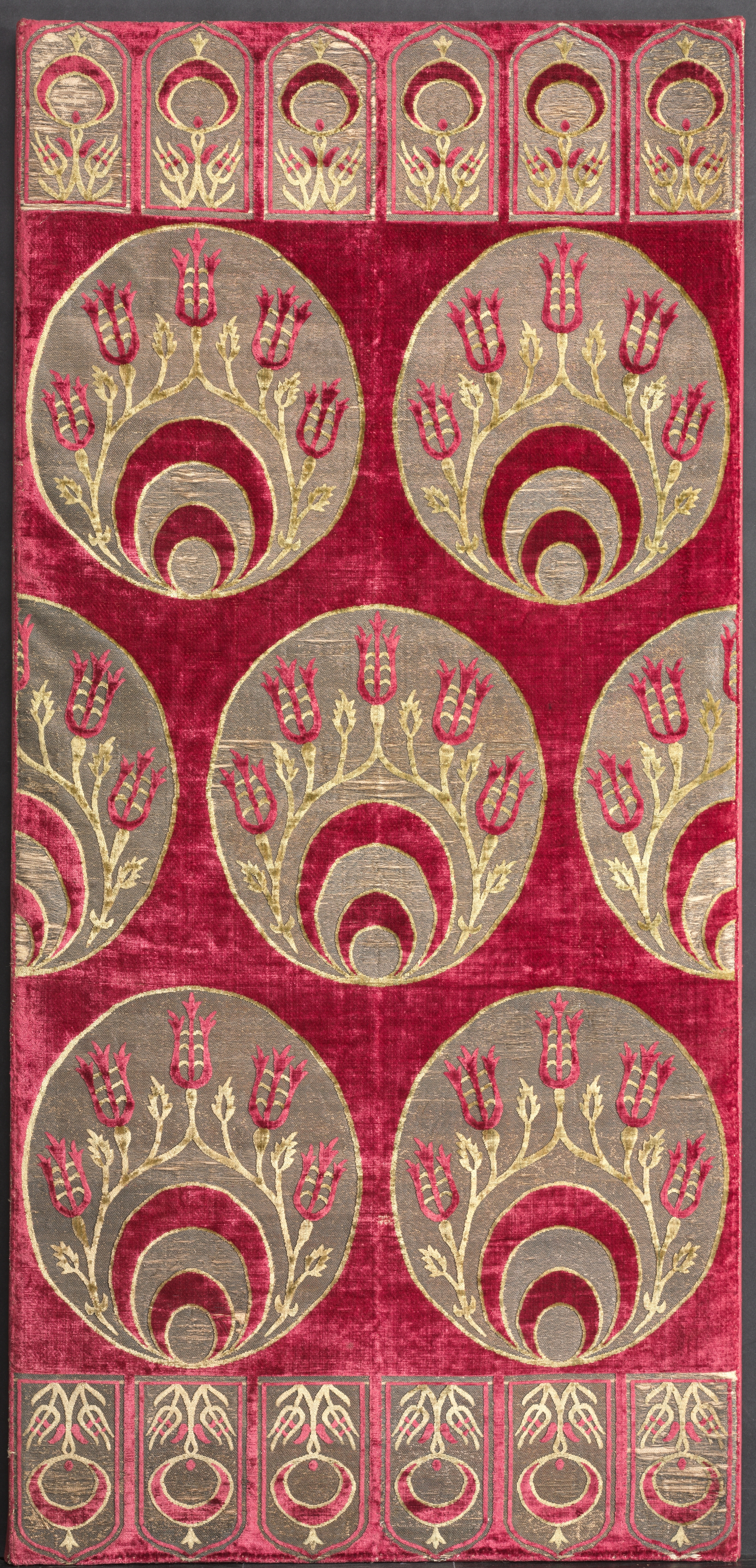
Deconstructing the Crescent: An Avant-Garde Analysis of the Brocaded Velvet Cushion Cover
At Zoey Fashion Lab, our mandate extends beyond the mere cataloging of textile artifacts. We engage in a process of deconstructive synthesis, wherein historical materiality is dismantled, its core genetic code—what we term the "New DNA Strand"—is isolated, and subsequently re-engineered for contemporary, avant-garde expression. The subject of today's analysis, a late-Ottoman brocaded velvet cushion cover from Istanbul or Bursa, presents a particularly potent specimen. Its physical composition—silk velvet pile, gilt- and silver-metal thread, and a cotton foundation—is a testament to imperial craftsmanship. Yet, its true value for the avant-garde designer lies not in its opulent surface, but in the structural and symbolic tensions embedded within its weave. This analysis will dissect the object across three strata: Material Dialectics, Geometric Subversion, and Translational Potential for Zoey Fashion Lab's future collections.
I. Material Dialectics: The Politics of Opulence and Structure
The initial sensory encounter with this cushion cover is one of overwhelming tactility. The silk velvet pile, with its deep, light-absorbing void, creates a ground of profound darkness. Upon this abyss, the brocaded pattern emerges, not as paint, but as sculpted light. The gilt- and silver-metal thread, likely a composite of silk core wrapped in hammered metal, does not merely reflect light; it fractures it. This is not a passive surface. It is a dynamic, aggressive field of visual noise. For the traditionalist, this is the pinnacle of luxury. For the avant-garde deconstructionist, it is a problem to be solved.
Consider the cotton foundation. Invisible in the final object, it is the utilitarian skeleton upon which the aristocratic flesh is stretched. This hierarchy—cotton as structural support, silk and metal as expressive surface—mirrors a social dialectic. The avant-garde gesture is to invert this. By exposing the cotton warp or weft through deliberate distressing, or by re-weaving the metal threads on a transparent base, we can foreground the labor and structure that opulence seeks to conceal. The "New DNA Strand" here is not the velvet's softness, but the tensile strength of the metal thread and the rigidity of the cotton ground. We propose a fabric that retains the visual grammar of the brocade—the metallic crescents—but renders them in a deconstructed, open-weave lattice, allowing the structural cotton to become the primary aesthetic feature. This is not a rejection of luxury, but a re-negotiation of its terms, shifting value from surface richness to systemic complexity.
II. Geometric Subversion: The Crescent as a Fractured Signifier
The motif itself—the crescent—is a loaded signifier. In its Ottoman context, it is a symbol of dynastic power, celestial authority, and imperial reach. The repetition of the crescent in a symmetrical, all-over pattern on the cushion cover suggests a desire for cosmic order, a microcosm of the Sultan's dominion. However, for the avant-garde, symmetry is a form of stasis. The "New DNA Strand" extracted from this geometric field is not the crescent's iconic completeness, but its potential for asymmetry and rupture.
Our analysis identifies that the brocaded crescents are not uniform; subtle variations in thread tension and metal oxidation create micro-irregularities. We propose to magnify these imperfections. The avant-garde application would involve de-symmetrizing the crescent: slicing it, re-orienting its points, or pairing it with its negative space. Imagine a garment where one shoulder features a full, metallic crescent of traditional proportions, while the opposite side presents only the ghostly outline of the crescent, embroidered with oxidized, blackened silver thread to suggest decay or eclipse. This is not a desecration of heritage; it is a critical commentary on the cyclical nature of power. The crescent, in our hands, becomes a symbol of flux, of the waning and waxing of ideologies. This subversion aligns with the avant-garde tradition of détournement, where a familiar icon is recontextualized to produce a new, often critical, meaning.
III. Translational Potential: From Cushion to Catwalk
The translation of this 2D decorative art into 3D wearable form is the ultimate test of our deconstructive methodology. The cushion cover is planar, static, and designed for the horizontal gaze. Fashion is kinetic, volumetric, and demands a vertical, moving gaze. The challenge is to transpose the weight and drape of the original material into a new ergonomic reality. Our proposed "New DNA Strand" is a hybrid textile: a double-faced fabric. One face will be a plush, black silk velvet, echoing the original's ground. The reverse will feature a metallic, openwork jacquard, where the crescent motif is re-scaled and distorted, appearing to warp across the body's contours.
This fabric is not meant to be draped passively. It is engineered for architectural manipulation. A cocoon coat, for instance, would present the velvet face outward, its somber luxury absorbing light. Upon movement, the interior metallic face would flash, revealing the deconstructed crescents in a cascade of silver and gilt light. The weight of the metal thread, traditionally a limitation, becomes a tool for creating deliberate, sculptural fall. The garment would not flow; it would articulate. Furthermore, the cotton foundation can be re-imagined as a separate, visible under-layer, perhaps a sheer organza printed with the crescent's structural grid, visible through strategic slits in the outer shell. This layered approach allows the garment to narrate its own construction, revealing the hierarchy of materials in real-time.
Consider a more radical application: a deconstructed bustier. The traditional corsetry is replaced by panels of the brocaded velvet, but the metal threads are left unbound at the edges, creating a frayed, metallic fringe that moves with the wearer. The crescents are not embroidered on but are cut out and re-appliquéd at skewed angles, creating a visual dissonance that challenges the eye. This is not costume; it is a wearable thesis on the relationship between ornament and structure, tradition and rebellion. The cushion cover, once an emblem of static domestic luxury, is reborn as a dynamic, critical, and profoundly contemporary piece of avant-garde armor.
In conclusion, the brocaded velvet cushion cover is far more than a historical artifact. For Zoey Fashion Lab, it is a catalyst for innovation. By dissecting its material hierarchy, subverting its geometric iconography, and re-engineering its structural properties, we unlock a "New DNA Strand" that is both deeply rooted in Anatolian heritage and radically projective in its fashion potential. The crescents no longer signify a fixed, imperial past; they become mutable signs of a fluid, deconstructed future.