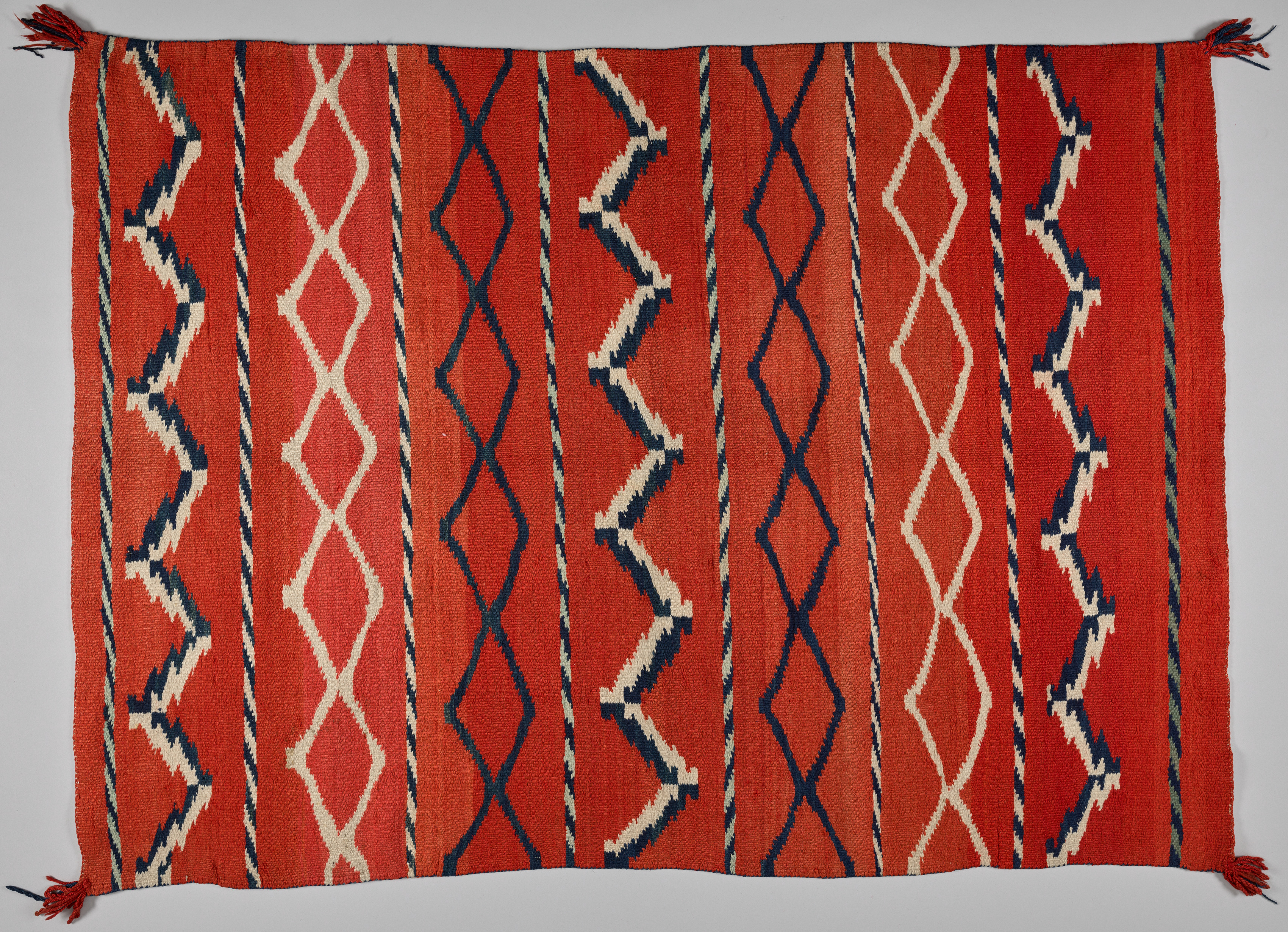
Deconstructing the Blanket: An Avant-Garde Analysis of a Navajo Tapestry
At Zoey Fashion Lab, our mandate transcends the conventional boundaries of garment analysis. We do not merely observe cloth; we interrogate its very molecular structure, its socio-political DNA, and its silent dialogue with time. Today, we turn our Chief Fabric Deconstructionist’s lens upon a singular object: a woman-crafted Navajo (Diné) wearing blanket from the Southwest, rendered in handspun wool through the demanding technique of tapestry weave. To the uninitiated, this is a textile of warmth. To the avant-garde eye, it is a radical manifesto woven in fiber—a precursor to deconstructionist fashion, a study in structural integrity, and a profound meditation on the intersection of utility and abstraction.
I. The Technical Subversion: Handspun and the Tapestry Weft
Let us first dissect the technical lexicon. The blanket is not woven; it is built. The handspun wool is our primary protagonist. Unlike industrially milled yarns, which offer a sterile, uniform tension, handspun fiber retains the kinetic memory of the spinner’s fingers. This irregularity is not a flaw; it is a deliberate rejection of mechanical perfection, a hallmark of the avant-garde. The variance in thickness creates a topographical surface—a micro-landscape of light and shadow that shifts with the wearer’s movement. In our lab, we equate this to the concept of imperfect finish, a technique later championed by Rei Kawakubo, where the flaw becomes the focal point of aesthetic power.
Furthermore, the tapestry weave itself is an act of radical structuralism. Unlike a twill or a plain weave that interlocks warp and weft for drape, tapestry weave is a weft-faced structure. The warp is entirely concealed, creating a rigid, almost architectural plane. The weft threads do not traverse the full width; they are discontinuous, turning back upon themselves to form intricate geometric fields. This creates internal slits and structural discontinuities. In contemporary fashion deconstruction, we would call these intentional stress points. The blanket is not a supple second skin; it is a stand-alone architectural shell, a rigid exoskeleton that holds its own space apart from the body. The Diné artist was not crafting a passive drape but an active, sculptural volume—a premonition of the power-shouldered, structured silhouettes of the 1980s, yet executed with a spiritual gravity that fashion has yet to replicate.
II. Archive Resonance: The Dialogue Across Centuries
The reference provided—Archive Resonance: 在人类文明的长河中,器物与绘画不仅是时代技艺的结晶,更是文化碰撞与美学交融的无声见证。十六至十七世纪...—translates to a reflection on how artifacts and paintings are silent witnesses to cultural collision and aesthetic fusion from the 16th to 17th centuries. This is the critical pivot. We must view this Navajo blanket not as an isolated indigenous craft, but as a node in a global network of exchange. The introduction of commercial Germantown yarns and aniline dyes in the late 19th century collided with the pre-existing Diné weaving tradition. Yet, the artist here chose handspun native wool, a deliberate act of cultural resistance against the influx of colonial trade goods.
This is where the avant-garde reading intensifies. The blanket becomes a document of hybridity. Its geometric patterns—diamonds, zigzags, and terraced steps—are not merely decorative. They are a visual language encoding cosmological narratives, weather patterns, and spiritual geography. When we view this through the lens of 16th-17th century globalism, we see a parallel to the chinoiserie and turquerie that swept European courts. But unlike European appropriation, which diluted foreign motifs into ornamental pastiche, the Diné artist is engaging in a syntactic appropriation. She is taking the trauma of displacement (the Long Walk, the forced confinement at Bosque Redondo) and weaving it into a structure of resilience. The blanket does not depict the collision; it is the collision, resolved into a wearable, functional harmony.
III. The Woman Artist: Gendered Labor as Radical Praxis
In the context of haute couture, the atelier is often male-dominated, with women relegated to the role of petites mains (little hands). Here, the Diné woman is the sole architect, engineer, and producer. She shears the sheep, cleans the wool, spins the yarn, dyes the fiber with native plants, and finally, executes the complex tapestry weave on an upright loom. This is a totalitarian control over the production chain—a concept that the modern luxury industry is only now beginning to explore through vertical integration and artisan partnerships.
From a feminist avant-garde perspective, this blanket is a weapon of autonomy. The rigid, geometric patterns are often interpreted as a reflection of the natural landscape—the mesas, the canyons, the lightning storms. However, we propose a more radical reading: these patterns are a mathematical abstraction of the female body’s resilience. The vertical warp threads are the spine; the interlocking wefts are the ribs, protecting the vital organs. The blanket, when worn, becomes a second skeleton—an externalized nervous system that shields the wearer from the harsh desert climate and the harsher realities of colonial encroachment. It is armor, but armor rendered in the softest, most tactile of materials. This dichotomy—softness as strength, rigidity as protection—is the core paradox that defines the most compelling avant-garde fashion.
IV. Re-contextualizing for the Zoey Fashion Lab Runway
How does Zoey Fashion Lab translate this artifact into a future-facing design ethos? We do not copy the pattern. We extract the principle of structural autonomy. We imagine a garment that does not conform to the body’s natural curves but instead creates a new, geometric silhouette that the body must inhabit. We propose a coat with discontinuous seams, echoing the tapestry’s internal slits, which open and close with movement to reveal flashes of skin or underlayers. We utilize raw, un-spun wool blends to capture that handspun irregularity, rejecting the sterile finish of modern mills.
Furthermore, we embrace the concept of the "wearable witness." Just as the blanket carries the history of its maker and her people, our garments should be designed to accrue memory. We will incorporate visible mending techniques into the initial design, not as a repair mechanism, but as a pre-emptive narrative—a suggestion that the garment’s life is a continuous process of becoming, not a static object of consumption.
V. Conclusion: The Blanket as a Proto-Deconstructionist Manifesto
In conclusion, the Navajo wearing blanket, in its handspun, tapestry-woven glory, is not a relic. It is a prophetic text. It predates the deconstructionist movements of the late 20th century by over a century, offering a masterclass in how to use structure, texture, and cultural memory to create a garment that is simultaneously protective, expressive, and politically potent. The Diné woman artist, working in silent concentration on her loom, was not merely making a blanket. She was weaving a philosophy of resistance into a wearable form. At Zoey Fashion Lab, we do not deconstruct to destroy; we deconstruct to reveal the hidden architecture of meaning. And in this textile, we find a blueprint for a fashion that is unapologetically structural, deeply resonant, and eternally avant-garde. The blanket is not worn; it is inhabited. And that is the highest form of design we can aspire to achieve.