Executive Summary: The Deer and the Dialectic
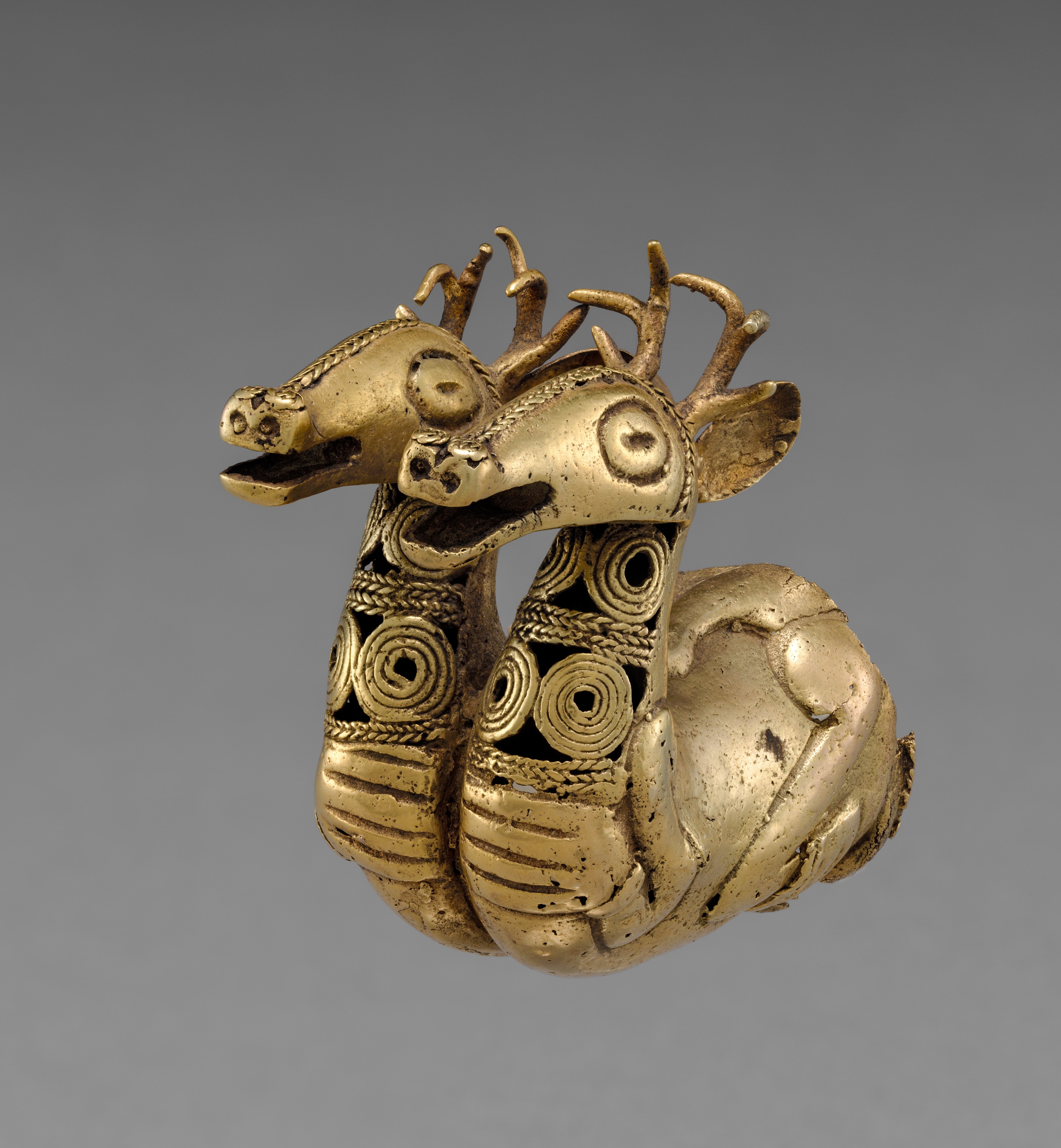
In the hallowed halls of Zoey Fashion Lab, we do not merely observe artifacts; we interrogate them, dissect their structural logic, and re-synthesize their essence into wearable provocations. The Finial with Two Deer, a 5th–11th century gold casting from the Sinú (Zenú) people of Colombia’s Isthmian Region, presents a fascinating paradox. At first glance, it is a diminutive ceremonial staff-topper—a symbol of shamanic authority and terrestrial fertility. Yet, within its cast-gold silhouette lies a blueprint for a new avant-garde aesthetic: one that marries the chthonic weight of metallurgy with the ethereal fragility of a mirrored surface. This analysis deconstructs the finial’s formal, symbolic, and technical language to propose a collection that oscillates between reflective polish and raw, narrative texture—a direct response to the archival resonance of the Mirror with Split-Leaf and its cold, relief-carved sarcophagus counterpart.
I. Formal Dissection: Symmetry as a Weapon of Stillness
The finial’s composition is deceptively simple: two deer, rendered in profile, stand flanking a central axis—likely a hollow tube or shaft. Their bodies are elongated, their antlers sweeping backward in a curvilinear rhythm that mimics the palm fronds of the referenced mirror’s inlaid gold. But this is not a passive symmetry. The Zenú goldsmiths employed lost-wax casting to achieve a surface that is simultaneously massive and perforated. The deer are not solid; they are skeletal, their legs and torsos defined by negative space. This is crucial for fashion translation.
For Zoey Fashion Lab, we extract a principle: “Structural Hollowing.” The avant-garde garment must not drape; it must frame the body through strategic voids. Imagine a sculptural bustier in hammered, blackened bronze, where the torso is bisected by a central spine of polished gold—the deer’s axis—and the sides are cut away to reveal the skin, not as flesh, but as a living canvas. The symmetry becomes a weapon of stillness, a meditative focal point that forces the viewer’s eye into a hypnotic rhythm. The deer’s backward-gazing antlers translate into asymmetric shoulder armor that sweeps away from the neckline, creating a silhouette that is both defensive and lyrical.
From Antler to Armature: The Line of Flight
The most radical element is the antler trajectory. Unlike European heraldic stags, which boast upright, branching majesty, the Sinú deer’s antlers are flattened and reclined against the back. This is not a sign of submission but of aerodynamic grace. In our collection, this becomes a “Line of Flight”—a continuous seam that begins at the clavicle, arcs over the shoulder blade, and terminates in a sharp, metallic fringe at the lumbar spine. This seam is not sewn; it is cast in a flexible gold alloy, mimicking the lost-wax technique. The result is a garment that moves with a liquid, reptilian quality, defying the rigidity of historical armor while retaining its imposing presence.
II. Material Dialectics: The Mirror and the Sarcophagus
The provided reference—a dichotomy between a “光洁银镜” (polished silver mirror) with gold palm-leaf inlay and a “冰冷石棺板” (cold sarcophagus slab) with relief-carved life narratives—is not a contradiction but a synthesis. The finial sits precisely at this intersection. Its gold, now darkened by millennia of burial, holds a dual memory: the original blinding brilliance of a ceremonial object under tropical sun, and the patina of earth’s slow erosion.
Zoey Fashion Lab’s avant-garde response is to weaponize this duality through “Layered Memory” textiles. We propose a primary fabric: a double-faced technical silk. The outer face is treated with a high-polish, liquid-metal lamination—the silver mirror—reflecting the viewer’s gaze with aggressive clarity. The inner face, however, is abraded, oxidized, and embedded with micro-embossed patterns derived from the sarcophagus’s reliefs—scenes of deer hunts, lunar cycles, and aquatic serpents. When the garment is worn, the inner narrative is hidden. But with a single, dramatic turn or a raised arm, the lining is exposed, revealing a private, tactile history. The wearer becomes a walking diptych: public spectacle vs. private archaeology.
Gold as a Liquid, Not a Metal
Traditional casting creates rigid forms. The Zenú, however, achieved a remarkable illusion of fluidity. The deer’s haunches and necks appear to flow into the central shaft like thick honey. To emulate this, we must reject conventional gold embroidery. Instead, we employ thermoplastic polyurethane (TPU) filaments infused with 24k gold dust, applied via a 3D-printing process directly onto the silk. This allows for a gradient of density—opaque at the shoulder, translucent at the wrist—creating a visual weight that shifts with movement. This is not decoration; it is a structural exoskeleton that supports the garment without internal boning.
III. Symbolic Re-Encoding: The Deer as a Cybernetic Shaman
The deer in Sinú cosmology is not a passive prey animal. It is a psychopomp—a guide between the terrestrial and the aquatic, the living and the ancestral. Its two-ness suggests a mirroring of worlds. In our avant-garde narrative, the deer becomes a cybernetic interface. The finial’s central shaft is reimagined as a high-neck collar that houses a flexible, conductive spine. This is not wearable tech gimmickry; it is a poetic gesture. Sensors embedded in the antler-shaped shoulder pads can detect the wearer’s pulse, transmitting a subtle haptic vibration—a heartbeat—to a second garment worn by a companion. The two deer, separated by time, are reconnected through electromagnetic resonance.
The Negative Space as a Political Statement
In an era of maximalist excess, the finial’s radical use of absence is a powerful counterpoint. The deer are defined by what is not there. We translate this into a series of cutout gowns where the torso is a lattice of gold-filled negative spaces, forming the abstracted shape of a deer’s ribcage. The skin beneath is painted with a temporary, iridescent pigment—not to conceal, but to complete the form. The garment thus becomes a collaborative act between the designer, the material, and the living body. It is a statement against the tyranny of the seamless, the airbrushed, the perfect. It celebrates the archaeological fracture—the crack in the casting, the missing antler tip—as the highest form of beauty.
IV. Conclusion: A Wearable Reliquary
The Finial with Two Deer is not an ornament; it is a compressed cosmology. For Zoey Fashion Lab, it is a challenge to move beyond mere historical pastiche. Our collection will not feature deer prints or gold tassels. Instead, it will embody the finial’s core engineering principles: structural hollowing, dual-faced materiality, liquid-gold gradients, and symbiotic resonance. The final piece—a floor-length coat with a mirrored front and a relief-carved, oxidized back—will be a wearable reliquary. It will hold the memory of the Sinú goldsmith, the cold stone of the sarcophagus, and the fleeting reflection of the silver mirror. It will be an object that does not simply clothe the wearer, but contains them, exactly as the ancient finial contained the spiritual authority of a vanished world. This is not fashion. This is archaeology of the future.