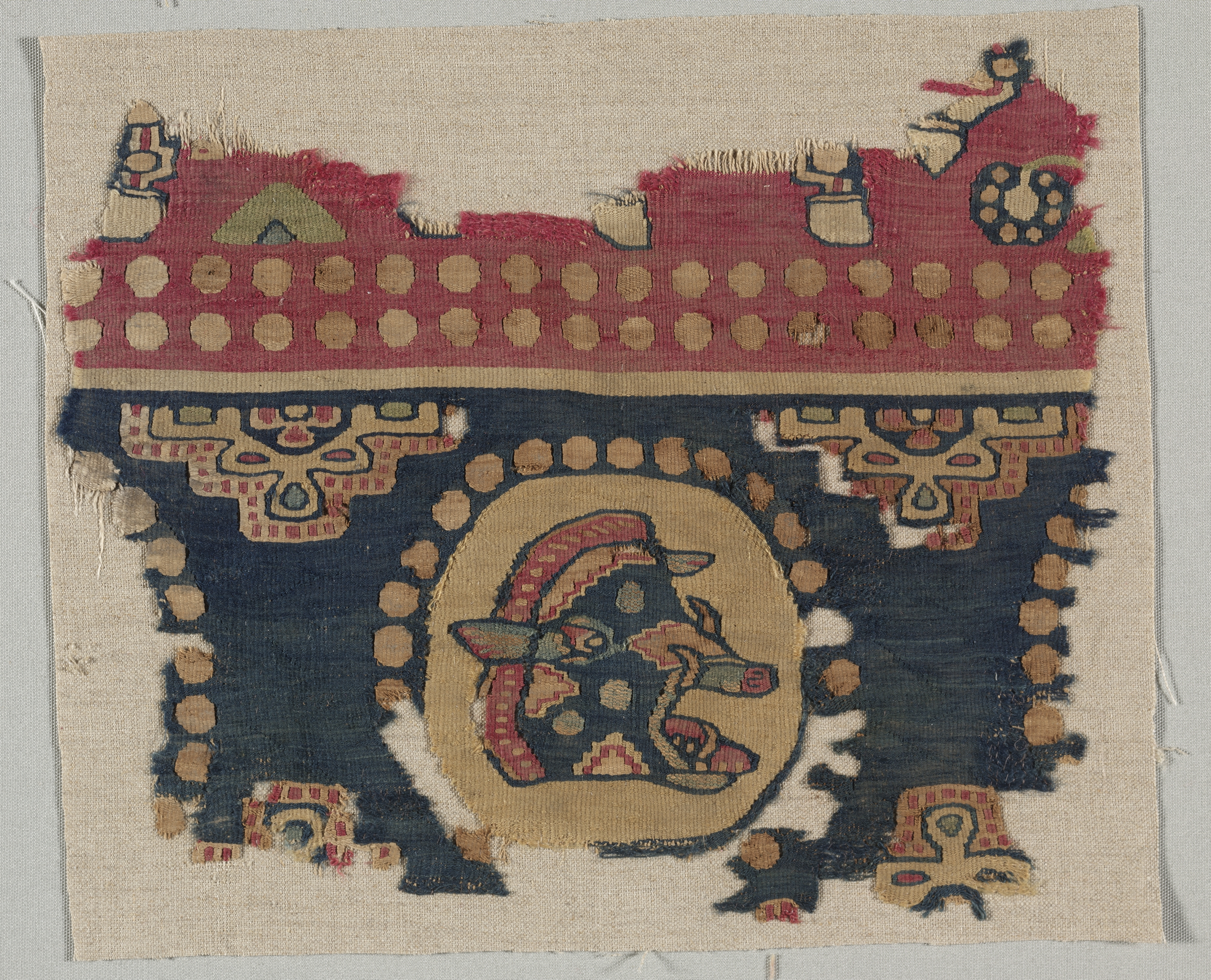
Deconstructing the Nomadic Gaze: The Boar-Head Fragment as Proto-Avant-Garde
At Zoey Fashion Lab, our mandate extends beyond the mere cataloging of historical textiles. We engage in a process of fabric deconstruction, peeling back the layers of weave, dye, and motif to expose the radical, often unsettling, dialogues embedded within. The subject of this analysis—a hanging fragment featuring a boar head, originating from 16th–17th century Iran and executed in a wool and linen tapestry weave—presents a profound paradox. On its surface, it is a relic of Safavid courtly or nomadic luxury. Yet, through the lens of avant-garde fashion theory, this fragment operates as a prescient artifact, a proto-deconstructionist manifesto woven centuries before its time. Its technical execution and iconographic violence do not merely depict a bygone aesthetic; they challenge the very ontology of textile art, prefiguring the disruptive strategies of contemporary fashion.
Technical Subversion: The Tapestry as a Site of Rupture
The technical choice of a wool and linen tapestry weave is the first point of avant-garde interrogation. In the hierarchy of Persian textile production, silk and metal-wrapped threads often signified courtly prestige. The deliberate use of coarse wool against a linen ground is not an indication of provincial inadequacy but rather a strategic material dissonance. The linen warp provides structural tension, a rigid, unforgiving skeleton, while the wool weft introduces a pliable, organic flesh. This binary opposition—the cool, crisp logic of linen against the warm, chaotic memory of wool—creates a tactile friction that modern avant-gardists would later call textural anarchy.
Furthermore, the tapestry technique itself is inherently deconstructive. Unlike embroidery, which adds to a surface, or printing, which imposes upon it, tapestry weave builds the image from the ground up, pixel by pixel, thread by thread. The boar’s head is not painted or applied; it is the fabric. This structural monism means that the image and its support are inseparable. For a contemporary fashion lab, this is a critical lesson in material honesty. The fragment refuses illusionistic depth. The eye cannot penetrate the weave; it is forced to confront the raw, pixelated essence of the form. This is a direct precursor to the deconstructed seams and exposed linings of Rei Kawakubo or Martin Margiela, where the construction process is not hidden but celebrated as the primary aesthetic event.
Iconographic Violence: The Boar as the Anti-Ornament
Iconographically, the boar head is a radical departure from the expected repertoire of Persian garden scenes, cypress trees, or literary heroes. The boar is a creature of the wild, of the hunt, and in Zoroastrian and later Islamic contexts, it carries a dual valence of ferocity and impurity. In the context of a hanging—an object designed for domestic or ceremonial display—the boar’s snarling visage introduces a rupture of the domestic sublime. It is not a passive ornament; it is an active, aggressive presence that stares back at the viewer.
This is where the fragment aligns most powerfully with the avant-garde ethos of détournement. The boar is not depicted in a narrative scene of the hunt, but isolated, fragmented, and magnified. This decontextualization transforms the animal from a narrative element into a pure signifier of raw, untamed power. The weaver has effectively created a graphic logo of aggression, centuries before the advent of brand semiotics. In the language of modern fashion, this is akin to Alexander McQueen’s use of skulls or Vivienne Westwood’s appropriation of heraldic emblems—taking a recognizable symbol and stripping it of its original context to generate a new, unsettling charge. The boar head, with its fierce eye and bristling snout, is not merely a decoration; it is a wearable provocation, a declaration that the fabric is not a passive backdrop but an active agent of psychological confrontation.
Archive Resonance: The Temporal Dislocation
The archival note referencing “Archive Resonance: 在人类文明的长河中,器物与绘画不仅是时代技艺的结晶,更是文化碰撞与美学交融的无声见证。十六至十七世纪....” translates to a meditation on objects as silent witnesses to cultural collision. This is the key to unlocking the fragment’s avant-garde potential. The text reminds us that this piece exists not in a vacuum but at a nexus of cross-cultural exchange—between the nomadic Turkic traditions of the steppe and the settled, urban sophistication of the Safavid court. The boar motif itself is a vestige of Central Asian shamanic and hunting cultures, filtered through the lens of Persian courtly artistry.
This temporal and cultural dislocation is precisely what the avant-garde seeks to replicate. The fragment is not a static object; it is a time-traveling device. When we, at Zoey Fashion Lab, view this piece, we are not seeing a 17th-century artifact. We are seeing a blueprint for temporal collage. The avant-garde designer does not invent from nothing; they curate and re-contextualize fragments from disparate histories. This hanging fragment serves as a masterclass in that practice. It demonstrates how a single, isolated motif can be extracted from its original narrative and re-planted into a new, synthetic context to generate fresh meaning. The boar’s head, once a symbol of royal hunting prowess, becomes, in our contemporary reading, a symbol of artistic defiance against the tyranny of cohesive, decorative unity.
The Fragment as a Complete Garment of Thought
In conclusion, the hanging fragment with boar head is not a historical curiosity but a philosophical prototype. Its technical execution in wool and linen rejects the seduction of luxurious surface, exposing the skeletal logic of construction. Its iconography introduces a disruptive, animalistic energy that undermines the presumed serenity of Persian ornament. And its archival resonance, as a witness to cultural collision, provides the theoretical framework for understanding it as a precursor to contemporary practices of sampling, remixing, and deconstruction.
For Zoey Fashion Lab, this fragment is a directive. It instructs us to look beyond the surface beauty of textiles and to interrogate their structural DNA. It validates the avant-garde impulse to break forms, to isolate motifs, and to present them with raw, unapologetic intensity. The boar’s head, severed from its body and woven into a field of linen, is the ultimate metaphor for the avant-garde condition: a powerful, isolated signifier, forever severed from its original context, yet generating immense aesthetic and intellectual energy precisely because of its fragmentation. It is not a hanging for a wall; it is a hanging for the mind, a textile that continues to unravel our preconceptions with every thread.