Deconstructing the Archival Thread: A Preliminary Assessment
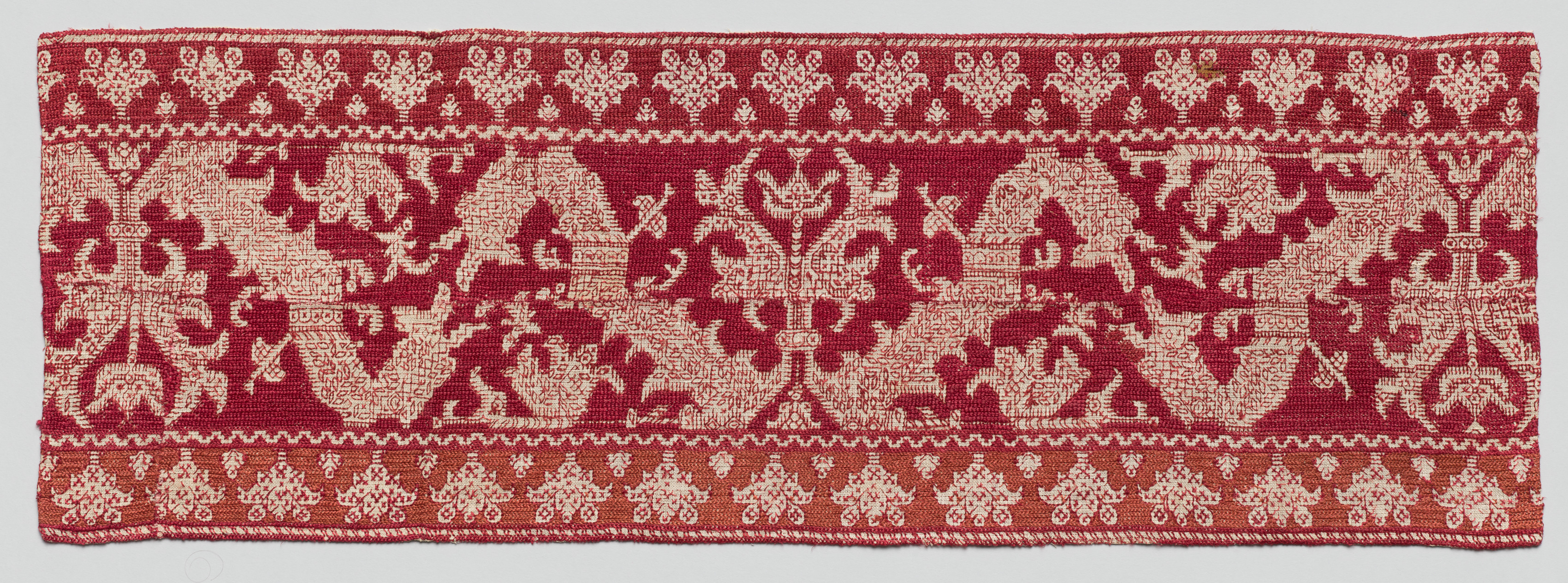
In the rarefied atmosphere of high fashion's intellectual vanguard, the archive is not a resting place but a launchpad. At Zoey Fashion Lab, we do not merely preserve fragments; we interrogate them, dissecting their structural logic and extracting the latent codes that can inform a new, avant-garde vernacular. The subject of this analysis—a fragment of furnishing textile from Azemmour, Morocco, dating to the 16th–17th century—presents a compelling paradox. It is a utilitarian object, destined for a domestic interior, yet it carries the weight of transcontinental dialogue, technical mastery, and a chromatic audacity that resonates profoundly with contemporary deconstructivist impulses. This is not a relic; it is a blueprint for disruption.
Our reference, “Archive Resonance,” speaks to the silent testimony of objects and paintings across human civilization. This fragment is precisely such a witness. It embodies the confluence of Andalusian, sub-Saharan, and Mediterranean aesthetics that defined the Moroccan coastal city of Azemmour during the Saadian dynasty. To the untrained eye, it is a piece of woven history. To the Chief Fabric Deconstructionist, it is a complex matrix of material politics, artisanal subversion, and proto-modernist composition. Our task is to strip away the veneer of “heritage” and expose the radical core that lies beneath.
Material Dialectics: Linen, Silk, and the Politics of Touch
The primary material substrate is a ground of linen, a fiber of ancient provenance in North Africa, valued for its tensile strength and cool, matte surface. Yet, the fragment’s true narrative is written in silk. The introduction of silk into the Moroccan weaving tradition is not a simple matter of trade; it is a story of imperial desire and artisanal adaptation. Silk, with its inherent luster and fluid drape, is the foreign body that disrupts the stoic, earthy presence of the linen. In our deconstruction, we identify this as a primary dialectic: the structural, utilitarian honesty of the linen against the opulent, almost rebellious, sensuality of the silk.
This is not a harmonious marriage. The technical execution reveals a tension. The embroiderer has not allowed the silk to dominate. Instead, the stitches—likely a variant of a counted-thread or darning stitch—are applied with a density that creates a raised, almost sculptural relief. The silk is disciplined, forced into geometric patterns that temper its natural fluidity. This is a crucial insight for our lab. The avant-garde often celebrates the ungovernable, the frayed edge, the raw materiality. Yet, this Moroccan artisan demonstrates a more sophisticated subversion: the imposition of rigorous, intellectual order upon a material of inherent luxury. The dye further complicates this. The palette, likely derived from madder (reds), indigo (blues), and weld (yellows), is not passively applied. The dye is a chemical agent that bonds with the fiber, creating a permanent record of a specific moment in time. The slight irregularities in tone—the “halo” effect where dye meets undyed thread—are not flaws. They are the fingerprint of the human hand, a testament to a process that precedes industrial standardization. In our reconstruction, we must honor this irregularity as a form of generative error, a source of organic variation that mass production cannot replicate.
Geometric Subversion: The Grammar of the Fragment
Let us now examine the compositional logic. The fragment, though partial, reveals a sophisticated use of geometric abstraction. The motifs—octagons, interlacing stars, and staggered diamond lattices—are not mere decoration. They are a visual language, a coded system of cosmic and mathematical harmony. However, the avant-garde eye perceives a disruption within this harmony. The pattern does not conform to a singular, centralized grid. Instead, it appears to shift, with the primary motif being cut off at the fragment’s edge. This is not an accident of damage; it is an inherent quality of textile design intended for furnishing. The pattern is designed to be infinite, to extend beyond the visible frame, suggesting a world without boundaries.
This is where the deconstruction becomes truly potent. The fragment’s “incompleteness” is its most radical attribute. It refuses closure. It presents a system of order that is inherently open-ended. For our design process, we extract this principle of non-linear repetition. We reject the idea of a seamless, all-over print. Instead, we propose a design language that operates on the principle of the “interrupted grid.” Garments would feature patterns that appear to be in constant motion, deliberately cut off at seams, collars, and hems, creating a visual friction that challenges the wearer’s perception of the body’s silhouette. The motif becomes a narrative that is both present and absent, a story that the wearer completes through movement.
Chromatic Avant-Garde: The Language of Dissonance
The color palette of this Azemmour fragment demands a radical reinterpretation. Historical analyses often describe such textiles as exhibiting “harmonious” hues. We reject this passive characterization. The juxtaposition of a deep, ferrous indigo against a searing madder red, punctuated by the acid yellow of weld, is not harmonious; it is discordant. It is a chromatic confrontation. This is a palette that does not soothe; it agitates. It speaks to a cultural milieu that was not isolated but was a vibrant crossroads of trade, conflict, and exchange. The colors are the echoes of caravans crossing the Sahara, of Portuguese ships on the Atlantic, of the opulent courts of Fes.
In our avant-garde application, we will amplify this dissonance. We will not mute the colors to make them “wearable.” Instead, we will isolate them, placing them in stark, unmediated opposition. A coat of raw, undyed linen will be slashed to reveal a lining of high-voltage indigo. A collar will be constructed from a patchwork of silk fragments in clashing reds and yellows, their edges left raw to emphasize their materiality. The goal is to create a garment that is not merely an object of beauty but a statement of cultural and aesthetic tension. The wearer becomes a living archive, a walking testament to the fact that beauty is not found in conformity but in the bold, unresolved conflict of opposing forces.
From Fragment to Future: A Deconstructivist Manifesto
In conclusion, this fragment from Azemmour is far more than a historical curiosity. It is a masterclass in material subversion, geometric disruption, and chromatic audacity. It demonstrates that the most profound innovations are often hidden within the most traditional of forms. The embroiderer, working within a strict technical and cultural framework, managed to produce an object of startling modernity. The density of the silk stitch, the open-ended grid, and the clashing color fields all prefigure concerns that would not be articulated in Western art for centuries.
For Zoey Fashion Lab, this analysis provides the foundational DNA for our next collection. We will translate the tactile relief of the embroidery into structural padding and quilting. We will deconstruct the geometric grid into asymmetric panels and cut-outs. We will weaponize the color palette to create looks that are intellectually challenging and visually arresting. This is not about nostalgia. It is about recognizing that the past holds the keys to a more radical future. The archive is not a tomb; it is a chrysalis. And from this fragment, we will birth a new form of fashion—one that is unapologetically complex, deeply informed, and relentlessly avant-garde.