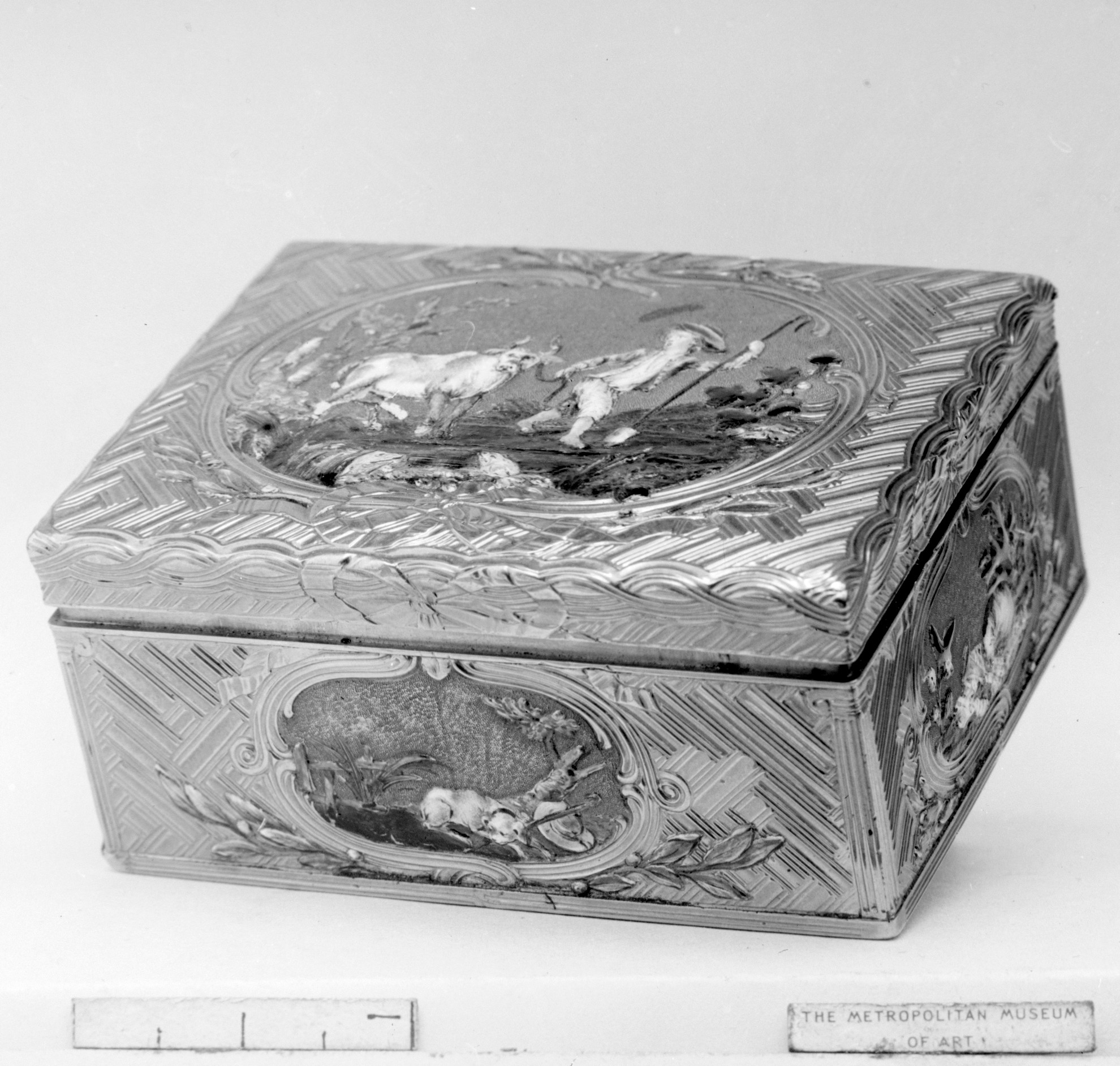
The Snuffbox Dialectic: Pastoral Intimacy as Structural Provocation for SS26
The snuffbox, historically a vessel of private indulgence and aristocratic micro-ritual, presents a paradoxical blueprint for avant-garde construction. Its gold and enamel surface, etched with Arcadian shepherdesses and bucolic reverie, is not merely decorative nostalgia—it is a compression of worlds. For Zoey Fashion Laboratory’s SS26 proposition, we extract from this object its core architectural tensions: the miniature versus the monumental, the tactile versus the optical, and the enclosed versus the exposed. The pastoral scenes, trapped within a gilded frame, become a metaphor for the body itself—a contained landscape waiting for liberation through deconstruction.
I. The Gilded Cage as Exoskeletal Silhouette
Our first intervention abandons the snuffbox’s function as a hand-held relic and reimagines its hinged lid as an exoskeletal shoulder plate. The silhouette for SS26 begins with a rigid, almost brutalist carapace that arcs from the nape to the clavicle, mimicking the box’s convex curvature. Yet, unlike the historical object’s seamless finish, we fracture this gold-toned shell with laser-cut apertures that reveal the enamel's chromatic depth beneath. The pastoral scenes are not painted but projected—via embedded micro-OLED filaments—onto a translucent polymer skin stretched across the frame. This creates a living, kinetic pastoral: sheep graze across the wearer’s scapula as she moves, and the shepherdess’s crook becomes a structural seam that bifurcates the torso.
The innovation lies in the negative volume. Traditional couture drapes fabric to follow the body. Here, we invert that logic. The shell stands 4.5 centimeters off the skin, creating a thermal and visual buffer zone. This gap is not emptiness; it is a repository for scent capsules that release notes of vetiver and orris root—echoing the snuff’s tobacco base—only when the wearer raises her arms. The silhouette, therefore, is not static. It breathes, expands, and contracts with gesture, transforming the pastoral idyll into a dynamic interface between human and object.
II. Enamel Chromatics and the Collapse of Perspective
The snuffbox’s enamel work typically employs grisaille or bas-taille techniques to achieve depth on a flat plane. For SS26, we translate this into a fabric-based optical layering system. A primary gown is constructed from a bi-stretch metallic organza, dyed in gradient hues of moss green, faded rose, and tarnished gold—colors lifted directly from the pastoral palette. Over this, we place a second layer of laser-perforated, enamel-coated mylar patches. These patches are not randomly distributed; they form a fractured perspective grid that, when viewed from the front, appears as a coherent landscape. But as the wearer turns, the grid collapses into abstract shards, mimicking the way a snuffbox’s lid catches light and distorts its painted scene.
This is not mere trompe l’oeil. The patches are engineered with shape-memory alloys that respond to body heat. When the wearer is in repose, the patches lie flat, revealing the full pastoral vista. When she moves dynamically—walking, gesticulating—the alloys curl upward, creating a three-dimensional topographical relief on the garment’s surface. The result is a silhouette that oscillates between two-dimensional pictorialism and three-dimensional sculpture, a direct challenge to the static nature of both historical miniatures and contemporary red-carpet dressing.
III. The Hinge: A Study in Articulated Waistlines
No snuffbox is complete without its hinge. In our SS26 construction, the hinge is liberated from its utilitarian role and becomes the central structural node of the lower torso. We present a pair of high-waisted trousers where the waistband is replaced by a series of interlocking, gold-anodized aluminum hinges. Each hinge is individually calibrated to allow 15 degrees of lateral flexion but restricts anterior bending to 5 degrees. This forces the wearer into a posture of upright, almost regal carriage—a deliberate echo of the snuff-taking aristocrat’s controlled gestures.
The trousers themselves are cut with a radical asymmetry: the left leg is voluminous, gathered from a single piece of enamel-printed silk taffeta, while the right leg is a sleek, almost liquid metallic knit that ends in a stirrup. The pastoral scene—a shepherd resting under an oak—is printed only on the voluminous side, and as the wearer strides, the image distorts and stretches, becoming an abstract smear. This is our commentary on the loss of the pastoral ideal in the age of algorithmic precision. The hinge, far from enabling movement, restricts it, creating a tension between the desire for bucolic freedom and the reality of engineered constraint.
IV. The Enamel Surface as Second Skin
Our final exploration concerns the material itself. Gold and enamel are hard, unyielding substances. To translate their essence into wearable form, we have developed a proprietary liquid ceramic composite that is sprayed directly onto the model’s body in a negative mold. Once cured, this composite forms a rigid, yet featherlight, cuirass that perfectly mirrors the wearer’s torso. The surface is then hand-painted with crushed mother-of-pearl and metallic powders, recreating the luster of enamel without its weight.
This cuirass is not worn over a garment; it is worn instead of one. It is a complete encapsulation of the snuffbox’s interior—the hidden, private scene—now made public and external. The pastoral motif is rendered in micro-engraving, so fine that it is only visible within 10 centimeters. This forces an intimate, almost voyeuristic proximity between viewer and wearer, subverting the snuffbox’s original function as a private object passed between trusted hands. The cuirass also features a detachable back panel, hinged at the spine, that opens like the snuffbox’s lid. Inside this cavity, we place a single, encapsulated silk garment—a gossamer shift that the wearer can release in a moment of performative unveiling. The act of opening becomes a couture gesture, a ritualized transition from armored exterior to vulnerable interior.
V. Conclusion: The Pastoral as a Future Archive
The snuffbox with pastoral scenes is not an antique to be copied but a generative algorithm for SS26. Its gold offers us a language of reflective surfaces that distort and magnify. Its enamel provides a chromatic discipline that resists the neon excess of contemporary fashion. And its pastoral scenes remind us that even within the most artificial, gilded confines, there exists a longing for the organic, the simple, and the unmediated. Zoey Fashion Laboratory’s collection does not resurrect the eighteenth century; it metabolizes it. We take the box’s closure and make it a gateway. We take its miniature scale and blow it up to architectural proportions. We take its stillness and imbue it with kinetic, reactive intelligence. The result is a wardrobe that functions as a wearable archive—not of the past, but of a future where the boundaries between object, body, and landscape are permanently, and beautifully, blurred.