Deconstructing the New DNA Strand: A Technical and Artistic Analysis
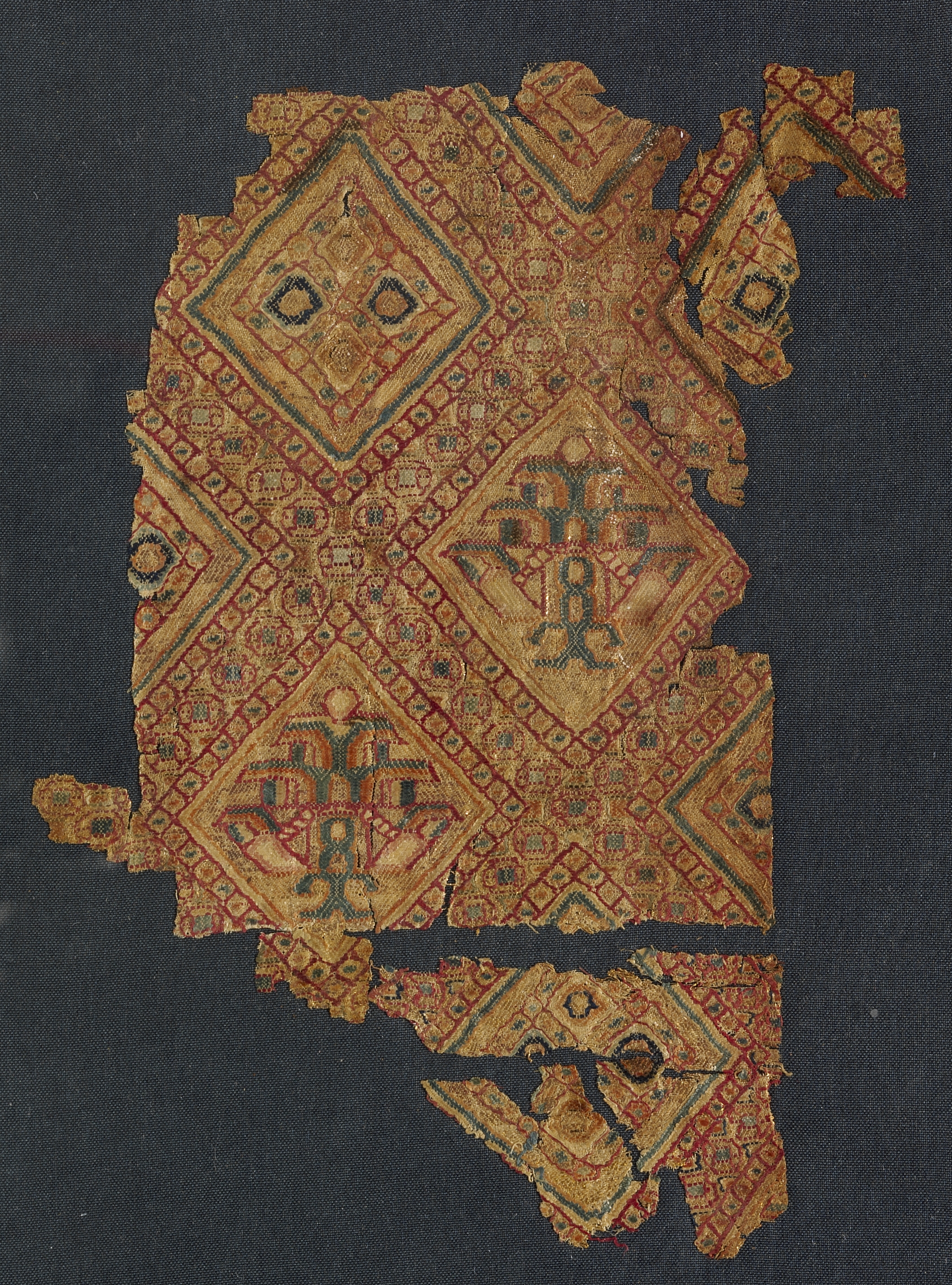
At Zoey Fashion Lab, our mandate extends beyond the mere observation of textiles; we engage in a forensic and poetic dialogue with the materials that shape our design language. The subject of this analysis—a fragment of jewel-like silk, originating from Iraq, likely Baghdad, and technically classified as a plain weave with brocaded patterning—presents a profound case study. Referenced internally as the "New DNA Strand," this piece is not an artifact of the past but a living blueprint for avant-garde creation. Our deconstruction reveals that the fragment’s true value lies not in its age, but in its structural and chromatic logic, which offers a radical departure from conventional Western draping and surface ornamentation.
I. Technical Provenance: The Weave as a Skeleton
The foundational structure of the fragment is a plain weave, the most elementary interlacing of warp and weft. Yet, within this apparent simplicity lies a sophisticated tension. The silk yarns—likely raw and unevenly spun in their original state—create a subtle, organic slub that catches light differently than a perfectly calibrated modern filament. For the avant-garde designer, this irregularity is not a flaw but a generative parameter. It suggests a move away from sterile, machine-perfect surfaces toward a tactile, almost biological irregularity. The plain weave acts as a quiet, neutral ground, akin to a blank musical staff, upon which the brocaded elements perform.
The brocaded technique is where the fragment’s identity as a "New DNA Strand" crystallizes. Brocading involves the insertion of discontinuous supplementary wefts, which are woven only where the pattern requires them. This creates a raised, sculptural relief that contrasts sharply with the flat ground. In this specific fragment, the brocaded threads are not merely colored; they are described as jewel-like, implying the use of tightly twisted, high-luster silks, possibly gilded or wrapped with metal foil to simulate gemstones. This is a crucial point for our lab: the pattern is not printed or dyed onto the surface; it is architecturally embedded within the cloth. The design is a structural event, not a superficial decoration.
II. Chromatic and Textural Alchemy
The "jewel-like" descriptor demands deeper scrutiny. In the original Iraqi context, this would have signified the use of costly dyestuffs—madder for ruby reds, indigo for sapphire blues, and weld or saffron for topaz yellows. The effect is a mosaic of intense, saturated hues that do not blend but coexist in sharp, optical vibration. For Zoey Fashion Lab, this chromatic strategy is a direct challenge to the monochromatic or tonal palettes often favored in minimalist avant-garde work. Instead, we propose a neo-Byzantine color theory, where clashing jewel tones—emerald against amethyst, citrine against garnet—are deployed not to harmonize but to create a dynamic, electric field on the body.
Texturally, the contrast is paramount. The plain weave ground is relatively smooth, perhaps with a matte or semi-matte finish, while the brocaded motifs are raised, dense, and reflective. This creates a tactile hierarchy that invites touch and visual exploration. In our reinterpretation, we can amplify this by pairing the fragment’s logic with contemporary materials: a base of matte, bio-based silk organza, overlaid with brocaded elements using recycled metallic yarns or even 3D-printed polymer nodes that mimic the raised, gem-like effect. The goal is to preserve the ancient dialogue between ground and figure while translating it into a futuristic, sustainable idiom.
III. The Avant-Garde Blueprint: Pattern as Code
To call this fragment a "New DNA Strand" is to recognize that its geometric or floral motifs function as a genetic code for garment construction. Traditional analysis might isolate the pattern as a decorative medallion or border. Our lab’s approach, however, reads the brocaded areas as structural seams and stress points. Imagine a garment where the dense, jewel-like brocade is not placed arbitrarily but engineered to provide rigidity and form—acting as an internal corset or exoskeleton—while the plain weave sections are left deliberately fluid, allowing for movement and drape. The pattern becomes a map for darting, pleating, and paneling, eliminating the need for external cutting lines.
This shift from decoration to construction is the essence of the avant-garde. The fragment suggests a garment that is self-supporting, where the heaviest, most ornate areas correspond to the body’s structural architecture (shoulders, hips, spine), while lighter zones allow for breathability and kinetic freedom. The designer becomes a genetic engineer, splicing the historical code of Baghdadi luxury with the computational logic of parametric design. The result is not a costume or a historical reproduction, but a new species of garment—one that grows from the inside out, its beauty derived from its internal logic.
IV. From Fragment to Future: Design Propositions
Translating this analysis into concrete propositions for Zoey Fashion Lab, we propose three distinct pathways. First, “The Reliquary Silhouette”: a cocoon-shaped coat where the plain weave base is cut in a single, seamless piece, and the brocaded elements are applied as separate, laser-cut patches that are then fused or stitched to mimic the original discontinuous wefts. These patches would be positioned over the shoulder blades and sternum, creating a protective, jeweled armor that contrasts with the soft, flowing lower hem.
Second, “The Chromatic Disruption”: a bias-cut slip dress that utilizes the fragment’s color palette but inverts the texture logic. Here, the plain weave is dyed in a vibrant, almost fluorescent jewel tone, while the brocaded pattern is executed in a monochromatic, matte black or white using a technical knit. This inversion forces the viewer to reconsider which element is "ground" and which is "figure," creating a cognitive dissonance that is quintessentially avant-garde.
Third, and most radically, “The Generative Gown”: a digital project where the fragment’s pattern is scanned and converted into a generative algorithm. This algorithm then dictates the placement of every seam, dart, and pleat on a 3D-rendered avatar, producing a garment that is unique to each wearer’s body measurements. The brocade becomes a variable, not a constant, expanding and contracting based on movement data. This is the true realization of the "New DNA Strand"—a garment that is not designed but grown from a seed of ancient data.
V. Conclusion: The Timelessness of Structural Logic
The fragment from Baghdad is far more than a beautiful relic. It is a masterclass in material intelligence, demonstrating that true luxury resides in the sophisticated manipulation of structure, texture, and color. For Zoey Fashion Lab, it serves as a vital counterpoint to the ephemeral trends of the fashion industry. By deconstructing its weave, we reconstruct our own methodology. We learn that the most radical future is often encoded in the most ancient of hands. The "New DNA Strand" is not a metaphor for nostalgia; it is a call to action. It urges us to look beyond the surface, to find the architectural code within the cloth, and to weave it anew into forms that have never been seen, yet feel intrinsically, profoundly right. This fragment is not an end—it is a starting point for a new lineage of design.