Deconstructing the Mist: An Avant-Garde Reading of Joseon Ink Painting
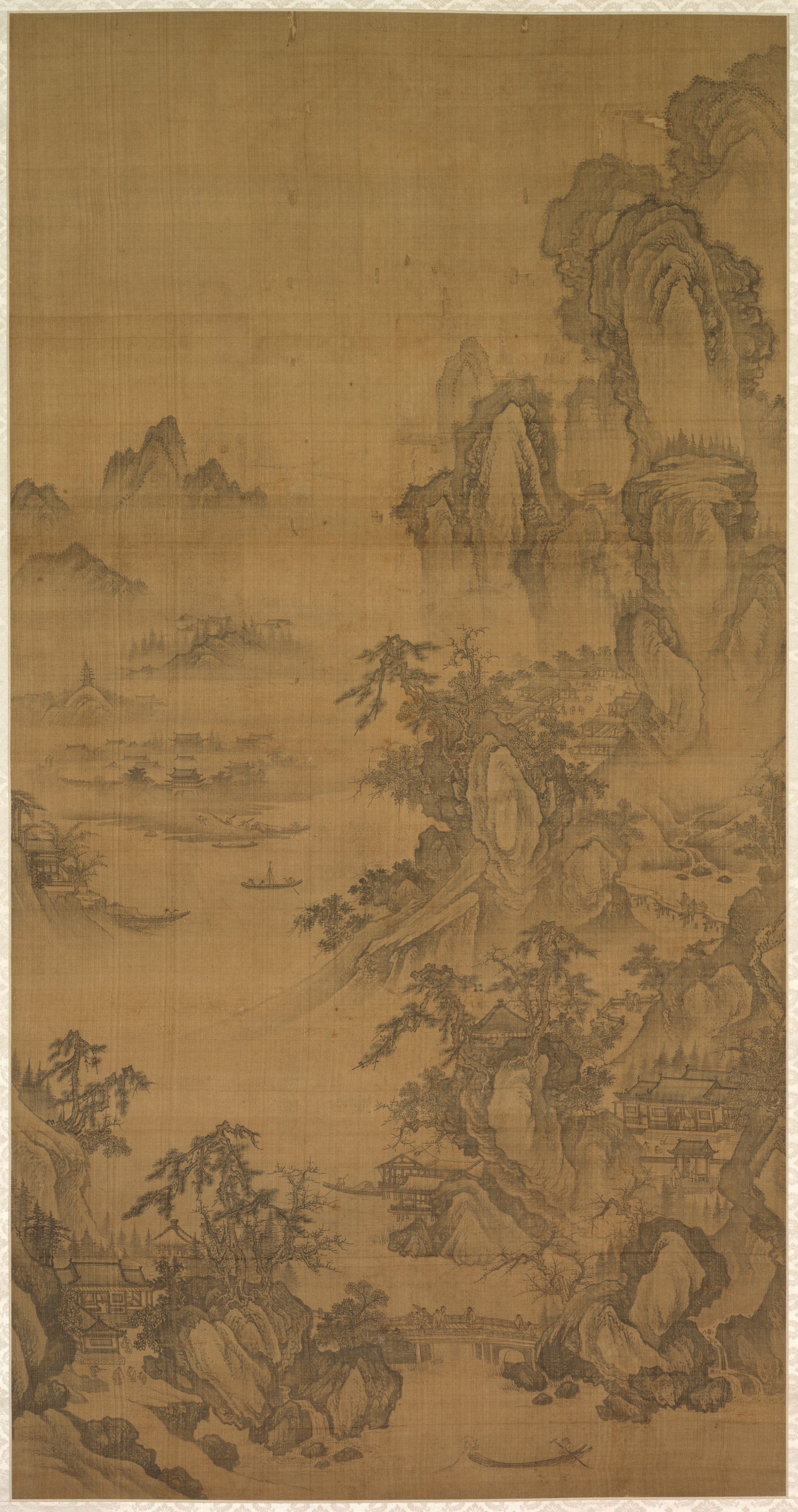
At Zoey Fashion Lab, our mandate extends beyond the mere cataloging of textile and garment history. We operate at the intersection of material culture and speculative design, extracting the latent, often radical, DNA embedded within historical artifacts. Today’s subject—a Joseon dynasty (1392–1910) hanging scroll titled Mountain Market, Clear with Rising Mist, rendered in ink on silk—presents a deceptively serene facade. On first glance, it is a quintessential example of literati painting: a misty valley, a winding path, the bustling yet tranquil suggestion of a mountain market. But for the Chief Fabric Deconstructionist, this work is not a static image. It is a pre-coded blueprint for an avant-garde fashion system, a repository of structural, tonal, and philosophical principles that, when isolated and recombined, challenge contemporary notions of drape, surface, and temporality.
The Silk Substrate: A Canvas of Tension and Yield
Our analysis must begin with the physical foundation: the silk. In the Joseon context, silk was not merely a support; it was an active participant in the image’s creation. The artist’s brush did not fight the material but engaged in a dialectic with it. The warp and weft of the silk create a micro-topography that the ink either seeps into or skates across, producing a variable density of mark. For the avant-garde designer, this silk is a metaphor for a non-uniform, responsive textile. We are not looking at a flat, passive canvas. We are looking at a woven terrain.
Deconstructing this, we propose a fabric innovation: a double-faced silk gauze with a differential weave density. One face would be tightly woven to accept sharp, calligraphic strokes, while the reverse would be looser, allowing for pigment bleeding and diffusion. This creates a garment with two distinct personalities—a sharp, graphic exterior that, when inverted or turned, reveals a soft, atmospheric interior. The garment becomes a mutable object, its meaning shifting with its orientation, much like the scroll’s meaning shifts between the market’s bustle and the mist’s obscurity. The seams would not be hidden but exaggerated, acting as the "warp" that binds these two opposing textile natures, creating a structural tension that is both visual and tactile.
Tonal Architecture: The Negative Space of the Garment
The most radical element in Mountain Market is not the ink itself, but the absence of ink—the reserved silk that becomes mist, air, and distance. This is the principle of yeobaek (留白), or "empty space," a cornerstone of East Asian aesthetics. In Western fashion, volume is often additive—padding, layering, and structure. The Joseon scroll proposes a subtractive model. The mist is not painted; it is revealed by the ink’s retreat. For the avant-garde silhouette, this translates to a deconstruction of the garment’s periphery.
Imagine a coat where the shoulders are not defined by padding but by the deliberate absence of fabric—a laser-cut or hand-frayed edge that dissolves into a fine, irregular fringe. This fringe is not decorative; it is the garment’s "mist," a zone of transition between the solid form and the ambient space. The internal structure of the garment—the seams, the darts—would be treated as the "ink," providing the sharp, defined moments of the market stalls and figures. The negative space between these structural lines would be allowed to billow, creating pockets of air that mimic the mist’s volume. The overall silhouette is not a fixed shape but a spectrum of opacity, from the dense, structured core to the ethereal, frayed edge.
Narrative Motion: From Scroll to Kinetic Drape
A hanging scroll is a vertical narrative. The eye travels from the bottom—the foreground of the market—upward through the mist to the distant peaks. This is a temporal journey, a slow unfolding. Traditional fashion is often designed for a static, frontal view. Our deconstruction demands a kinetic, multi-planar garment that reveals itself over time and through movement. The Mountain Market is not a single scene; it is a sequence of events compressed into one plane.
We translate this into a garment with a hierarchical layering system. The base layer, closest to the body, is a dense, dark, almost black silk—the "foreground ink" of the market’s commerce. Over this, a sheer, translucent organza layer is suspended, not sewn at the shoulders, but anchored at a single point, like a scroll’s mounting rod. This layer represents the "mist." It is not static; it shifts with the wearer’s gesture, now obscuring the base layer, now revealing it. The outermost layer, perhaps a structured jacket, is the "mountain"—a solid, immobile form that provides contrast. The garment’s narrative is not read in a single glance but experienced as the wearer moves, offering glimpses of the dense "market" beneath the shifting "mist" of the sheer layer, all framed by the solid "mountain" of the outer shell. The fastenings are the artist’s seal—small, precise, vermillion accents that punctuate the monochrome composition, drawing the eye to specific points of structural import.
Monochrome Disruption: The Ink’s Variable Viscosity
Joseon ink painting is famously monochromatic, but this is a profound misunderstanding. The ink is not one color; it is a spectrum of value, from the deepest, almost greasy black to the palest, watery gray. The brush carries multiple dilutions simultaneously, creating a single stroke that transitions from solid to wash. This is the principle of nongdam (濃淡), or thick and thin. In fashion, we often think of color blocking as separate fields. The scroll proposes gradient as structure.
Our fabric development team is exploring a jacquard-woven textile with a variable yarn count. The yarns are not dyed after weaving but are pre-dyed in a gradient bath, creating a single continuous textile that moves from a deep, opaque charcoal to a translucent, pale gray. When cut and draped, the garment does not rely on separate panels of color. Instead, the color transition itself defines the silhouette. A sleeve might be dark at the shoulder, dissolving to a pale, almost invisible gray at the cuff. The "line" of the garment is not a seam but a tonal shift. This challenges the very notion of pattern-making. We are not cutting pieces to assemble a shape; we are cutting a continuous gradient to reveal a shape through the manipulation of value. The avant-garde result is a garment that appears to be in a state of constant atmospheric change, a wearable weather system.
Conclusion: The Scroll as a Living System
The Mountain Market, Clear with Rising Mist is not a relic. It is a generative algorithm for design. Its genius lies not in its depiction of a scene, but in its articulation of a process—the interaction of material, time, and emptiness. For Zoey Fashion Lab, the deconstruction yields not a costume, but a philosophy of making. We reject the static, the opaque, and the fixed. We embrace the translucent, the kinetic, and the ephemeral.
The avant-garde collection born from this analysis will not feature images of mountains or markets. Instead, it will embody their structural logic. It will feature garments that breathe with negative space, textiles that shift in value across their surface, and silhouettes that are defined by what they omit as much as what they contain. The wearer becomes the brushstroke; the body, the silk; and the movement through space, the rising mist. This is the new DNA strand we are weaving—one that connects the quiet, profound wisdom of a Joseon scroll to the bold, deconstructed future of fashion. The market is not a place; it is a state of being. And we intend to wear it.