Deconstructing the Avian Archive: The Feathered Panel as Proto-Avant-Garde Textile
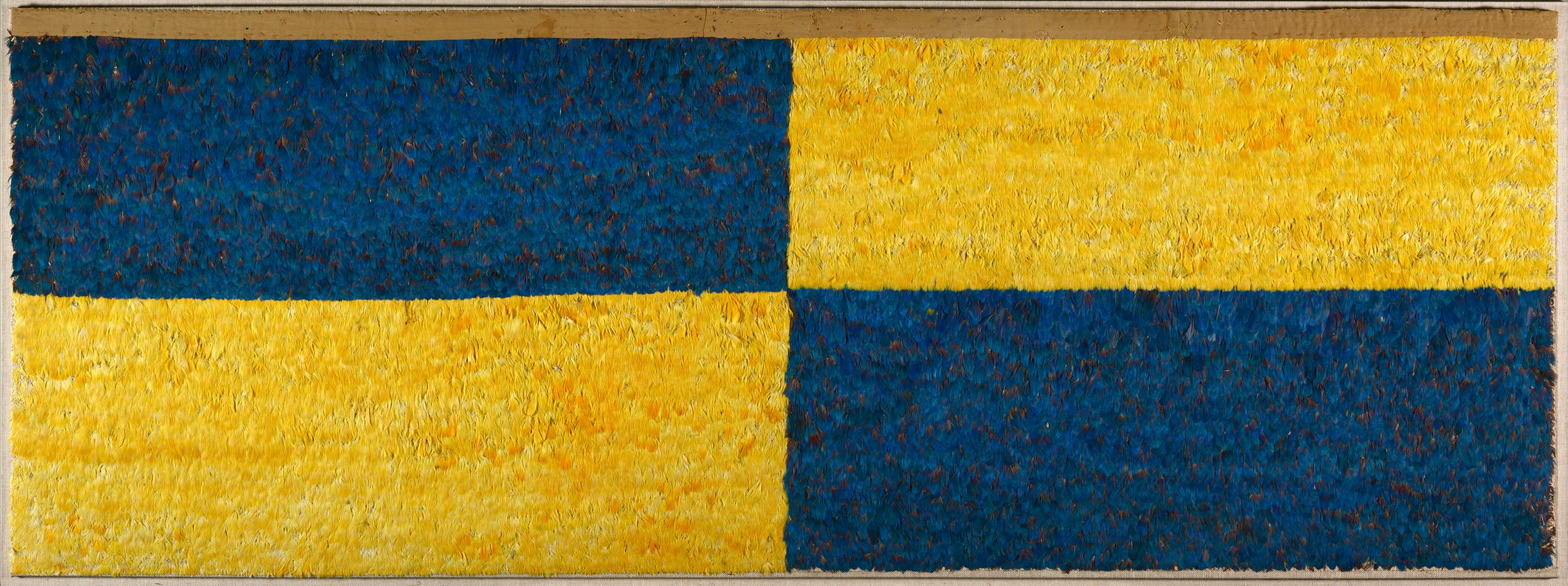
In the hallowed halls of textile history, the Feathered Panel from Peru’s Far South Coast (Pampa Ocoña, 7th–10th century) is often relegated to the category of “pre-Columbian artifact”—a relic of a bygone civilization. Yet, for Zoey Fashion Lab, this object is not a relic. It is a manifesto. Executed with the iridescent plumage of the Papagayo macaw, knotted onto strings and stitched to a cotton plain-weave ground, with a camelid fiber upper tape, this panel dismantles our contemporary understanding of materiality, surface, and time. To view it through the lens of the avant-garde is to recognize that the Wari and Nasca artisans of the Andes were not merely craftspeople; they were radical deconstructionists who understood that the body is a canvas and the environment is a wardrobe. This analysis will dissect the panel’s technical grammar, its chromatic subversion, and its philosophical resonance with the modern fashion laboratory’s ethos of rupture and re-assembly.
I. Technical Grammar: The Logic of Dislocation
The technical construction of the Feathered Panel is a masterclass in what we might term “structural displacement.” Unlike conventional weaving, where thread becomes cloth through interlacing, this panel employs a hybrid additive process. The artisan first produced a plain-weave cotton cloth—a neutral, passive substrate. Then, in a separate operation, individual Papagayo macaw feathers were meticulously knotted onto fine strings. This pre-assembled “feather cord” was then stitched onto the cotton ground in horizontal registers. The camelid fiber tape at the upper edge serves not merely as a hem but as a transitional membrane, bridging the soft, organic cotton with the rigid, linear feather fringe.
From a deconstructionist perspective, this process is profoundly avant-garde. The feather is not woven into the cloth; it is applied onto it. This is an act of surface violence—a deliberate puncture of the plane to introduce a foreign element. The cotton is the canvas, but the feather is the event. The knotted string acts as a structural exoskeleton, a visible ribcage that exposes the mechanics of attachment rather than hiding them. In a 21st-century fashion lab, we would call this “exposed construction” or “technical visibility.” The Wari artisan refused the illusion of seamless integration. Instead, they celebrated the joint, the knot, the point of tension. This is the same logic that drives contemporary designers who leave seams raw, who expose boning, or who print the stitching diagram onto the final garment. The Feathered Panel is a 1,300-year-old precursor to the deconstructed jacket.
Material Dialectics: Cotton, Camelid, and Avian
The material triad of this panel—cotton, camelid fiber, and macaw feather—creates a dialectical tension that is essential to its avant-garde character. Cotton plain-weave is democratic, breathable, and grounded. Camelid fiber (likely alpaca or vicuña) is warm, dense, and terrestrial. The Papagayo macaw feather, however, is celestial. It is weightless, iridescent, and unapologetically chromatic. By forcing these three disparate materialities into a single plane, the artisan produced a textural polyphony that defies hierarchy. The feather does not embellish the cotton; it interrogates it. The cotton’s matte, off-white surface is thrown into relief by the feather’s explosive blue, yellow, and red. The camelid tape, with its fuzzy halo, softens the transition while simultaneously acting as a rigid architectural border.
This is not mere decoration. It is a philosophical statement about the non-hierarchy of materials. In the contemporary avant-garde, we see this echoed in the work of designers who pair recycled nylon with hand-painted silk, or who fuse 3D-printed polymers with organic wool. The Feathered Panel proves that the impulse to hybridize—to refuse the purity of a single fiber—is an ancient, Andean instinct. The panel is a proto-cyborg textile, part animal, part plant, part human intention.
II. Chromatic Subversion: The Politics of Iridescence
The color palette of the Papagayo macaw is not subtle. It is a scream of tropical intensity—cobalt, vermilion, and solar gold. In the arid, monochromatic landscape of the Pampa Ocoña, these feathers would have been a shocking intrusion. This chromatic aggression is a key avant-garde tactic. The panel does not seek to blend with its environment; it seeks to rupture the visual field. The macaw feathers are not dyed or altered; they are used in their raw, hyper-saturated state. This is an act of chromatic authenticity—a refusal to mediate nature through human pigment.
Consider the context of the 7th–10th century Andes. The Wari and Nasca cultures were sophisticated in their use of natural dyes on cotton and camelid fiber. Yet here, the artisan chose to bypass dye entirely. By importing feathers from the tropical lowlands (the Papagayo macaw is not native to the high desert coast), they were engaging in a form of material colonialism—but in reverse. They were bringing the jungle to the desert, forcing a biogeographic collision. In fashion terms, this is akin to a designer using neon PVC in a collection of hand-loomed linen. The clash is intentional. The result is a garment that is both alien and rooted, both exotic and structurally rigorous.
The Fringe as Deconstructive Gesture
The most radical element of the Feathered Panel is its fringed edge. The feathers are knotted onto strings that hang free, creating a dynamic, kinetic border. This is not a static hem. It is a zone of instability. As the wearer moves, the feathers undulate, catching light and shifting color. This introduces an element of temporal performance into the textile. The panel is not a fixed object; it is a living surface that changes with every gesture.
In the avant-garde fashion context, this prefigures the work of designers like Hussein Chalayan, whose garments transform mechanically, or Issey Miyake, whose pleats activate with the body’s motion. The Feathered Panel understands that clothing is not a static sculpture but a kinetic interface between the body and the world. The fringe is the point of negotiation. It is the frayed edge where the garment dissolves back into raw material. This is deconstruction at its most literal: the garment is always in the process of becoming un-garmented, of returning to feather, to string, to chaos.
III. Philosophical Resonance: The Archive as Future
The reference to “Archive Resonance” in the prompt—citing 16th to 17th-century cultural collisions—is instructive. The Feathered Panel is an archive of a collision between the highland Andean world and the tropical Amazonian lowlands. It is a physical record of trade routes, ecological knowledge, and aesthetic exchange. But for Zoey Fashion Lab, the archive is not a repository of the past; it is a generative matrix for the future. We do not copy the panel; we extract its principles.
What are those principles? First, material disobedience: the refusal to accept the given boundaries of fiber and texture. Second, structural transparency: the willingness to expose the mechanics of making. Third, chromatic audacity: the use of color as a weapon against visual complacency. Fourth, kinetic dynamism: the design of garments that live only in motion. These principles are not historical curiosities. They are the foundational grammar of a new avant-garde that looks to the ancient world not for nostalgia, but for radical alternatives to Western industrial fashion.
From Panel to Prototype
In our lab, we have translated the Feathered Panel into a series of proto-types. We use recycled iridescent mylar strips knotted onto bio-based nylon cords, stitched onto organic cotton grounds. The camelid fiber tape is replaced with a 3D-printed bioplastic border that mimics the fuzzy halo of the original. The result is a garment that carries the genetic code of the Pampa Ocoña panel but speaks the language of the Anthropocene. We are not recreating a Wari shawl; we are re-activating its logic in a new material context.
The Feathered Panel teaches us that the avant-garde is not a European invention. It is a transhistorical impulse that appears wherever artisans refuse to accept the tyranny of the conventional. The Wari artisan who knotted a macaw feather to a cotton string was performing an act of radical deconstruction—taking apart the given world and reassembling it according to a new, more vibrant logic. Zoey Fashion Lab is proud to continue this tradition. We look to the past not to replicate, but to resonate—to find the frequencies of innovation that still vibrate in ancient threads, and to amplify them into the future of fashion.
In conclusion, the Feathered Panel of Pampa Ocoña is not an artifact. It is a blueprint for rupture. Its technical hybridity, chromatic violence, and kinetic fringe are not merely historical features; they are provocations. They ask us to reconsider what a garment can be, what materials can do, and how the body can become a site of cultural and ecological collision. For Zoey Fashion Lab, this panel is a touchstone—a reminder that the most radical future is often woven from the threads of a deeply radical past.