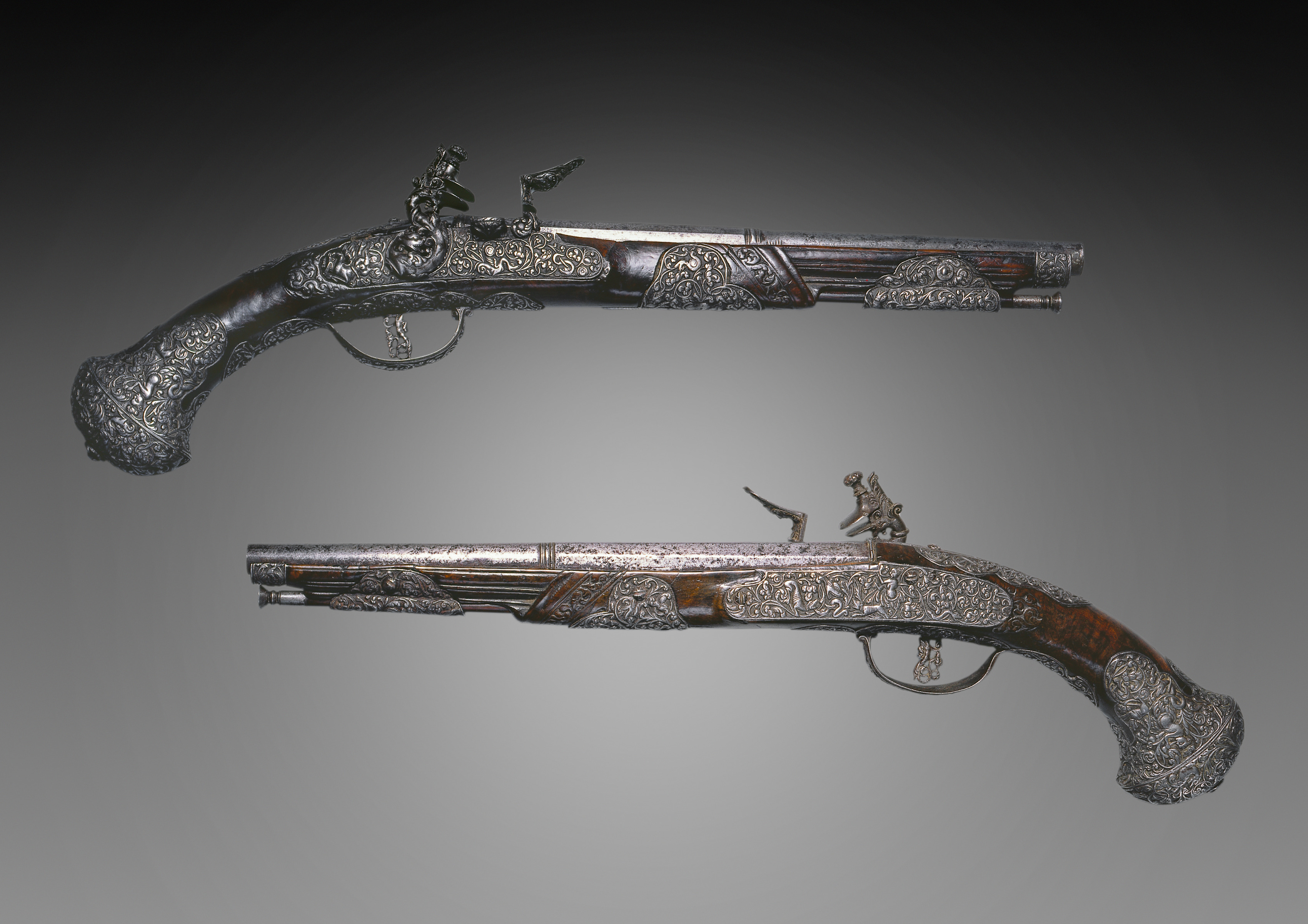
Deconstructing the Baroque Trigger: An Avant-Garde Analysis of Brescian Flintlocks
At Zoey Fashion Lab, we do not merely observe historical artifacts; we interrogate them. We strip away their functional context to reveal the raw, structural DNA that can be re-sequenced into contemporary form. The subject of this analysis—a pair of 17th-century Brescian flintlock pistols—presents a paradox of immense creative potential. On the surface, these are instruments of lethal force, objects of aristocratic vanity, and pinnacles of the Italian Baroque metalworker’s art. Yet, beneath the cold steel and warm walnut, we detect a New DNA Strand—a genetic code composed of tension, ornamentation, and mechanical precision that resonates profoundly with the Avant-garde ethos of our design house. Our task is to de-fabricate these pistols, not into their constituent metals, but into a lexicon of silhouette, texture, and conceptual weight.
I. The Architecture of Aggression: Silhouette and Line
The first element we extract is the profile. The flintlock’s form is a study in angular dynamism. It is not a smooth, organic curve like a classical Greek amphora; rather, it is a sequence of abrupt, decisive breaks. The butt, flaring outward with a pronounced, almost defiant, drop, creates a negative space that cradles the palm—a gesture of power we can translate into exaggerated shoulder pads or sculptural hip projections. The lock plate, flat and rectangular, sits as a stark, mechanical counterpoint to the swelling stock. This juxtaposition of the hard line (the steel mechanism) against the soft mass (the walnut) is the pistol’s primary design thesis.
For our Avant-garde application, we isolate the trigger guard. This delicate, sweeping loop of steel is not merely protective; it is a line of tension that invites the finger. In our fabric analysis, we see this as a potential structural seam—a curved, exposed boning element on a corset or a dramatic, metallic-threaded piping that traces the silhouette of a tailored jacket. The hammer, cocked back in a state of perpetual readiness, offers a jagged, aggressive apex. We interpret this as a sharp, asymmetric shoulder peak or a collar that snaps upward in a defiant, reptilian gesture. The overall silhouette is one of compressed energy—a form that appears coiled, ready to spring, which we emulate through strategic gathering, pleating, and the use of rigid, high-tensile fabrics that hold a shape against the body’s natural gravity.
II. The Baroque Skin: Chiseled Texture as Fabric
Moving beyond form, we deconstruct the surface. The chiseled decoration on the steel is not a mere engraving; it is a topographical map of light and shadow. The Brescian masters employed champlevé and repoussé techniques to create intricate foliate scrolls, grotesque masks, and mythological scenes that writhe across the metal’s surface. This is not a flat print; it is a three-dimensional embroidery in steel. The depth of the cuts creates a tactile experience, one that changes with the angle of light and the viewer’s proximity.
In our re-imagining, this translates directly into a new concept of textile relief. We reject flat, digitally printed imitations. Instead, we propose a fabric development strategy that mimics the chisel’s action. This involves heavy, sculptural jacquards with a pronounced, almost brutalist texture; laser-cut leathers layered over contrasting bases to create a literal depth of field; and the strategic placement of matte and high-gloss surfaces to simulate the interplay of polished steel and darkened crevices. The intricate scrollwork becomes a motif for baroque-inspired embroidery, but executed with a modern, industrial precision—using metallic threads, blackened sequins, and even thin, flexible wires to recreate the sensation of a carved, metallic surface. The walnut stock, with its rich, swirling grain, is deconstructed not as wood, but as a warm, organic substrate. We translate this into textured, cognac-toned leathers, or heavy, felted wools with a natural, irregular surface that provides a grounding, sensual contrast to the cold, ornate steel.
III. The Mechanics of Desire: Hardware and Articulation
The most intellectually stimulating aspect of this analysis is the mechanical articulation. A flintlock is a machine of cause and effect: the pull of the trigger releases the hammer, which strikes the frizzen, creating a spark that ignites the powder. Every component is visible, functional, and interdependent. This is a philosophy of design that the Avant-garde perpetually seeks—a move away from hidden structure towards exposed, celebrated mechanics.
We see the pistol’s visible screws, pins, and springs as a blueprint for a new type of fastening system. We propose designs where the construction is the decoration. Zippers are not concealed but become the central spine of a garment, their metallic teeth echoing the serrated jaw of the hammer. Grommets and rivets are not functional afterthoughts but are placed with the deliberate rhythm of the chiseled steel patterns. We imagine a coat where the lock mechanism itself is abstracted into a series of articulated, gunmetal-toned panels that pivot at the shoulder or hip, allowing for movement while maintaining a rigid, architectural form. The concept of the frizzen—the striking plate—becomes a mirrored, polished element on a cuff or a collar, a piece of functional armor that catches the light and serves as a focal point of raw, metallic beauty.
IV. The Avant-Garde Integration: The New DNA Strand
To synthesize these elements, we must move beyond literal reproduction. The goal is not to create a gun-shaped dress, which would be a costume. The goal is to extract the genetic code—the principles of tension, ornament, and mechanical honesty—and re-sequence them into a new, wearable organism. The New DNA Strand is therefore composed of three core sequences:
1. The Sequence of Tension (Silhouette): Garments must possess a clear point of structural conflict. A sharp, asymmetrical shoulder juxtaposed against a fluid, draping body. A rigid, corseted waist that explodes into a volume of fabric, mimicking the flare of the butt. The line of the body must never be passive; it must always suggest a latent, kinetic energy.
2. The Sequence of Ornamental Depth (Texture): We reject surface-level decoration. All texture must have depth. This is achieved through layering, sculptural manipulation, and the unexpected marriage of materials. A simple black sheath dress is transformed when overlaid with a chiseled, leather cuirass that echoes the pistol’s steel work. The texture is not applied; it is integral to the garment’s structure.
3. The Sequence of Exposed Function (Hardware): The garment’s construction must be its story. Seams are top-stitched with industrial precision. Closures are oversized and architectural. The hardware is not an accessory; it is the skeleton upon which the fabric is draped. This approach celebrates the process of making, aligning with the Breascia gunsmiths’ pride in their visible craftsmanship.
In conclusion, these Brescian flintlocks are far more than historical weapons. For Zoey Fashion Lab, they are a masterclass in the Avant-garde principle of conflict as beauty. They teach us that true innovation lies not in the absence of aggression, but in its sophisticated, aestheticized control. By deconstructing their steel and walnut, we have found a blueprint for clothing that is powerful, sculptural, and intellectually rigorous—a new form that is both of its time and timelessly ahead of it. The trigger has been pulled on a new collection.