Executive Summary: The Regal Ram as a Deconstructed Archive
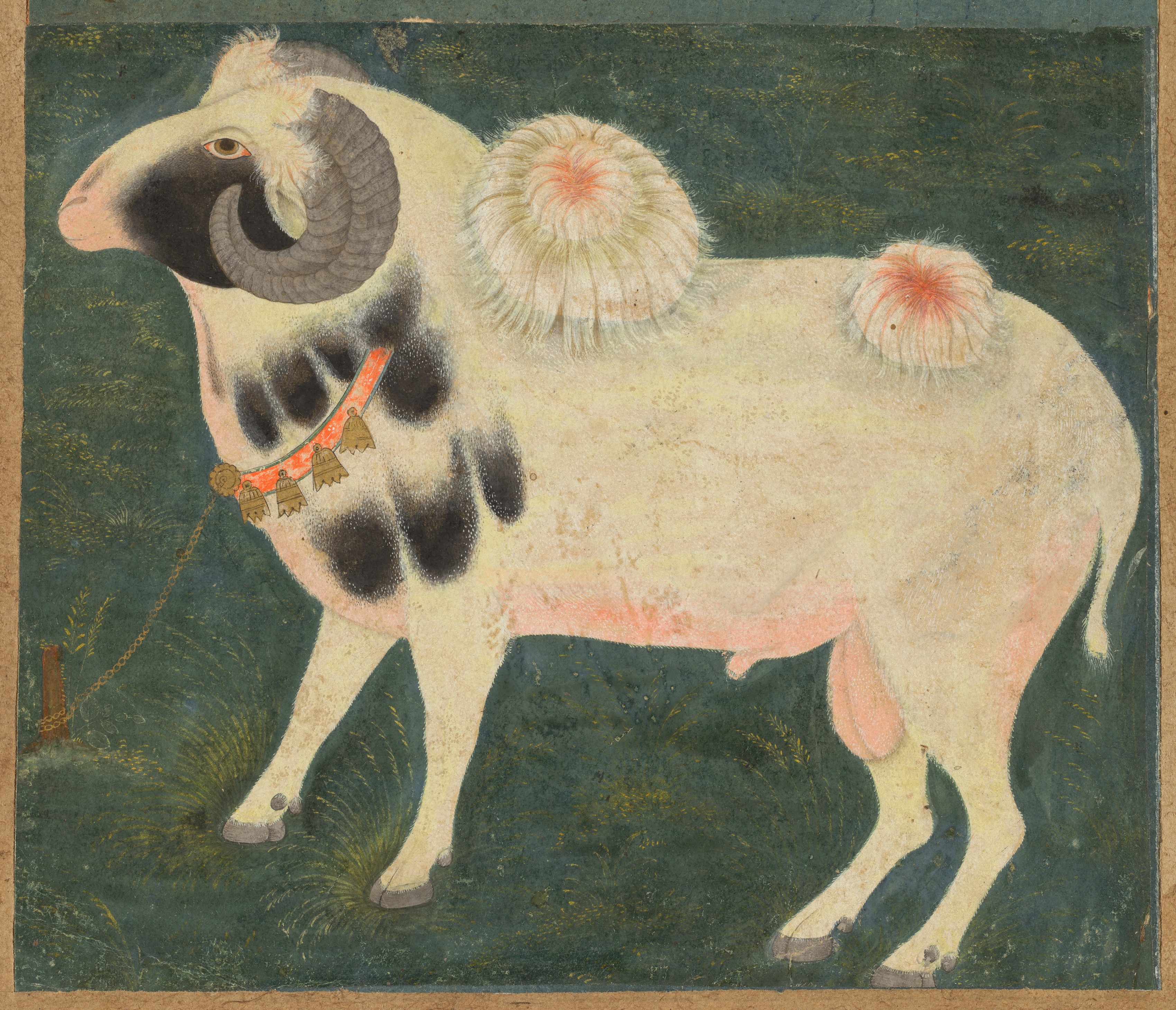
In the rarefied intersection of Mughal miniature painting and contemporary avant-garde garment theory, Zoey Fashion Lab presents a singular artifact: a royal ram bearing a gold chain, executed in gum tempera and gold on paper. This object, hailing from the opulent courts of India, is not merely a historical curiosity. Within our laboratory’s framework, it functions as a prototype for a wearable narrative—a study in tension between imperial adornment and animalistic vitality. The reference to the Mirror with Split-Leaf—where a polished silver surface meets a cold sarcophagus relief—provides a critical dialectic. Our analysis deconstructs the ram’s imagery to propose a new lexicon of avant-garde fashion: one that layers gilded constraint over organic form, and ornamental surface over existential depth.
I. Material Semiotics: Gum Tempera, Gold Leaf, and the Politics of Skin
The technical medium—gum tempera and gold on paper—is the first site of deconstruction. In Mughal ateliers, gum tempera offered a matte, porous ground, absorbing pigment like skin absorbs light. The gold, applied in delicate leaf, created a specular rupture—a point where the eye cannot rest, where the viewer is blinded by wealth. For Zoey Fashion Lab, this duality maps directly onto fabric innovation. Consider a double-faced jacquard: one side a dull, breathable cotton (the gum tempera’s humility), the other a metallic-coated polymer (the gold’s arrogance). The ram’s fleece, depicted with thousands of tiny brushstrokes, becomes a metaphor for micro-embroidery—each stitch a deliberate act of obsession, yet collectively forming a chaotic, organic mass.
The “gold chain” is not merely an accessory; it is a structural seam. In our avant-garde reading, the chain is a visible zipper, a series of interlocking metal grommets, or a laser-cut leather cord that physically binds the garment’s silhouette. It speaks to the politics of restraint—how luxury often functions as a cage. The ram, a symbol of virility and sacrifice, is here rendered passive by the chain. This is the core tension we extract: fashion as voluntary servitude. The wearer of a Zoey Fashion Lab garment based on this motif does not simply put on clothing; they don a paradox—the power of the wild animal, neutered by the very gold that elevates it.
II. The Archive Resonance: Silver Mirrors and Stone Sarcophagi
Your reference to the Mirror with Split-Leaf is not accidental; it is the key to unlocking the ram’s temporal displacement. The mirror’s polished silver face represents the present’s narcissism—a surface that reflects only the immediate, the beautiful, the fleeting. The sarcophagus, cold and carved, represents the past’s permanence—a narrative etched in stone, demanding to be read but never touched. The royal ram sits precisely between these two poles. Its gold chain is the mirror’s glint; its woolly body is the sarcophagus’s rough-hewn relief.
In avant-garde fashion, this translates to a design philosophy of contrapuntal layering. We propose a garment where the front panel is a high-shine, mirror-like PVC (the silver), and the back panel is a heavy, textured bouclé wool (the stone). The ram’s profile is then printed or embroidered across the seam—not as a unified image, but as a fractured motif, split down the middle. One half is rendered in luminous gold thread, the other in matte black worsted yarn. The garment becomes a wearable memento mori, reminding the wearer that beauty (the mirror) is always adjacent to mortality (the sarcophagus). The ram, as a sacrificial animal, is the perfect mediator.
III. Avant-Garde Silhouette: From Miniature to Monumental
Mughal miniatures are intimate—meant for close inspection, held in the palm. The avant-garde imperative is to scale up without losing intimacy. Zoey Fashion Lab proposes a silhouette that exaggerates the ram’s anatomy into architectural forms. The curled horn becomes a spiral collar, constructed from horsehair and resin, rising behind the neck like a baroque ruff. The fleece is translated into a voluminous, quilted parka, but the quilting pattern follows the precise curl of Mughal brushwork—each diamond-shaped cell a nod to the original’s dense texture.
The gold chain, in this scale, becomes a belt of interlocking brass links, each link engraved with a miniature leaf pattern from the split-leaf motif. This belt cinches the garment at an unnatural, high waist—reminiscent of both Mughal courtly dress and contemporary corsetry. The effect is simultaneously regal and absurd, a commentary on the ridiculousness of power. The ram’s legs, depicted in the original as delicate and poised, are reimagined as tapered, peg-like trousers in stiffened silk, forcing the wearer into a mincing, ceremonial gait. This is not practical clothing; it is ritual armor for the modern ego.
IV. Color Theory and Surface Degradation
The original palette—deep indigo, madder red, orpiment yellow, and shell gold—is preserved but deliberately degraded. In our avant-garde translation, fabrics are over-dyed, then partially bleached, to mimic the craquelure of aged gum tempera. A garment might feature a vibrant saffron underlayer, visible through a torn, translucent top layer of gunmetal grey organza. This speaks to the archive’s fragility. The mirror tarnishes; the sarcophagus erodes. So too must the fashion object show its own decay. We introduce bio-based sequins that yellow and warp over time, and iron-infused threads that rust upon contact with sweat. The garment is designed to be a living archive, changing with each wear, just as the original painting has changed with each century.
The gold chain itself is not left pristine. In our prototype, it is oxidized and partially blackened, with only the high points polished to a shine. This technique, borrowed from jewelry making, creates a chiaroscuro effect—the chain appears lit from within, or emerging from shadow. This aligns with the mirror-sarcophagus dialectic: the gold is the mirror’s promise, but the oxidation is the tomb’s reality.
V. Conclusion: The Ram as a Wearable Hypothesis
Zoey Fashion Lab’s analysis of the royal ram is not a replication of Mughal art. It is a philosophical extraction. We take the gold chain—that symbol of captivity—and ask: what does it mean to be bound by beauty? We take the gum tempera’s matte finish and ask: what is the texture of humility in an age of digital gloss? The Mirror with Split-Leaf provides the final answer: identity is a split surface. One side reflects what we want to see; the other side tells the story of what we are. The ram, with its dual nature—beast and royal, sacrifice and sovereign—is the ideal avatar for this split.
Our proposed collection, titled “Gilded Yoke,” will feature garments that are heavy yet flexible, ornate yet raw. Each piece will carry a hidden label—a small, embroidered ram’s head—serving as a signature of this deconstruction. We invite the wearer to enter the archive, not as a passive observer, but as an active participant in the resonance between silver and stone. The ram’s gold chain is no longer a mark of subjugation; it is a connective tissue between the historical and the hysterical, the sacred and the profane. In this, we find the true avant-garde: not the rejection of history, but its violent, beautiful re-tailoring.