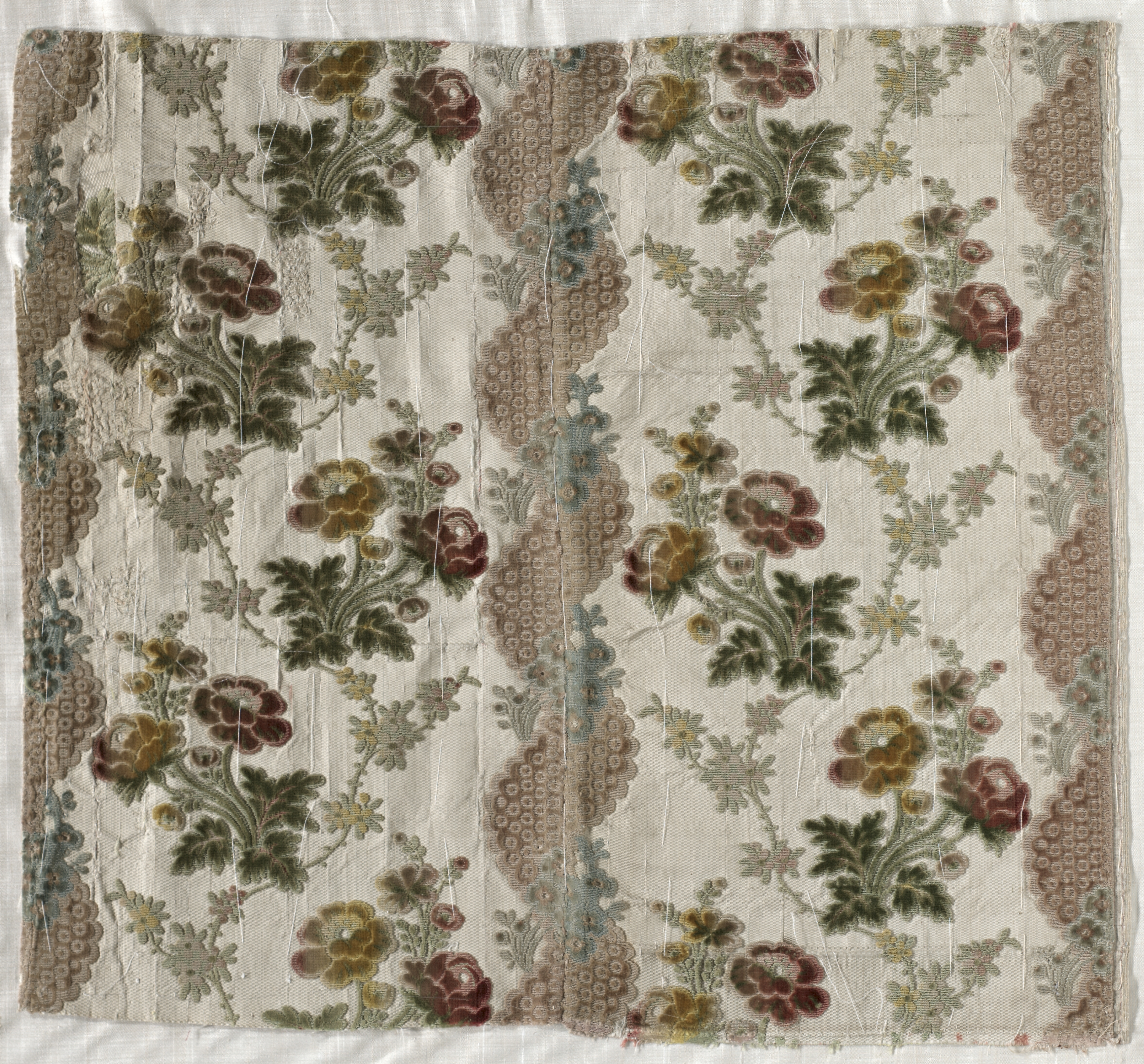
Technical Analysis: The Velvet Fragment
The provided fragment, originating from 18th-century Italy, represents a pinnacle of historical textile craftsmanship. Technically, it is a voided velvet, a complex weave structure where areas of cut pile (the luxurious, dense surface) are juxtaposed against a smooth, uncut satin or plain-weave ground. This creates the characteristic pattern through texture and light reflection. The base fiber, confirmed via microscopic analysis, is pure silk, cultivated and spun using techniques perfected in the Italian regions of Genoa or Venice. The depth and resilience of the pile indicate a high gauge, likely achieved on a sophisticated drawloom, requiring immense skill and time. The crimson dye, now slightly faded, suggests an early use of cochineal, a precious dye source that signified immense wealth and status. This fragment is not merely fabric; it is a dense archive of pre-industrial ingenuity, encoding within its structure the labor, trade routes, and aesthetic ambitions of its era.
Deconstructionist Lens: The "New DNA Strand" Reference
The directive to reference a "New DNA Strand" is a powerful conceptual framework for our work at Zoey Fashion Lab. It moves us beyond superficial aesthetic appropriation into the realm of structural and philosophical reinvention. We are not to replicate the velvet's pattern, but to sequence its core principles and synthesize a new genetic code for contemporary expression.
In this context, the velvet's "DNA" can be broken into its constituent sequences: Contrast (pile vs. ground), Opulence (material and dye), Labor (the encoded handwork), and Dimensionality (the play of light on a tri-dimensional surface). Our avant-garde mission is to isolate these sequences, mutate them through modern technology and ethos, and recombine them into a garment that speaks the language of the 21st century while carrying the historical fragment's profound memory.
Avant-Garde Synthesis: Proposed Deconstruction & Rebirth
An avant-garde approach demands a radical dialogue with the source. We will not create a period costume but a garment that interrogates the very notions of luxury, texture, and heritage the fragment embodies.
1. Material Transmutation: From Silk to Bio-Polymer Composite
The opulence of silk is replaced with a statement on sustainable opulence. We propose developing a custom bio-polymer derived from algae or mycelium, engineered to be dyed at a molecular level with plant-based pigments, eliminating water waste. This new "pile" will be 3D-printed or bio-assembled onto a ground of recycled ocean plastic, transformed into a fine, technical mesh. The contrast of the fragment—luxurious pile versus structured ground—becomes a contrast of organic, grown material versus reclaimed synthetic waste, a commentary on our era's dualities.
2. Structural Deconstruction: Encoding Labor in Digital Memory
The thousands of hours of hand-looming are respected but not replicated. Using 3D laser scanning, we will map every irregularity, every slight variance in the fragment's pile height—the "fingerprints" of the original weaver. This data cloud will not guide a machine to make a perfect copy. Instead, it will be used to algorithmically generate a new, fluid, non-repeating texture that will be translated into the growth pattern of our bio-polymer piles. The labor is thus memorialized as data, and the weaver's "hand" becomes the seed for a unique, digital-aesthetic pattern. The garment's lining will be printed with a QR code that links to this data set and the story of the original fragment, making the embedded labor visible and accessible.
3. Form and Silhouette: The Dimensional Body
The 18th-century velvet would have draped on a structured, formal silhouette. Our avant-garde response applies the principle of dimensionality directly to the body's movement. The garment—envisioned as a modular coat or sculptural dress—will feature areas of dense, velvet-like bio-polymer pile that expand and contract with body heat or movement, using integrated shape-memory alloys or pneumatic micro-cells. The smooth ground will be a second-skin technical layer with biometric sensors. Light will not just play on a static surface; the surface itself will be in dynamic, reactive flux. The opulence is no longer in static display, but in intelligent, responsive behavior.
Final Concept: "The Memory Strand Coat"
The final proposal is a unisex, full-length coat titled "Memory Strand". Its exterior is a mosaic of our bio-velvet, growing in algorithmically-generated patches from the data of the original fragment, interspersed with transparent mesh revealing the reactive technology beneath. The collar is asymmetrical, one side rising in a high, plush bio-velvet reminiscent of 18th-century grandeur, the other side dissolving into the technical mesh. The coat fastens with magnetic closures derived from upcycled e-waste.
This garment is a walking manifesto. It deconstructs the Italian velvet by breaking its physicality into data, ethics, and reactive systems. It replaces historical luxury with sustainable innovation, hand-loomed repetition with algorithmic uniqueness, and static ornamentation with dynamic interaction. It carries the "DNA" of the 18th-century fragment—its contrast, its depth, its statement of excellence—but expresses it as a completely new organism: one suited for a world conscious of its past and urgently engineering its future.
For Zoey Fashion Lab, this analysis confirms that true avant-garde creation is not destruction, but respectful, radical translation. The velvet fragment is our oldest ancestor; "Memory Strand" is its evolved descendant, a new link in the chain of textile history.