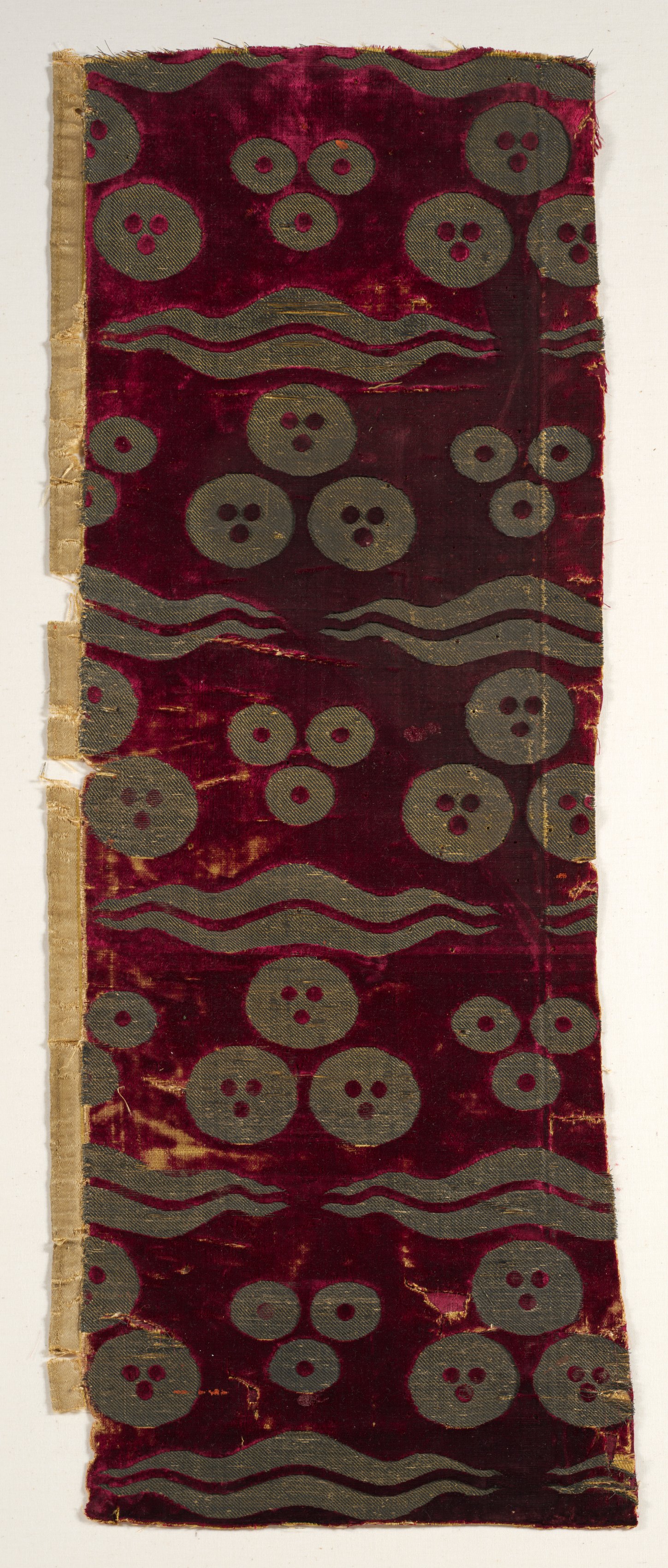
Deconstructing the New DNA Strand: Brocaded Velvet with Chintamani Design
As Chief Fabric Deconstructionist for Zoey Fashion Lab, my mandate extends beyond mere material analysis. I am tasked with decoding the genetic code of textiles—unraveling their historical, technical, and cultural threads to re-sequence them into avant-garde expressions. The subject of this examination, a brocaded velvet bearing the chintamani motif, originating from Bursa, Turkey, and composed of silk and silver-metal thread, presents a particularly potent case. I have designated this artifact as the “New DNA Strand” not as a poetic flourish, but as a scientific descriptor of its capacity to rewire contemporary design logic.
This fabric is not a passive relic; it is an active biological entity. Its double-faced construction, its metallic scaffolding, and its symbolic patterning form a triple helix of meaning that demands rigorous deconstruction before it can be reconstructed into something startlingly new.
Technical Autopsy: The Weave and the Warp
The foundational structure is velvet, a pile weave created by looping supplementary warp threads over metal rods or wires. When the rods are withdrawn, the loops are either left intact (uncut velvet) or sliced open to create a dense, plush surface (cut velvet). In this specimen, the ground is a tightly woven silk satin, providing a lustrous, reflective base. Upon this ground, the velvet pile rises—a soft, tactile forest of silk filaments.
The term “brocaded” signifies that this is not a uniform velvet. Supplementary weft threads, distinct from the ground and pile, are introduced only in specific areas to create the pattern. Here, the supplementary weft is not silk but silver-metal thread, likely a silver-gilt strip wrapped around a silk core. This is a critical technical detail. The metal thread is inelastic, rigid, and highly conductive—both thermally and visually. Its insertion creates a significant structural tension. The fabric is forced to accommodate two opposing material personalities: the yielding, absorbent silk pile and the unyielding, reflective metal.
This tension is the first “mutation” in our DNA strand. In conventional velvet, the pile dominates, absorbing light to create depth. In this brocaded version, the metal thread interrupts the pile, creating hard, mirror-like planes that bounce light back with aggressive precision. The technical challenge for any designer is not to soften this dichotomy but to amplify it. The fabric’s structural integrity depends on this opposition; to neutralize one element is to collapse the entire system.
The Chintamani Code: Symbolism as Genetic Marker
The pattern itself—the chintamani—is a genetic marker of immense cultural and spiritual significance. Originating in Buddhist and Hindu iconography as the “wish-fulfilling jewel,” it was adopted by Ottoman court design, particularly in Bursa, during the 16th century. The motif typically consists of three circles (often representing leopard or tiger spots) arranged in a triangle, accompanied by wavy, cloud-like or tiger-stripe bands.
In the Ottoman context, the chintamani was not mere decoration. It signified power, spiritual authority, and the divine right of the sultan. The tiger stripes evoked ferocity and courage; the leopard spots, nobility and swiftness. The triple-circle arrangement is often interpreted as a symbol of the cosmos, or the unity of body, mind, and spirit. By encoding this pattern in silver-metal thread on a silk pile, the fabric becomes a talisman—a materialized prayer for protection and dominance.
For Zoey Fashion Lab, the chintamani is a potent, albeit dangerous, code. To use it literally is to produce costume, not couture. The deconstructionist approach requires us to isolate the motif’s core syntax: repetition, triangulation, and undulation. The three spheres are not static; they imply movement and rotation. The wavy bands are not passive backgrounds; they are dynamic energy fields. By abstracting these geometric and kinetic principles, we can re-sequence the pattern into a new visual language that retains its ancestral power while shedding its historical costume.
Avant-Garde Reconstruction: From Relic to Radical
The avant-garde is not about ignoring the past; it is about weaponizing it. This Bursa velvet, with its inherent contradictions, is the perfect raw material for a collection that challenges the very notion of wearable fabric. The “New DNA Strand” suggests a future where the fabric is not merely a surface for a garment, but a structural and conceptual participant in the design.
Strategy One: Subversive Draping
Traditional Ottoman kaftans were constructed with flat, rectangular panels to showcase the fabric’s pattern without distortion. The avant-garde strategy is to violate this orthodoxy. By cutting the brocaded velvet on the bias—a technically difficult feat given the metal threads—we force the fabric to curve, stretch, and torque. The rigid silver threads will resist, creating micro-fractures and puckers in the silk pile. This is not a flaw; it is a deliberate scarification of the material. The resulting garment would feature a sculptural, almost architectural volume, where the chintamani circles are distorted into elliptical orbits, and the tiger stripes become fractured lightning bolts. The fabric’s refusal to conform becomes the design statement.
Strategy Two: Deconstruction and Fragmentation
Instead of preserving the fabric’s integrity, we can dissect it. Laser-cutting the velvet to remove entire sections of the pile, leaving only the metallic brocade skeleton, creates a lace-like, metal mesh. This process exposes the satin ground beneath, transforming the plush surface into a topographic map of raised and recessed areas. The chintamani motif would be disassembled into its constituent parts: a single silver circle used as a grommet, a strip of tiger stripe as a structural strap, a fragment of the wave pattern as a decorative hem. This approach treats the fabric as a kit of parts, allowing for modular, reconfigurable garments that challenge the permanence of couture.
Strategy Three: Haptic and Kinetic Contrast
The most avant-garde property of this fabric is its dual sensory profile. The silk pile is warm, soft, and inviting; the silver thread is cold, hard, and repellent. A garment designed for Zoey Fashion Lab should exploit this haptic dissonance. Consider a form-fitting bodice where the velvet pile is placed against the skin for comfort, while the metallic brocade is exposed on the exterior, creating a mirror-like armor. As the wearer moves, the metal threads will catch the light, creating a shimmering, animated surface that is both ancient and futuristic. The chintamani circles become optical devices, reflecting the environment and the audience, making the wearer a living, moving sculpture.
Furthermore, the weight of the silver thread is a design parameter. This is not a light, airy fabric. It has substantial mass and gravity. An avant-garde silhouette would not fight this weight but embrace it. The garment could be designed to hang heavily from the shoulders, creating deep, dramatic folds that emphasize the fabric’s density. The natural drape of the velvet would be punctuated by the sharp, unyielding edges of the metallic pattern, producing a visual rhythm of softness and severity.
Conclusion: A Living Specimen
The brocaded velvet with chintamani design from Bursa is far more than a historical artifact. It is a complex, living system of technical, cultural, and sensory data. Its “New DNA” is defined by the antagonistic relationship between silk and metal, the symbolic weight of the chintamani, and the structural memory of its Ottoman origins.
For Zoey Fashion Lab, this fabric is not a material to be respected; it is a challenge to be overcome. By employing subversive draping, laser-driven fragmentation, and a deep understanding of haptic contrast, we can re-sequence this ancient weave into an avant-garde statement that is neither nostalgic nor futuristic, but rather timelessly disruptive. The final garment will not merely be worn; it will be inhabited—a piece of living history, mutated for the modern body, carrying within its threads the ferocity of the tiger and the unyielding brilliance of silver, reborn as radical couture.