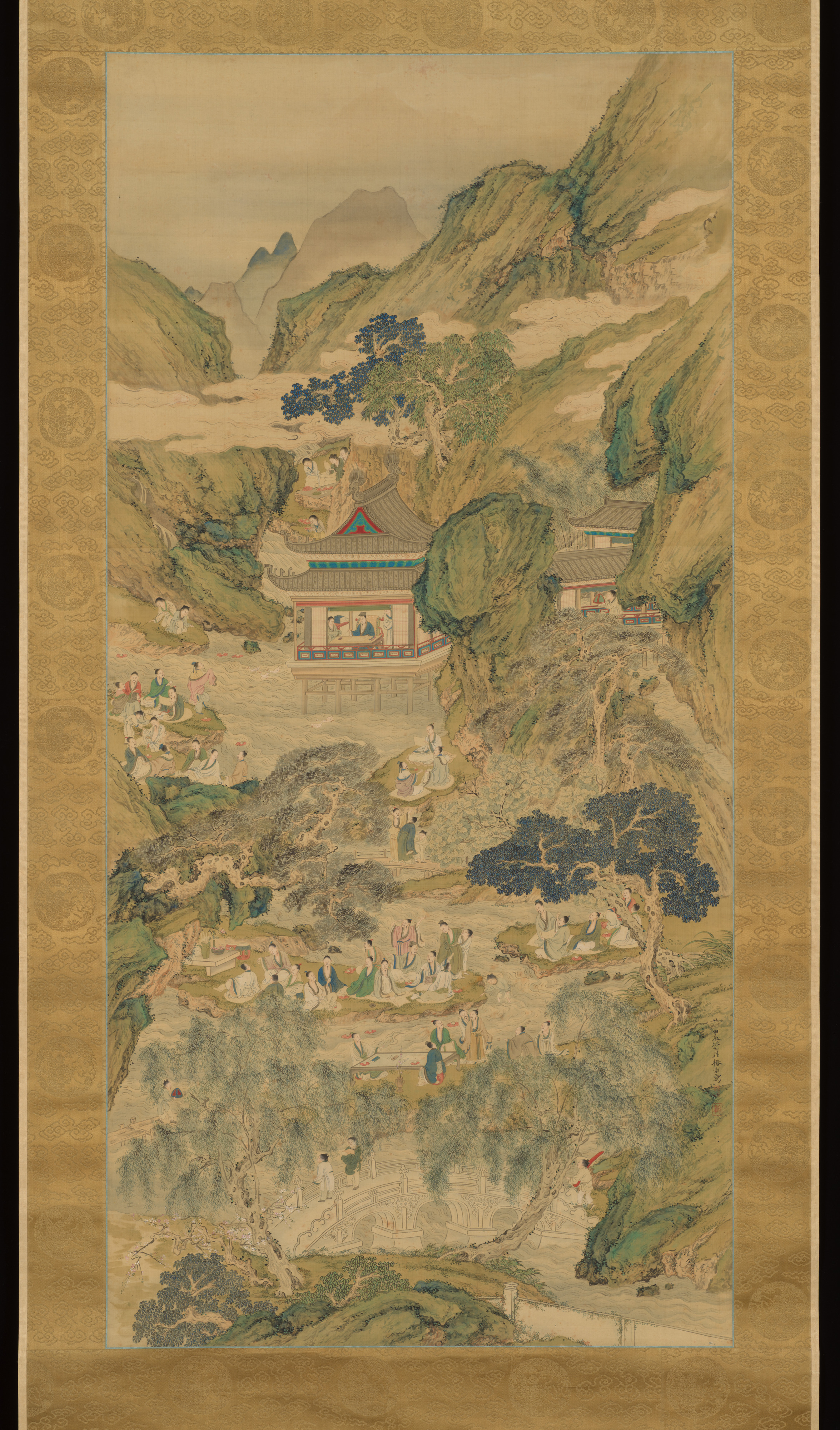
Deconstructing the Pavilion: A Blue-Green Blueprint for SS26
The Orchid Pavilion Gathering, rendered in ink and color on silk, is traditionally read as a pastoral idyll—a moment of scholarly repose along a winding stream. For the Zoey Fashion Laboratory, however, this hanging scroll is not a relic. It is a pre-visualization of parametric drapery, a chaotic algorithm of water, rock, and calligraphic gesture that predates computational design by a millennium. Our SS26 investigation strips the scene of its literati nostalgia to expose a radical core: the tension between rigid architectural framing and fluid organic overflow. We are not recreating a garden party; we are engineering the garments that would be worn by figures who exist simultaneously within and outside that painted space—specters of a future where silk is a structural alloy and ink is a conductive thread.
I. The Scroll as a Spatial Matrix: From Flat Silk to Voluminous Shell
The fundamental avant-garde action is to treat the scroll’s two-dimensional plane as a pattern-making schematic. The blue-green palette—mineral azurite and malachite—is not a color story; it is a geological strata map. We extract the contour lines of the mountain ridges and translate them into sharp, cantilevered shoulder pads that jut forward like eroded cliff faces. These are not soft paddings. They are laminated bio-resin forms, sculpted to mimic the brush’s dry-brush texture, creating a silhouette that reads as fractured topography from the front and a clean, severe blade from the profile.
Simultaneously, the winding stream—the qu shui or “winding water”—becomes our foundational seam. Instead of a natural waistline, we propose a diagonal, hydro-dynamic seam that spirals from the right hip, across the torso, and terminates at the left clavicle. This seam is not decorative. It is a functional articulation point, allowing the garment’s lower volume to detach and reattach via magnetic, water-jet-cut connectors. The wearer can shift from a restrictive, columnar silhouette (the scroll rolled) to a billowing, kite-like train (the scroll unfurled) in a single gesture. This is transformative architecture, a direct response to the painting’s own duality of permanence (the rock) and transience (the flowing water).
II. Calligraphic Ink as Structural Tension
The cursive calligraphy that crowds the upper register of the scroll is typically overlooked in favor of the figural scene. In our analysis, those black, gestural strokes are the original blueprint for tensile strength. We have isolated the negative space between the characters and converted them into laser-cut perforation patterns on high-tensile technical silk. These perforations are not merely ventilatory; they create a variable-stiffness textile. When the fabric is relaxed, the perforations gape open, revealing under-layers of phosphorescent organza. When the fabric is pulled taut by an internal corsetry system of carbon-fiber boning, the perforations close, creating a dense, opaque surface that mimics the solidity of the ink block.
This technique produces a garment that “writes” on the body. The silhouette itself becomes a calligraphic act—sharp, abrupt angles at the elbows and knees, interrupted by fluid, sweeping panels that mimic the brush’s momentum. For SS26, we propose an asymmetric tunic where the left sleeve is a solid, ink-black sheath of recycled polyamide, while the right sleeve is a translucent, blue-green lattice of the same material, the perforations mapping the character for “flow” (流). The visual dissonance is intentional: it is the sound of the brush scratching silk, made wearable.
III. Blue-Green Mineralogy: Chromatic Engineering for the Future
We reject the notion of “color blocking.” The azurite and malachite pigments are treated as temperature differentials. The deep, verdant malachite is deployed on the interior of garments—the linings, the under-layers—acting as a cooling, absorptive surface. The brighter, colder azurite is reserved for exterior shells, which we engineer with a micro-ridged surface that refracts light like the mineral’s crystalline structure. This is not dye; it is mineral-infused polymer coating, applied via a robotic spray process that follows the exact topographic data of the original mountain brushstrokes.
The result is a chromatic shift dependent on movement. As the wearer walks, the ridges catch and scatter light, causing the garment to oscillate between a flat, painted appearance and a shimmering, three-dimensional volume. This echoes the painting’s own illusionism, where flat pigment suggests cavernous depth. In our SS26 context, this is active camouflage for the urban environment, a way to disappear into reflective glass facades or, conversely, to appear as a living geological anomaly.
IV. Silhouette Propositions: The Pavilion as Wearable Shelter
Our primary silhouette for this study is the “Pavilion Back”. A rigid, exoskeletal frame of recycled aluminum, shaped like the scroll’s wooden roller, extends from the nape of the neck down to the sacrum. This frame is not a backpack; it is an extension of the spine. From this frame, multiple layers of blue-green silk are hung in asymmetric tiers, mimicking the layered eaves of the garden pavilion. The front of the garment remains stark, minimal, almost monastic—a high-necked, sleeveless shell. The drama is entirely posterior, a mobile piece of architecture that creates a powerful negative space between the body and the fabric.
This silhouette challenges the primacy of frontal presentation. It forces the viewer to engage with the garment’s circumambient volume, to walk around it as one would circumnavigate a sculptural garden rock. The “eaves” are weighted with small, polished hematite discs, causing them to sway in a slow, hypnotic rhythm that mimics the lazy flow of the stream. It is a garment that performs stillness and motion simultaneously, a paradox central to the original painting’s depiction of scholars frozen in time yet engaged in lively poetic exchange.
V. Conclusion: The Scroll Unfurled into the SS26 Landscape
The Orchid Pavilion Gathering is not an escape from the world; it is a protocol for negotiating complex social and natural systems. For SS26, Zoey Fashion Laboratory uses this protocol to propose a wardrobe of kinetic, geological, and calligraphic forms. We discard the notion of the garment as a second skin. Instead, we present it as a portable environment, a fragment of a painted landscape that the wearer inhabits and activates. The blue-green hues are no longer historical pigments but speculative colorways for a post-natural era. The hanging scroll becomes a hanging garment, and in that translation, we find not nostalgia, but a radical, forward-looking blueprint for how we might dress our bodies as living monuments to the fluidity of time and structure. The future is not unwritten; it is merely waiting to be unfurled.