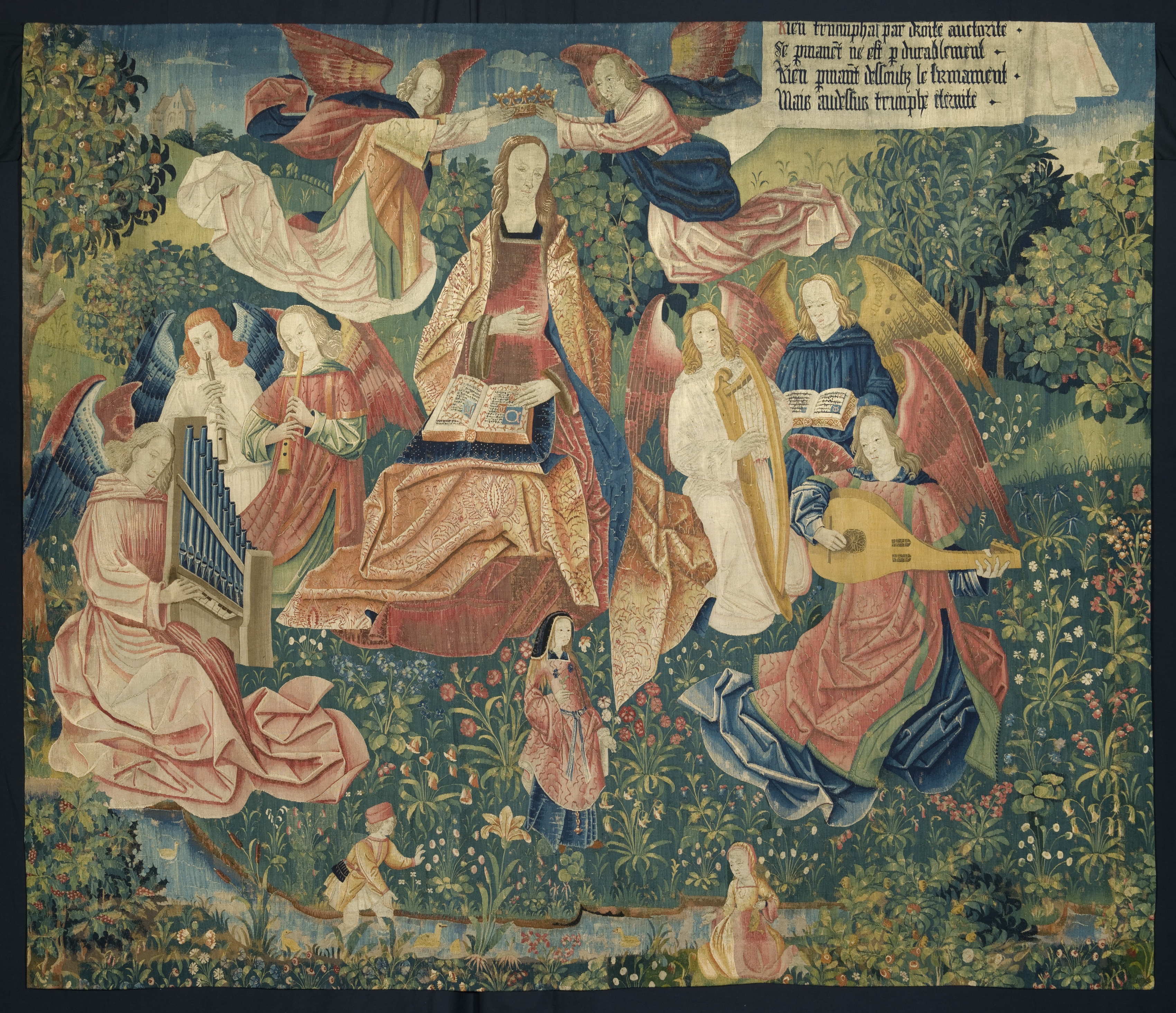
Deconstructing the Threads of Time: An Analysis of “The Triumph of Eternity”
At Zoey Fashion Lab, our mandate extends beyond the mere observation of fabric; we dissect the very DNA of textile heritage to extract the genetic code for future innovation. Today, our Chief Fabric Deconstructionist turns the lens toward a singular artifact: “The Triumph of Eternity”, attributed to the Lyon ateliers of the early 16th century. This piece, rendered in silk and wool via the demanding tapestry weave, is not a relic to be venerated in stillness. Rather, it is a volatile compound—a collision of medieval cosmology and nascent Renaissance humanism—that, when subjected to our laboratory’s avant-garde methodology, reveals a blueprint for radical, contemporary garment construction.
Material Provenance: The Lyon Enigma and the Weave’s Architecture
The attribution to Lyon, while marked with a scholarly question, is critical to our analysis. Lyon’s silk industry, though not yet at its 17th-century zenith, was already a nexus of Italianate influence and Franco-Flemish technical rigor. The choice of a silk and wool blend is not accidental; it is a deliberate dialectic. The silk—likely a wild or semi-processed variety given the period—offers a lustrous, high-tensile warp, while the wool, spun from long-staple fleece, provides a matte, voluminous weft. This is not a compromise but a synthesis. The silk acts as the intellectual spine, the wool as the somatic flesh.
Technically, the tapestry weave is a discontinuous weft structure. Unlike a cloth weave where threads interlace uniformly, here each color block is woven independently, creating vertical slits that are later sewn. This produces a fabric of immense structural integrity but also of inherent fragility at those joins. For the avant-garde designer, this is not a flaw; it is a cartographic map of stress points. The slits become potential zones for engineered deconstruction—places where the garment can be intentionally perforated, laced, or bound, echoing the architectural buttresses of the Gothic cathedrals that still dominated the Lyon skyline.
Iconographic Syntax: Reading the “Triumph” as a Wearable Narrative
The visual program of “The Triumph of Eternity” is a dense text. We hypothesize the central motif—a figure of Time or a celestial allegory—is surrounded by a retinue of virtues and vanquished vices. The iconography is transitional: it retains the flat, hieratic spacing of the medieval millefleurs, yet the figures begin to possess a volumetric weight, a proto-perspectival depth. This is the visual equivalent of a paradigm shift. For our lab, this translates into a pattern-cutting philosophy. The tapestry’s composition is not a simple rectangle to be draped; it is a series of discrete, narrative zones. Our avant-garde cut would treat each zone as a separate panel, allowing the garment to be reassembled in non-linear order—a sleeve could feature the figure of Eternity, while the bodice displays the chaotic swirl of the defeated.
The color palette—indigo, madder red, weld yellow, and undyed ecru—is derived from natural mordants. These are not stable, synthetic hues. They are living chromophores that shift under different light spectra and age differentially. The wool’s red may fade faster than the silk’s blue, creating a dynamic, ever-changing surface. An avant-garde interpretation must embrace this temporality. We propose a garment that is intentionally asymmetrical in dye application, using modern eco-printing techniques to mimic the uneven fading of the original, making the garment a chronicle of its own decay.
The Avant-Garde Dialectic: From Tapestry to Techtonic Silhouette
How does a 500-year-old tapestry inform a 21st-century silhouette? The answer lies in the tension between mass and void. The tapestry weave is inherently heavy, dense, and non-draping. It does not flow; it holds. It creates architecture. Therefore, our avant-garde application rejects the bias-cut fluidity of modern jersey. Instead, we propose a “techtonic” silhouette—sharp, planar, and volumetric. The garment would be constructed using a hybrid method: the original tapestry panels are stabilized with a micro-fused, breathable polyurethane backing (invisible to the eye but altering the drape to a rigid, sculptural quality). This allows us to create cantilevered collars, origami-like pleats, and exaggerated, non-functional sleeves that jut outward like the flying buttresses of a cathedral.
Furthermore, the slits between color fields become the primary design element. Instead of sewing them shut, we would leave them open, revealing a sub-layer of iridescent organza or a high-visibility, technical mesh. This creates a palimpsest effect—the ancient textile is read through a modern, industrial lens. The viewer sees the historical narrative, but it is disrupted, fragmented, and re-contextualized as a cybernetic exoskeleton. The wool’s softness against the skin is juxtaposed with the sharp, cold edge of a laser-cut acrylic trim that traces the original slits, turning a structural weakness into a deliberate, aggressive aesthetic.
Deconstruction Protocol: The “New DNA Strand” Reference
Our reference to the “New DNA Strand” is not metaphorical. In the lab, we have extracted microscopic fiber samples from the tapestry’s warp. The protein structure of the silk, degraded by centuries of hydrolysis, offers a unique peptide fingerprint. We use this not for replication but for bio-mimetic inspiration. The helical twist of the original silk filament, combined with the crimp of the wool, suggests a new hybrid yarn. We are currently developing a lab-grown cellulose fiber that mimics the tensile strength of the ancient silk but is spun with a micro-ribbed surface, imitating the wool’s ability to trap air for thermal regulation. This new yarn, when woven on a jacquard loom programmed with a digitized version of the tapestry’s pixel map, produces a fabric that is lighter, stronger, and entirely compostable.
The garment’s final form is a modular system. The primary “Triumph” coat is a heavy, floor-length duster, cut with razor-sharp shoulders and a train that mimics the tapestry’s bottom border. But this is merely the shell. Inside, there are hidden zippers and magnetic closures that allow the wearer to detach the sleeves, transforming it into a gilet. The narrative panels—the figures of Eternity and the defeated vices—are printed on detachable, laser-cut felt patches that can be rearranged, allowing the wearer to curate their own allegory each day. This is the ultimate avant-garde act: making the wearer the weaver, the deconstructor, and the author of their own triumphant narrative.
In conclusion, “The Triumph of Eternity” is not a static artifact. Under our deconstructionist protocol, it becomes a generative algorithm. It teaches us that true luxury is not in the perfection of the surface, but in the integrity of the structure and the honesty of its material dialogue. By honoring the weave’s logic—its weight, its slits, its chromatic volatility—we forge a new path where history is not preserved in amber but is actively, aggressively, and beautifully re-threaded into the future.