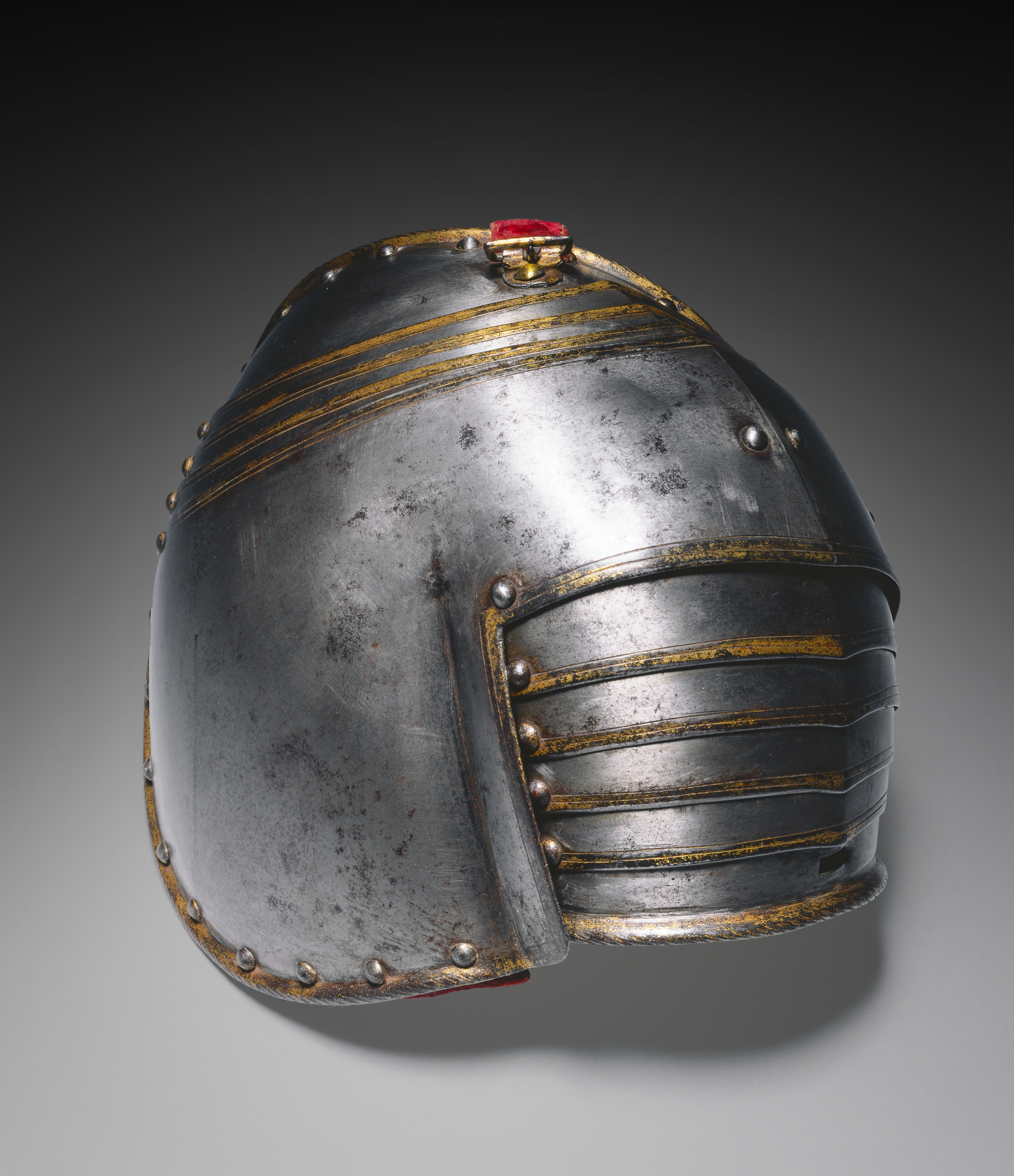
Deconstructing the Pauldron: A Technical and Conceptual Analysis for Zoey Fashion Lab
At Zoey Fashion Lab, our mandate is not merely to catalog garments but to interrogate their structural DNA, extracting the genetic code of historical craftsmanship and re-sequencing it for contemporary, avant-garde expression. The subject of this analysis—a right-shoulder pauldron of Italian origin, executed in blued steel with gilt borders—presents a fascinating paradox. It is simultaneously an artifact of martial function and a jewel of metallurgical artistry. When we overlay our internal reference, “New DNA Strand,” we move beyond simple replication. We are tasked with isolating the core expressive vectors of this object and translating them into a language of fluid, sculptural fashion. This report dissects the pauldron across three primary strata: Material Alchemy, Structural Semiotics, and Avant-Garde Transmutation.
1. Material Alchemy: The Chromatic Dialogue of Blued Steel and Gilt
The pauldron’s immediate visual impact is derived from a sophisticated chemical and chromatic tension. The blued steel base is not a passive surface; it is a product of controlled oxidation, a deliberate act of corrosion that transforms iron into a deep, lustrous indigo-black. This process, historically perfected in Northern Italy, creates a surface that absorbs light, offering a matte, almost velvety depth. It speaks of night, of shadow, of the quiet strength of a weapon waiting in the dark. In contrast, the gilt borders—applied via mercury gilding or fire-gilding—are pure, unrepentant luminosity. The gold is not merely a trim; it is a structural exclamation, a line of solar energy that delineates the form’s edge. The visual result is a study in opposites: absorption versus reflection, depth versus surface, shadow versus light.
For the fashion designer, this is not a lesson in color matching, but in material psychology. The blued steel suggests a modern, almost gothic sensibility—think of high-performance technical fabrics with a matte, water-resistant finish. The gilt border, however, introduces a note of opulent, historical decadence. In our “New DNA Strand” protocol, we do not seek to imitate the metal but to emulate its energetic polarity. We would propose a fabric pairing of a micro-sanded, high-density nylon (for the blued effect) with a laser-cut, heat-bonded metallic film (for the gilt). The challenge is to maintain the same optical hierarchy: the dark mass must feel volumetric and primary, while the gold must remain a precise, architectural edge—never a dominant field, but a definitive boundary.
2. Structural Semiotics: Anatomy of the Right Shoulder
The choice of the right shoulder is not arbitrary. In historical armor, the right pauldron was often larger and more articulated to accommodate the lance or sword arm, allowing for a greater range of forward motion while providing maximum protection. This asymmetry is a key signifier. It marks the body as a site of active agency, of thrust and engagement. The left side remains comparatively open, creating a dynamic imbalance. Furthermore, the pauldron’s construction—a series of overlapping lames (steel plates) riveted to leather straps—is a primitive but effective system of kinetic articulation. It is a rigid exoskeleton that moves with the body, a perfect fusion of constraint and flexibility.
Deconstructing this for the runway, we identify the overlap as the primary structural motif. The pauldron is not a single, monolithic shell; it is a sequence of scales, each one slightly shadowing the next. This creates a rhythmic pattern of ridges and valleys, a topographical map of movement. In our avant-garde application, we translate this into modular tailoring. We envision a jacket or a top where the right shoulder is built from a series of cantilevered, rigid panels—perhaps of molded bio-resin or thermoformed leather—that overlap like fish scales. These panels would be attached to a flexible, stretch-based underlayer, allowing for the same articulation as the original lames. The gilt border becomes a fine line of gold piping that traces the edge of each panel, creating a fragmented, luminous grid across the shoulder. This is not a costume; it is a re-engineering of the silhouette to create a new point of tension and release, a sculptural volume that begins at the acromion and cascades down the deltoid.
3. Avant-Garde Transmutation: The “New DNA Strand” Protocol
Our internal reference, “New DNA Strand,” dictates that we extract the informational core of the artifact and splice it with alien elements. For this pauldron, the core genetic markers are: Asymmetry, Layered Rigidity, and Chromatic Contrast. The avant-garde application must not be a direct copy, but a mutation that challenges the viewer’s perception of the human form.
Our proposal is a conceptual garment titled “Lancia d’Ombra” (Lance of Shadow). The primary silhouette is a deconstructed, asymmetric blazer. The left side is fluid, cut from a liquid silk-wool blend in a deep charcoal. The right side, however, is the site of intervention. Instead of a conventional sleeve, we construct a hybrid exoskeleton using 3D-printed polymer nodes that are articulated via magnetic joints. These nodes are printed in a gradient finish—from a matte, dark graphite at the shoulder to a polished, metallic bronze at the elbow—mirroring the blued-to-gilt transition. The nodes are not attached to the fabric; they float above it, creating a negative space between the garment and the armor, a visual representation of the historical gap between the arming doublet and the steel plate.
Furthermore, we introduce a kinetic element. Unlike the static historical pauldron, our version is designed to respond to movement. The magnetic joints allow the nodes to shift and realign, creating a sound like distant chimes and a visual shimmer as the light catches the metallic edges. The garment becomes a performative instrument. The gilt border is re-imagined not as a solid line, but as a series of interrupted, laser-cut perforations along the edge of the polymer, allowing light to pass through in a pattern that evokes the fine chasing on the original steel. This is a deliberate act of vulnerability—a rigid structure that admits light, a defense mechanism that is also a lattice for illumination.
Conclusion: From Artifact to Agency
The Italian pauldron is a testament to the human desire to protect and project power. For Zoey Fashion Lab, it is a cipher waiting to be decoded. The blued steel offers a lesson in depth and restraint; the gilt borders, a lesson in precise opulence; and the asymmetric structure, a lesson in kinetic dynamism. By applying the “New DNA Strand” reference, we reject the museum case and embrace the laboratory. Our final garment is not a tribute to the past but a provocation for the future—a wearable architecture that questions the boundary between clothing and armor, between the organic body and the constructed self. It is an assertion that true avant-garde design is not about novelty for its own sake, but about re-contextualizing historical intelligence to solve new, aesthetic problems. The right shoulder is no longer just a joint; it is a stage for a new kind of performance, one where shadow and light, rigidity and flow, engage in a perpetual, beautiful conflict.