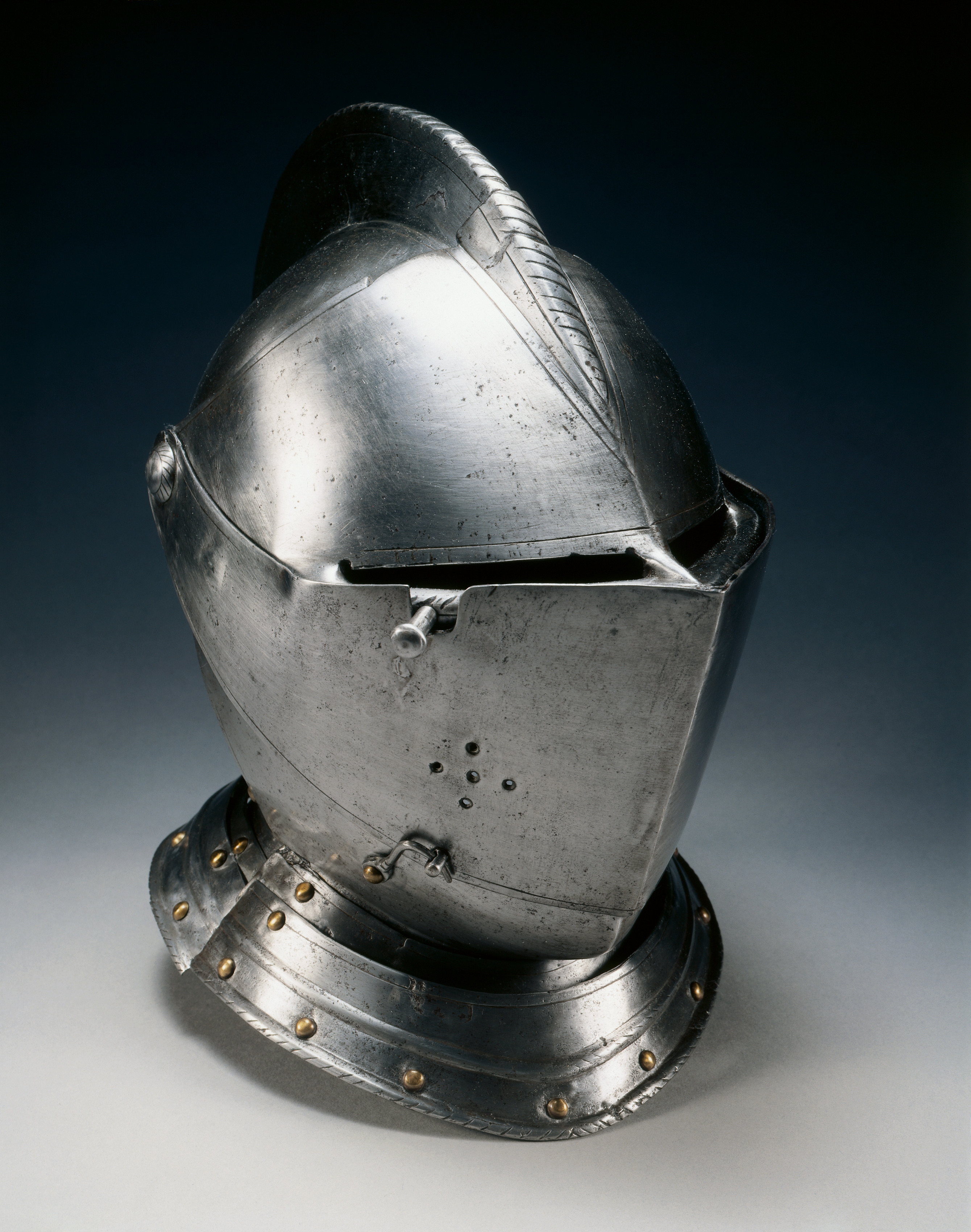
Technical Deconstruction: The Armored Exoskeleton
The German suit of armor, circa 16th century, represents a zenith in pre-industrial metallurgical engineering and biomechanical design. Our analysis begins not with cloth, but with a hardened exoskeleton. The primary materials—iron, steel, leather, and brass rivets—form a hierarchical system of protection and mobility. The iron and steel plates are not monolithic; they are carefully shaped, differentially hardened, and articulated via leather straps and brass rivets to create a movable shell. This is a garment engineered for impact dispersion, where curved surfaces deflect blows and layered plates (lames) slide over one another, allowing for a surprising range of motion. The brass rivets are not merely fasteners; they are pivot points, the crucial joints in this metallic anatomy. The leather serves as the silent, flexible substrate, the "fabric" that connects the rigid plates, absorbing stress and preventing metal-on-metal grinding. This is a lesson in structural articulation and modular, protective layering—principles we can abstract from warfare and apply to couture.
Conceptual Genesis: The New DNA Strand
The directive to reference a "New DNA Strand" is pivotal. It moves us beyond literal replication into the realm of genetic recombination. We are not creating a costume; we are splicing the armored genome with the DNA of high fashion. The double helix of the armor is one strand of fortification, authority, and articulated structure. The complementary strand we introduce is vulnerability, fluidity, and organic growth. The new DNA strand is a hybrid: a garment that appears both protective and exposed, rigid and soft, historical and futuristic. It speaks to a modern psyche that armors itself digitally and emotionally, yet craves authentic connection and expression. The armor's form is the chromosome; our avant-garde interpretation is the gene expression.
Avant-Garde Translation: From Battlefield to Runway
Translating this technical and conceptual analysis into an avant-garde silhouette requires a fearless dismantling of codes. The suit of armor ceases to be an object and becomes a philosophy of construction.
Material Re-sequencing
We will transmute the core materials. Hammered steel plates become thermoformed bioplastic or laser-cut, anodized aluminum, offering similar rigidity with radical weight reduction. The leather strapping evolves into technical elastic webbing or silicone-bonded mesh, providing memory and stretch. The brass rivets are reimagined as magnetic closures or 3D-printed polymeric hinges, allowing for modular garment reconfiguration by the wearer. We introduce new genetic material: sheer, liquid metallique jerseys to represent the body beneath the armor, and hand-blown glass "plates" that offer form but no protection, interrogating the very idea of sartorial defense.
Silhouette and Articulation
The iconic silhouette—broad shoulders, cinched waist, full leg—is a powerful starting point. We will exaggerate the shoulders into architectural, upward-sweeping forms, perhaps using lightweight armatures, while dissolving the waist into a fluid drape or a corset of connected chains. The articulated leg plates inspire a new approach to tailoring: trousers with segmented, overlapping panels along the thigh and calf, creating dynamic, sculptural lines with movement. The helmet's visor, a symbol of anonymity, is fragmented into a delicate, face-framing cage of wire or transparent acrylic, revealing even as it obscures.
Surface and Narrative
The original armor's surface, often polished or fluted, tells a story of craft and intimidation. Our surface narrative will be more complex. Using acid etching, digital printing, and embedded LEDs, we can create patterns that mimic both cellular structures (tying back to the DNA strand) and digital glitches. A gown may feature a corset of "rusted" intelligent textile (a visual effect) that slowly "heals" to a polished state via thermochromic reaction, symbolizing resilience. The concept of damage and repair becomes an aesthetic virtue, with visible "welds" of silicone seam tape and embroidered "stress fractures."
The Zoey Fashion Lab Prototype: "Die Neue Helix"
The resulting collection, "Die Neue Helix" (The New Helix), will manifest as a series of looks that feel both ancient and alien. Imagine a cocktail dress with a bodice constructed from interlocking, matte ceramic plates over a sleeve of sheer, silver mesh. A tailored coat features articulated "vambraces" on the sleeves that click softly with movement, made from recycled carbon fiber. A gown flows from a rigid, structural breastplate of mirrored acrylic into a skirt of deconstructed white leather straps, mimicking the interior strapping of the armor, laid bare and beautiful.
Each piece will be a dialogue between protection and exposure, between the imposed structure of society (the armor) and the organic truth of the individual (the DNA). The legacy of the German armorer—a master of functional, anatomical design—is honored not through replica, but through radical reinvention. We take his rivets and make them magnetic; we take his steel and make it translucent; we take his intent to shield the body and subvert it into a framework for revealing identity.
In conclusion, this suit of armor provides the ultimate muse: a garment where every stitch, rivet, and curve had a life-or-death purpose. Our avant-garde mission is to retain that intensity of purpose while redirecting it from physical survival to poetic expression. We are not building for battle, but for the modern landscape of identity—a realm where the most compelling armor is often breathtaking vulnerability, structured by an unshakeable sense of self. The new DNA strand is now sequenced. The next phase is cultivation.