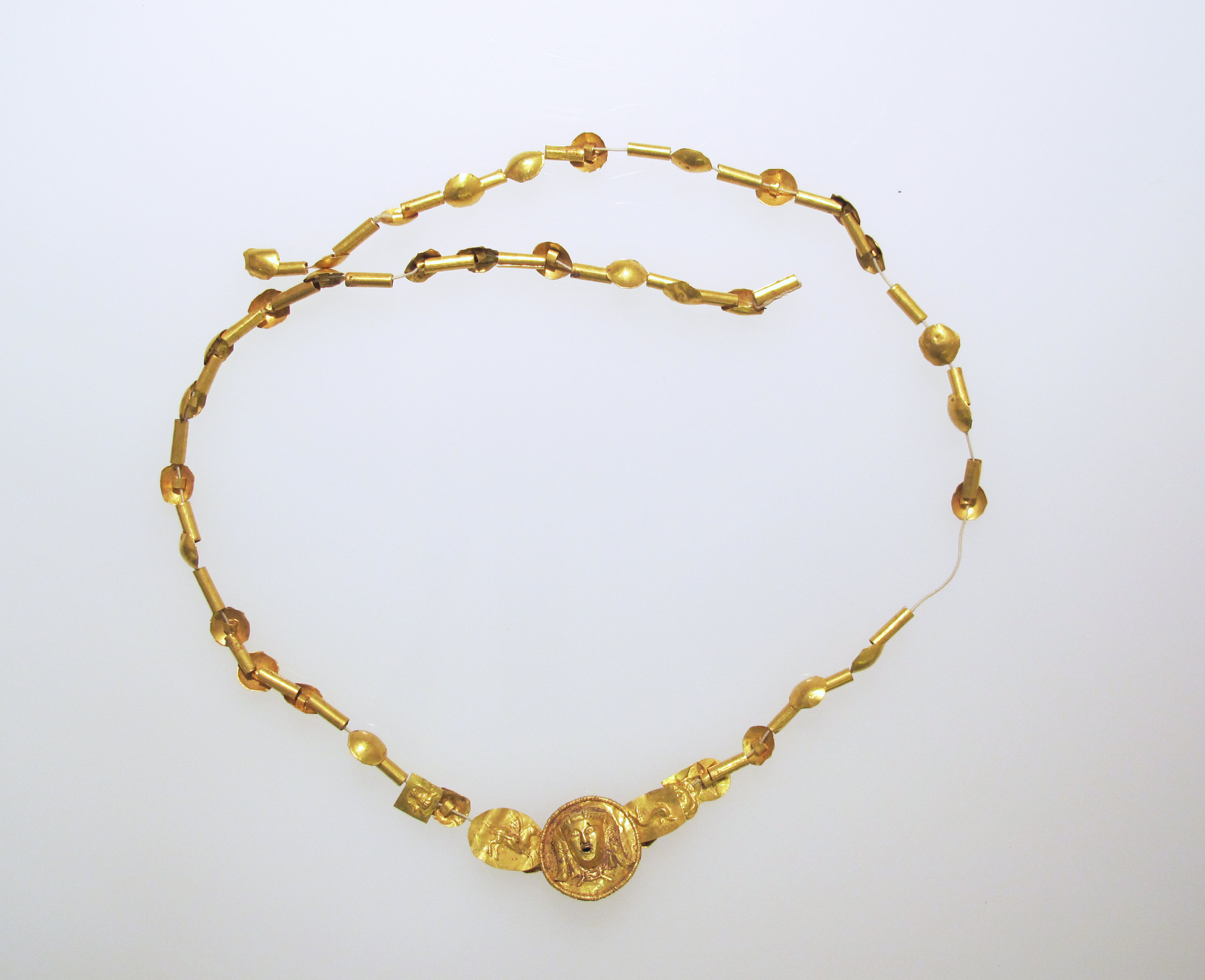
Deconstructing the Etruscan Torque: From Funerary Relic to Futuristic Exoskeleton
The Etruscan gold necklace, far from a mere ornamental relic, presents a profound architectural proposition. It is a circuit of power, a corporeal map delineating social hierarchy and spiritual belief through the medium of hammered and granulated gold. For Zoey Fashion Laboratory's SS26 inquiry, we do not see a necklace to be worn; we perceive a topological problem centered on the neck and shoulder axis. The Etruscan artifact’s intrinsic value lies not in its material opulence, but in its function as a non-verbal data stream—a narrative of life, death, and eternity etched in metal. Our task is to transcode this ancient data stream through the lens of deconstructive aesthetics, transforming its symbolic weight into a language of futuristic silhouette and structural innovation.
Archive Node Decryption: The Mirror and the Sarcophagus
The provided archive node—"一面是光洁银镜上以黄金镶嵌的纷繁棕叶纹,另一面是冰冷石棺板上以浮雕诉说的生命叙事"—offers the critical hermeneutic key. This duality of the polished silver mirror and the cold stone sarcophagus slab encapsulates the core Etruscan tension: reflective vanity versus mortal finality, surface versus depth, the ephemeral present versus the eternal narrative. The "split-leaf" motif is not mere decoration; it is a fractalized organic form, a biological code suspended in gold. For SS26, this dichotomy becomes our foundational algorithm. We propose garments that are bi-facial architectures: one side a hyper-reflective, liquid-metal sheath (the mirror), the other a textured, matte,浮雕-like topography suggesting fossilized data or anatomical cartography (the sarcophagus). The body becomes the site where these two states—luminance and shadow, fluidity and calcification—are in constant dialogue.
Structural Innovation: From Torque to Exo-Topology
The traditional necklace’s loop is decommissioned. In its place, Zoey Fashion Laboratory engineers the “Cervical Load-Bearing Exo-Structure.” Inspired by the torque’s rigid yet encircling form, this innovation utilizes aerospace-grade polymers electroplated in 24k gold micro-flake, creating a weightless yet monumental framework. This structure emanates from the sternum, arches over the shoulders—mapping the clavicle with precision—and terminates in a series of articulated, telescoping rods that extend down the spine or curve over the deltoids to form impromptu sleeve foundations.
This exo-topology performs multiple functions: it redefines the shoulder silhouette, creating sharp, geometric planes that interrupt the organic line of the body. It serves as an anchor point for draped, non-woven textiles, allowing for garments that appear to be generated from the structure itself. A single length of technical silk-chiffon may be algorithmically pleated and threaded through the exo-structure, creating a cascading drape that is part garment, part architectural rendering. The Etruscan granulation technique is reimagined as a surface treatment of micro-solder points and conductive ink trails, suggesting a wearable circuit board pulsating with latent energy.
Material Alchemy & Silhouette Manifesto
Gold is not used as adornment but as a functional skin. Through physical vapor deposition (PVD), we coat molded neoprene, laser-sintered nylon, and even tempered glass with layers of gold so thin they interact with light on a quantum level, creating iridescent shifts from warm auric to cold lunar silver—a direct homage to the archive’s mirror. The "split-leaf" motif is extruded into 3D-printed lattice forms, acting as ventilated, flexible body armor or as exaggerated, asymmetric epaulettes that distort the body’s scale.
The SS26 silhouette is one of controlled contradiction. It embraces the monumental severity of the sarcophagus slab in structured, minimalist backplanes, while simultaneously capturing the reflective fragmentation of the mirror in hyper-kinetic, liquid-front draping. A single look may feature a rigid, gold-deposited corset that appears cast from the body, paired with trousers that are nothing more than a series of sheer, overlapping panels suspended from the exo-structure, evoking the layered narratives of a浮雕. The neck is never merely exposed; it is always engaged in a structural dialogue—framed, extended, or liberated by the cervical architecture that replaces the necklace.
The Futuristic Corpus: Wearable Data Fields
Ultimately, this analysis moves beyond garment construction toward the creation of a wearable data field. The Etruscan necklace was a repository of cultural memory. Our SS26 response proposes that the body itself becomes an interface. The gold exo-structures can be embedded with micro-LEDs that respond to biometric data, visualizing breath or heartbeat as a pulsating light pattern along the conductive "granulation" trails. The bi-facial fabrics become a canvas for dynamic, nano-ink displays that shift between reflective and absorptive states, between showing the "leaf" pattern and showing the "narrative" text.
In conclusion, Zoey Fashion Laboratory’s SS26 collection, germinated from the Etruscan gold necklace, is an exercise in archaeological futurism. We have disassembled the artifact’s material, symbolic, and formal codes to engineer a new paradigm for the corporeal experience. We replace adornment with architecture, narrative with interface, and gold with a spectrum of luminous possibility. The result is not clothing as protection or display, but as a prosthetic for a new consciousness—one that, like the Etruscans, seeks to inscribe the eternal onto the vessel of the present.