Technical Deconstruction: The Architecture of Opulence
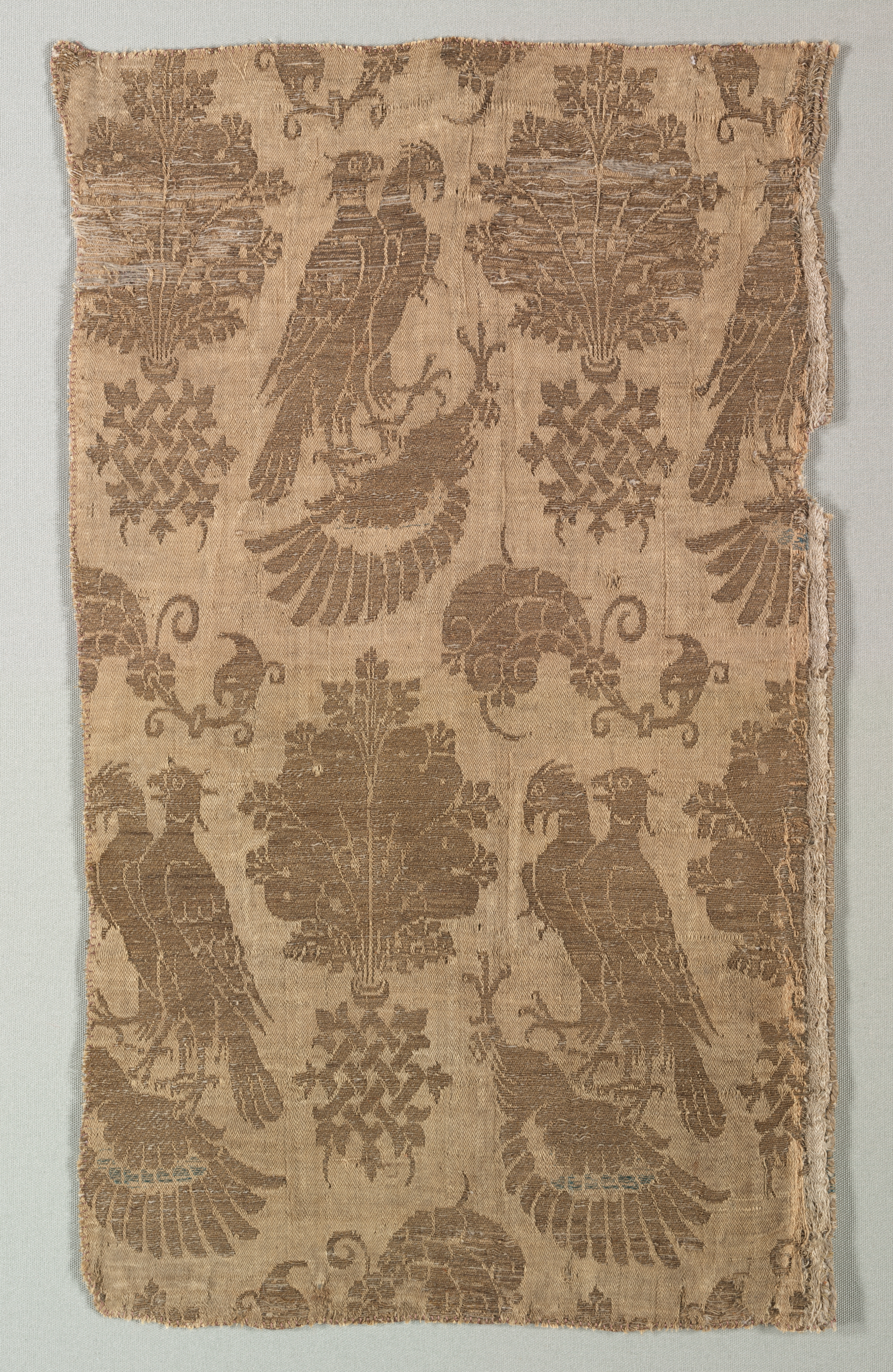
This textile is a masterclass in late 14th-century Italian luxury weaving, a lampas of formidable technical ambition. The very structure speaks of a workshop operating at the pinnacle of its craft. Lampas, the dominant weave for high-end patterned silks in this period, involves the interaction of two warp systems and two weft systems. Here, the analysis suggests a combination of two lampas weaves within the same piece. This is not merely decorative; it is structural rhetoric. One weave ground likely provides a dense, stable foundation, while the second, perhaps with a higher proportion of gold thread, allows for the raised, glittering detail of the primary motifs. The gold thread itself would have been silver-gilt membrane—thin strips of animal membrane wound around a silk core, then gilded. This material imbues the pattern with a tangible, three-dimensional luminosity, catching light not as a flat surface but as a series of microscopic, reflective facets.
Pattern Semiotics: Falconry, Heraldry, and the Performance of Power
The iconography is a precise visual language of secular authority. The falcon, a symbol of nobility, martial skill, and elevated perspective, is not depicted in isolation but within a framed, heraldic context. This transforms the animal from a naturalistic subject into an emblem. The inclusion of explicit heraldic elements—likely shields, crests, or mantling—anchors the fabric in the very real world of lineage, alliance, and territorial claim. In the last third of the 14th century, Italy was a tapestry of city-states, mercenary lords (condottieri), and rising merchant princes. Such a textile would have been commissioned for a specific, potent purpose: as a diplomatic gift, a dynastic marriage trousseau, or a ceremonial garment for a ruler seeking to visually articulate their legitimacy and reach. The pattern repeat is large and commanding, designed to be displayed on a mantle or wall hanging, ensuring the message was seen at a distance.
Archive Resonance: The Dialectic of Surface and Substance
The provided reference—"一面是光洁银镜上以黄金镶嵌的纷繁棕叶纹,另一面是冰冷石棺板上以浮雕诉说的生命叙事" (On one side, the intricate palmette pattern inlaid in gold upon a smooth silver mirror; on the other, the narrative of life told through relief on a cold stone sarcophagus panel)—offers a profound conceptual key. This textile exists in a similar dialectical space between surface glamour and mortal gravity.
The Mirror: Illusionistic Splendor and the "Now"
The "silver mirror" corresponds to the fabric's immediate, dazzling impact. The gold-on-silk technique creates a hyper-real, almost illusionistic depth, much like opus anglicanum embroidery or contemporary painting seeking pictorial space. The "纷繁棕叶纹" (intricate palmette pattern) mentioned likely refers to the secondary, filling motifs—the lush acanthus or vine scrolls that frame the primary heraldic falcons. This is the aesthetic of the present moment: brilliant, captivating, and designed to reflect the wealth and taste of its owner. It is a performance of vitality and power meant for the courtly gaze.
The Sarcophagus: Heraldry as Eternal Narrative
The "cold stone sarcophagus" speaks to the timeless, monumental narrative encoded within the heraldic elements. In medieval thought, heraldry was a legible language of identity that transcended the individual, speaking of lineage past and future. The falcon and its accompanying coats of arms are not mere decoration; they are a proclamation of legacy, intended to endure beyond a single lifespan. Placed on a garment, this transforms the wearer into a living monument, a bearer of dynastic destiny. The weave itself, with its enduring materials, is a testament to this desire for permanence amidst the ephemeral nature of political fortune and life itself.
Zoey Fashion Lab: Avant-Garde Translation Protocol
For an avant-garde translation, we must move beyond pastiche. We do not recreate the falcon; we deconstruct its semantic and structural DNA to speak to contemporary notions of identity, legacy, and protection.
Concept: "Heraldic Fragmentation & Digital Patina"
Core Idea: To explore the tension between permanent identity (heraldry) and fluid self-construction, between handcrafted legacy and digital erosion.
Material & Technical Translation:
1. Structural Echo: Replace the dual lampas weave with a fusion of technical craftsmanship and digital degradation. Use a heavy, sculptural silk faille as the "ground weave." Over this, apply laser-cut fragments of the heraldic pattern in gilded vegan leather and translucent, resin-coated technical mesh, creating a layered, bas-relief effect that echoes the original's dimensionality.
2. Gold Thread Metaphor: The gilt membrane becomes inconstant, corroded luminosity. Use threads of tarnished metallic lurex alongside clear monofilament yarns that catch light like broken glass. Incorporate heat-transfer patches with pixelated, glitching versions of the falcon motif, suggesting a digital artifact struggling for coherence.
3. Pattern Deconstruction: Explode the symmetrical, repeating heraldic frame. Isolate the falcon's talon, a single shield quarter, a segment of the palmette scroll. Scatter these as forensic fragments across the garment. Use sublimation printing to create a ghosted, faded backdrop of the complete pattern, like a memory beneath the sharp, fragmented present.
Silhouette & Application:
Move beyond the historical mantle. Propose a deconstructed trench coat or a structured asymmetrical gilet. The coat becomes a canvas for this fragmented heraldry, acting as a modern "coat of arms"—a protective outer layer that proclaims a complex, fractured identity. Seams can be left raw, referencing the textile's edge, or sealed with gilded, industrial zippers that mimic the lines of heraldic partitions. The interior lining could feature a pristine, digitally printed version of the complete 14th-century pattern, a hidden, intact legacy against which the exterior fragmentation plays out.
This approach honors the original's material innovation and semantic depth while radically recontextualizing it. We translate the permanence of stone and the glitter of the mirror into a conversation about the durability of identity in the digital age, creating a garment that is both an archive and a prophecy. The avant-garde lies not in ignoring history, but in engaging with its most complex resonances to illuminate the present.