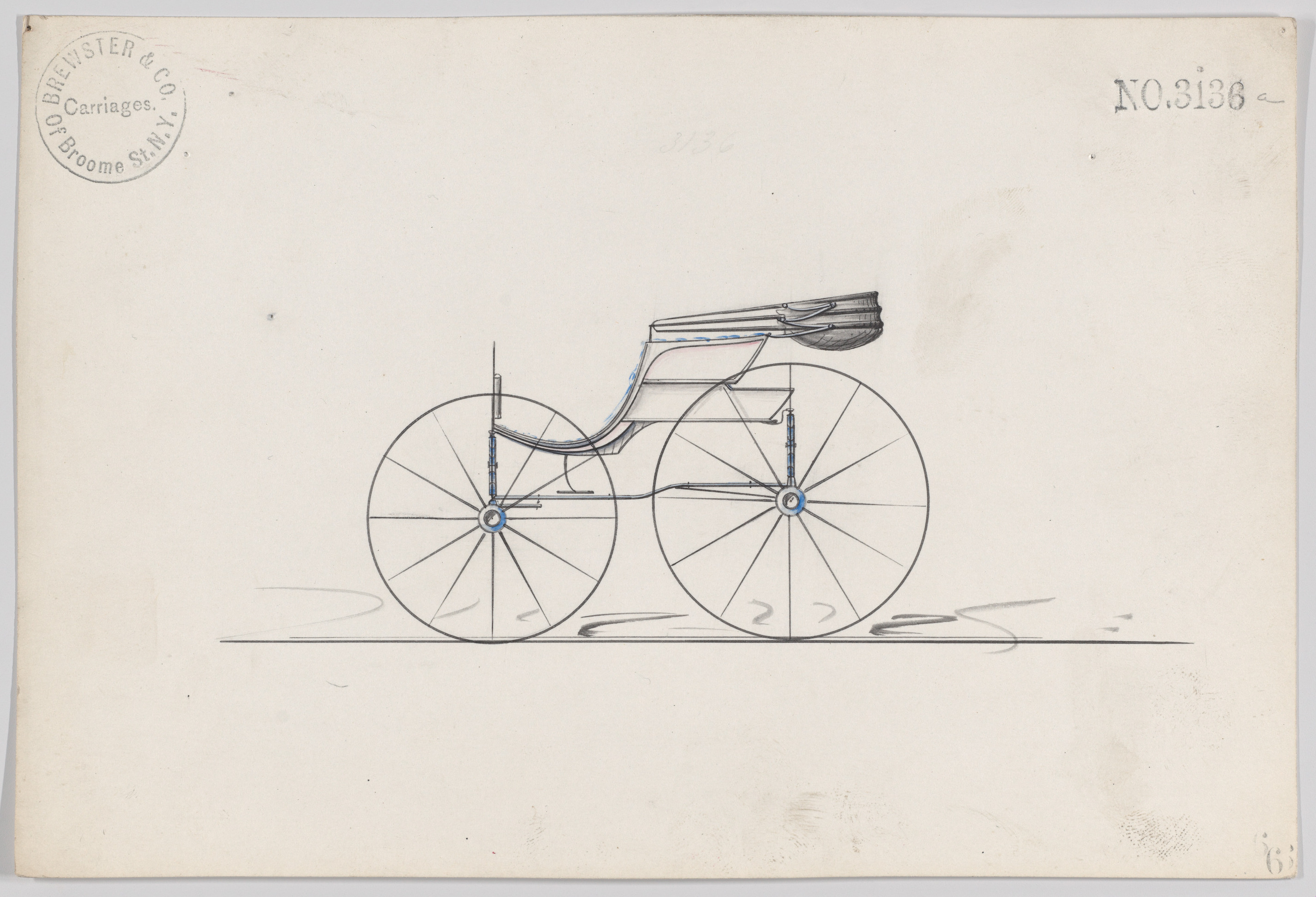
Deconstructing the Equine Archetype: A Structural Exegesis of Pony Phaeton 3136a
Within the archival folios of Zoey Fashion Laboratory, Designation 3136a, Pony Phaeton, emerges not merely as a sketch but as a profound architectural manifesto. Originating from the conceptual Global Frontier—a psychic territory unbound by geography or temporal convention—this standalone study, rendered in the stark clarity of pen and ink with strategic interventions of watercolor and gouache, proposes a radical re-articulation of the corporeal for SS26. It transcends the traditional equestrian reference, deconstructing the very symbology of the pony—a symbol of both untamed nature and refined domestication—to engineer a silhouette that is simultaneously biomechanical and poetically austere. The work operates at the nexus of exoskeletal rigor and fluid, organic suggestion, establishing a new dialectic between wearer and garment-as-chassis.
Silhouette as Chassis: The Exoskeletal Framework
The primary innovation of 3136a lies in its treatment of the silhouette as a load-bearing exoskeletal chassis. The artist’s hand, evident in the decisive ink lines, constructs a framework that appears to grow from the scapulae, cascading over the shoulders in a series of engineered plates that suggest both equine withers and aerodynamic fairings. This is not tailoring in the classical sense; it is a process of anatomical grafting. The torso is reimagined as a central tension member, from which all other elements depend. The most striking feature is the pronounced, arched ribcage extension, a form that evokes both the barrel of a horse and the monocoque structure of a high-performance vehicle—the "Phaeton" of the title. This convex volume creates a protected, negative space between garment and body, challenging the SS26 propensity for the purely cutaneous. The silhouette rejects the fluid drapery often associated with the season, instead presenting a rigid, exteriorized topology that carves its own environment in space.
Paradoxical Textility: The Material Proposition
While the medium is traditional, the materiality it implies is profoundly futuristic. The gouache highlights—stark whites and cool grays—suggest not fabric, but composite surfaces: liquid-seal polymers, anodized aluminum mesh, and molded bioplastics with a matte, cutaneous finish. The watercolor washes in the lower register imply a dramatic shift in substance, where the rigid exoskeleton appears to dematerialize into a cloud of technical tulle or electro-static chiffon. This creates a critical dichotomy: structural absolutism versus ethereal dissipation. The "skirt" or leg-suggesting element is not a separate piece but a continuous, transformative extrusion from the hard chassis, proposing a manufacturing technique where density and flexibility are programmed within a single, seamless construction. This is a direct challenge to the industry’s reliance on hybridized separates, advocating instead for a unitary garment architecture.
Kinetic Implications: The Gait of Form
True to its equine inspiration, 3136a is inherently kinetic. The design is not static; the ink lines possess a vectorial quality, diagramming potential movement. The high, rigid collar acts as a restraint, a gestural moderator, forcing a posture of elevated awareness. The deep, open back, hinted at with strategic negative space in the rendering, serves as a counterbalance to the frontal volume, suggesting a respiratory mechanism or a heat-dissipation system. This is apparel for a dynamic, post-urban ecosystem. The silhouette’s forward pitch implies momentum, its anchored shoulders suggesting harness points for unseen forces. For SS26, this moves beyond the spectacle of the runway walk, proposing a wearable kinematics where the garment actively participates in and modifies the wearer’s biomechanics, echoing the symbiotic relationship between rider and steed.
Contextual Disruption: SS26 and the Global Frontier
Positioned within the speculative context of SS26, Pony Phaeton 3136a stands as a deliberate anomaly. As the industry flirts with digital escapism and neo-romanticism, this study advocates for a return to tactile structural intelligence. The "Global Frontier" is not an outward expansion, but an inward one—a frontier of the body’s relationship to constructed form. It rejects nostalgia, instead utilizing the archetype as a functional blueprint for a future where clothing is a prosthetic interface with our environment. The color palette—black, white, gunmetal gray—is intentionally non-seasonal, asserting that true innovation lies in form, not hue. It is a stark, authoritative statement that prioritizes architectural integrity over decorative trend, redefining avant-garde not as ornamentation of the bizarre, but as the rigorous application of engineering principles to the human form.
In conclusion, Designation 3136a is a complete sartorial philosophy rendered on paper. It is a blueprint for a future where the garment is a static sculpture that implies dynamic function, a protective shell that liberates through its constraints, and a historical reference utterly decomposed into a new, vital morphology. For Zoey Fashion Laboratory, it represents a cornerstone study, a definitive argument that the future of couture lies not in what we add to the body, but in how we intelligently, and radically, re-engineer its dialogue with space.