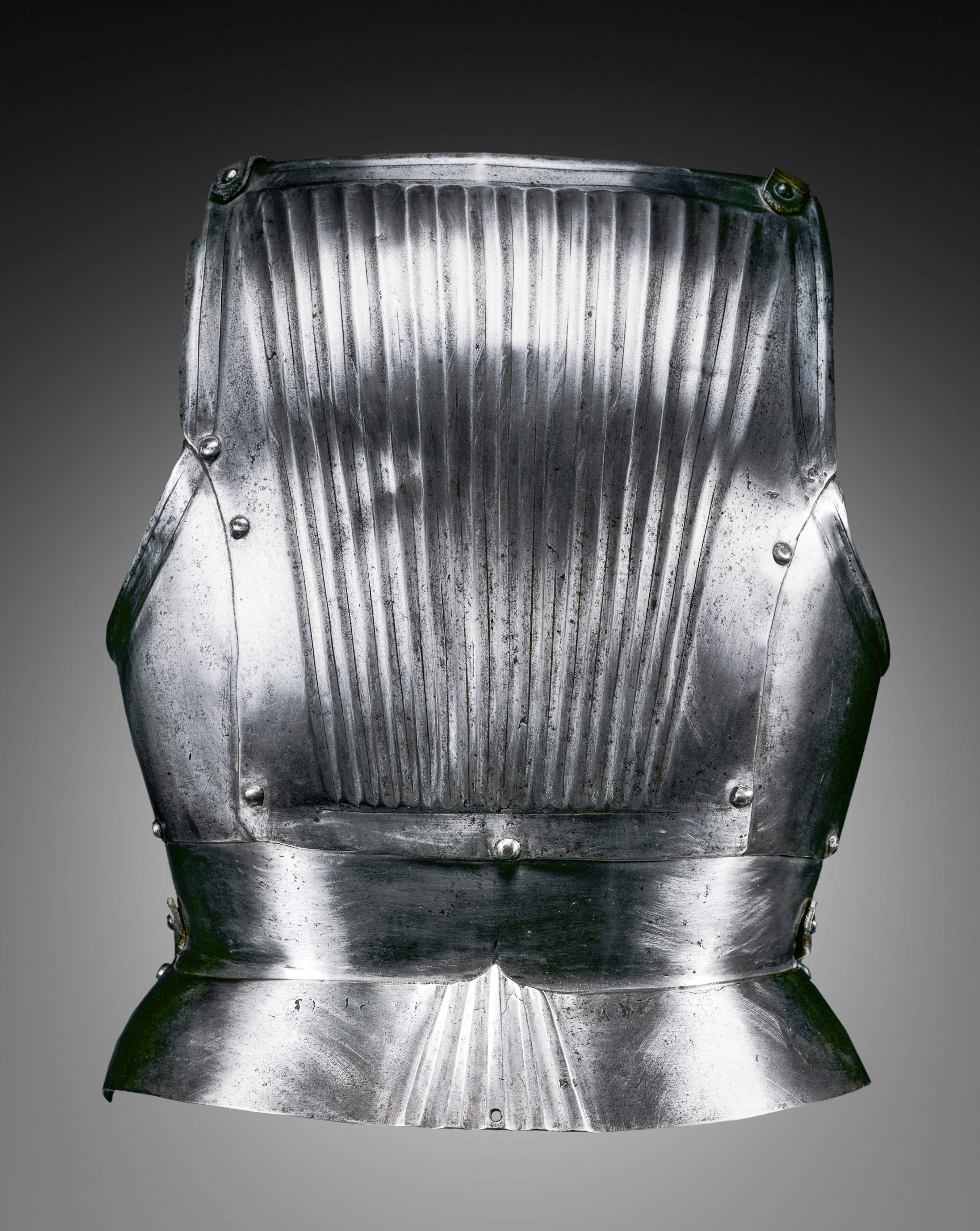
Technical & Historical Deconstruction: The Maximilian Backplate
The provided artifact—a backplate from a Maximilian-style armor, originating in Germany (likely Nuremberg) in the early 16th century—presents a foundational paradox. It is a piece of defensive engineering born from the zenith of late medieval warfare, yet its form and fabrication speak directly to the core principles of avant-garde design: radical structure, material truth, and conceptual rigor. Our analysis will deconstruct this object not as a relic, but as a progenitor of a specific aesthetic and technical DNA, which we are labeling the New DNA Strand.
Structural Avant-Garde: The Fluted Genome
The most immediate and defining characteristic is the full-vertical fluting. This is not mere decoration; it is high-performance structural engineering. Each flute acts as a corrugated reinforcement, dramatically increasing stiffness and resistance to impact without a proportional increase in weight or material thickness. The parallel lines create a visual rhythm of shadow and light, but their origin is profoundly functional. This principle—where form is inextricably born from, and reveals, function—is a cornerstone of avant-garde design philosophy. The fluting transforms a static shell into a dynamic, architectonic form. It introduces a textural narrative dictated by physics, a concept we can transpose into textiles through complex, integral pleating, laser-cut ribbing, or heat-molded textiles that mimic this structural integrity. The flutes are the original "wearable architecture."
Material Honesty & Hybrid Construction
The material specification—steel with brass rivets—is a masterclass in material honesty and hybridity. The steel is the primary language: strong, resilient, and serious. The brass rivets, however, are the precise punctuation. They are functional, securing the internal leather straps to the plate, but they also provide a deliberate, contrasting visual accent. This is not hidden stitching; this is exposed, celebrated jointure. It declares, "Here is how I am made." This honest celebration of assembly informs the New DNA Strand. We can interpret this as the intentional exposure of seams, the use of contrast stitching not as embellishment but as a cartographic tool tracing the garment's construction, or the combination of radically different textiles (e.g., technical matte neoprene punctuated with glossy, metallic fastenings or laser-sintered polymer clips) where each material's inherent property is showcased, not disguised.
The Nuremberg Implication: Modularity & the Articulated Form
The suggested origin, Nuremberg, is critical. Nuremberg was a hub of the *Plattner* (armorer's) craft, renowned for its high-quality, often modular "munition" armors. This backplate was not a standalone sculpture; it was a component of an articulated system designed for a mobile human body. It connects to gorgets, pauldrons, and faulds through precise straps and sliding rivets, allowing for a tailored range of motion. This concept of modular articulation is profoundly avant-garde. It suggests clothing as a system of interconnected, intelligent components. Imagine a garment built from interlocking, rigid textile panels connected by flexible, tensile mesh or elasticated ligaments, each part moving independently yet in harmony with the body's biomechanics. The backplate is a module, a single strand in a larger functional organism.
The "Maximilian" Silhouette: Organic Exoskeleton
The Maximilian style emerged during a transition—the Gothic era's sharp, angular lines were evolving into the more rounded, robust "white armor" of the Renaissance. This backplate captures that moment. It mimics the idealized human torso (the pectoral and dorsal musculature) but abstracts and amplifies it into an exoskeleton. It creates an imposed, enhanced silhouette—wider at the shoulders, cinched at the waist, flaring again at the hips. This is not tailoring to the body's passive form; it is *reconstructing* the body's architecture. In an avant-garde context, this translates to silhouette manipulation that is both protective and projective. It informs structured shoulders, corseted waist definitions not for period revival but for geometric statement, and hip constructions that extend the body's line into space, creating a powerful, confident, and slightly alien silhouette—a human form evolved.
Synthesis: The New DNA Strand for Zoey Fashion Lab
Therefore, the New DNA Strand extracted from this early 16th-century German backplate is as follows:
1. Structural Textility: Move beyond surface pattern. Integrate the structural function as the primary aesthetic. Let pleats, seams, and seams be load-bearing. Let materials be chosen for inherent performance, with their texture telling the story of their purpose.
2. Honest Hybridity: Combine contrasting materials not for eclectic effect, but for dialogic function. Celebrate points of connection, assembly, and articulation. Expose the method of construction as the decoration.
3. Modular Articulation: Design not just garments, but systems. Create pieces that are components, capable of interconnection and reconfiguration, allowing for tailored movement and personal adaptation by the wearer.
4. Imposed Silhouette: Embrace the exoskeletal. Use construction to create a new bodily architecture—one that is protective, projective, and powerful, redefining the relationship between cloth and corporeal form.
This backplate is not a historical costume piece. It is a blueprint. It represents a moment where material science, anatomical understanding, and artistic ambition fused to create a functional, formidable second skin. For Zoey Fashion Lab, the avant-garde path forward is not to replicate the object, but to replicate its process and principles: engineering as aesthetics, honesty as luxury, articulation as innovation, and the human form as a site for architectural enhancement. The New DNA Strand is, in essence, the code for building the modern soft armor.