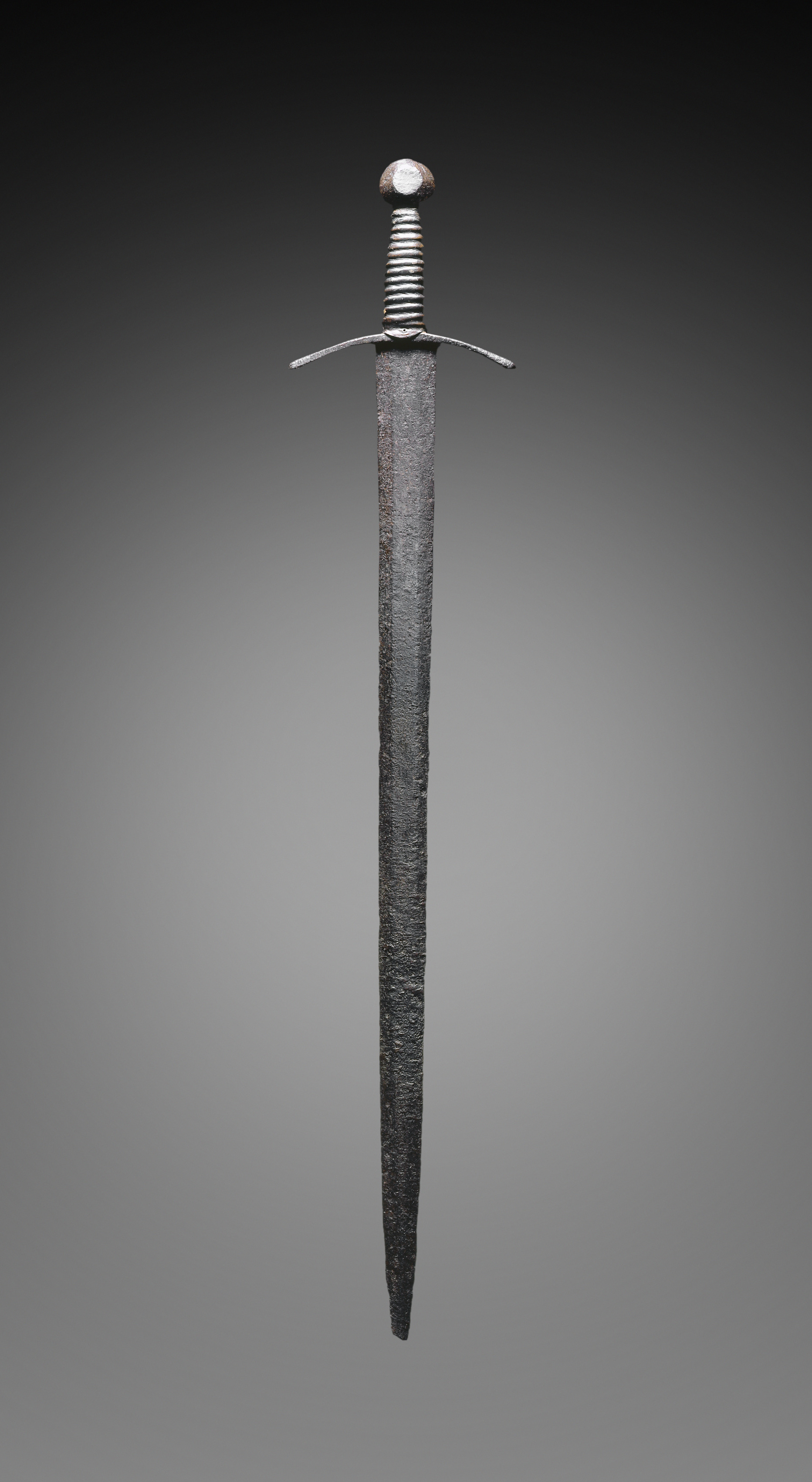
Technical Deconstruction: The 15th-Century European Sword as a Foundational Blueprint
The provided artifact—a European longsword from the early 15th century—presents not as a weapon for our replication, but as a profound structural manifesto. Its core technical triad of steel, leather, and wire offers a foundational lexicon for avant-garde construction. The steel blade is the uncompromising structural DNA: a tapered, resilient core that dictates form and intention. The leather wrap of the grip represents the adaptive interface, the point of intimate human contact, malleable and molded by use. The wire, often binding the leather or decorating the crossguard, is the tensile detail—a element of precise, continuous reinforcement and subtle complexity. This is not mere historical reference; it is a blueprint for integrity, where material honesty dictates form.
Conceptual Genesis: The "New DNA Strand" Reference
The directive to reference a "New DNA Strand" is the critical catalyst, transforming historical analysis into futuristic prophecy. We interpret this not as literal genetics, but as a paradigm of recombination, mutation, and encoded information. The sword's original "DNA"—its sequence of purpose (combat), form (double-edged blade, cruciform hilt), and material—must be spliced and recombined. The new sequence we propose is: Purpose (Protective Articulation) + Form (Deconstructed Helix) + Material (Technical Hybrid).
Thus, the sword evolves from an instrument of division to one of dynamic integration. Its thrusting and parrying motions are translated into articulated joints and protective panels. Its defining length becomes a line of fluid architecture around the body. The "New DNA Strand" is a code for garments that are armorial yet mobile, structured yet organic, carrying the memory of their origin in every seam and joint.
Avant-Garde Translation: From Blade to Articulated Architecture
The avant-garde outcome must resonate with the sword's formidable presence while dismantling its literalness. The core silhouette will be defined by elongated lines and a pronounced central "spine" running the length of the garment, mirroring the blade's dominant axis. This could manifest as a severe, high-necked bodice or a jacket with a rigid, tapered back panel.
Material Re-sequencing: Steel, Leather, Wire Reborn
Steel is reinterpreted beyond cold metal. We propose laminated technical textiles with a metallic sintered coating, achieving a hammered, grey-steel visual and rigid integrity where needed. Alternatively, laser-cut acrylic or polished polymer can be layered to create "plates" with transparency or opacity, suggesting armor without the weight. These become the garment's "blade"—the structural exoskeleton.
Leather retains its role as the primary interface but is engineered. Imagine molded vegetable-tanned leather that forms to the body's curves like a grip, or laser-perforated leather layered over luminous substrates to suggest wear and underlying complexity. It provides warmth, tactility, and historical echo at the points of contact: shoulder yokes, sleeve grips, corseted sections.
Wire becomes the quintessential detail of the new DNA. This is not decorative filigree, but functional articulation. We envision aircraft cable, sheathed in fine bi-colour braiding, acting as tensile "tendons" that connect rigid panels, allowing controlled movement. It appears as spiral-bound closures, as exoskeletal wiring tracing the scapula, or as a complex harness system that holds the garment's architecture to the body—a direct homage to the wire-wrapped grip.
Form Language: Deconstructed Helix and Cruciform Silhouette
The cruciform silhouette of the sword (blade, crossguard, grip) is abstracted into the garment's architecture. The crossguard translates into shoulder articulation—rigid, extended epaulettes or geometric capes that create a strong horizontal line, broadening the silhouette. The blade's taper is inverted or displaced: a jacket may flare sharply at the hem like a blade's tip, or a skirt may be paneled to narrow severely towards the ankle.
Most critically, the "New DNA Strand" informs the construction logic. Seams and panel lines will spiral or follow a double-helix pattern around the body's limbs and torso. This creates unexpected, dynamic lines that break from traditional tailoring, suggesting a molecule being stretched or sequenced. Gussets and articulated joints, highlighted by our "wire" tendons, will be placed at the body's pivot points, enabling a range of motion that rigid armor denies—a fusion of protection and performance.
The Zoey Fashion Lab Prototype: "Sequence XV"
The resulting collection piece, codenamed "Sequence XV", is an avant-garde outerwear system. It features a long, spine-stiffened coat in sintered grey textile, with a silhouette echoing a scabbard. Its front opens to reveal a complex, leather-bodied harness that supports the wearer. The sleeves are constructed with helical seams, from rigid polymer "vambrace" at the wrist to soft leather at the inner arm. Across the chest and back, sheathed aircraft cable forms a geometric, tensile web, connecting rigid panels to a central spinal column, allowing the coat to move with a distinctive, articulated grace.
This analysis deconstructs the sword not to create costume, but to extract a genetic code of resilience, interface, and tension. By mutating its historic DNA through the lens of avant-garde philosophy and technical innovation, Zoey Fashion Lab can produce wearables that are conceptually formidable, structurally ingenious, and deeply resonant with a past reimagined for the future.