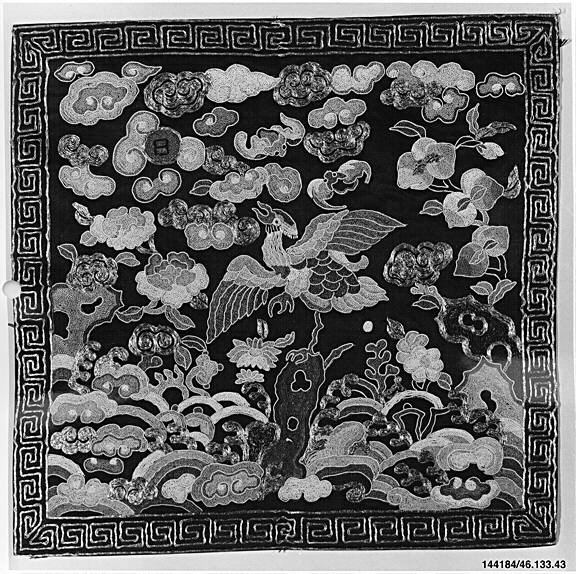
Deconstructing Hierarchy: The Mandarin Duck Badge as Avant-Garde Prototype
Within the ossified semiotics of imperial regalia lies a potent kernel for structural revolution. Zoey Fashion Laboratory’s SS26 investigation seizes upon the Qing Dynasty Mandarin Duck rank badge—a symbol of marital harmony and bureaucratic grade—not as an artifact to be reproduced, but as a conceptual scaffold for deconstruction. This analysis posits the badge not as ornament, but as a generative architectural blueprint, a flat plane whose encoded meanings of union, status, and nature will be exploded into a three-dimensional, futuristic silhouette discourse. The mission is to transmute historical rigidity into dynamic, wearable architecture, using silk and metallic thread not as mere materials, but as antagonistic collaborators in form-making.
Semiotic Fracturing & Volumetric Translation
The foundational avant-garde maneuver is a deliberate fracturing of the badge’s unified pictorial field. The intertwined Mandarin ducks, representing inseparable partnership, are computationally disassembled into their constituent formal elements: the sinuous curve of a neck, the radial fan of a feather cluster, the implied orbital path of one bird around the other. These elements are not printed or embroidered; they are extruded, inflated, and articulated as load-bearing components of the garment’s armature. Imagine a bodice where the negative space between the two birds becomes a laser-cut exoskeleton in stiffened silk organza, creating a suspended, aerodynamic void across the torso. The “harmony” is no longer depicted; it is spatially enacted through tension and balance between separated forms, a commentary on contemporary connections in a digital age.
This process translates the badge’s two-dimensional hierarchy into a volumetric hierarchy of structural prominence. The central, most emblematic motifs undergo maximal dimensional expansion, perhaps manifesting as a rotational, padded-hip apparatus inspired by the ducks’ rounded bodies, while peripheral cloud or wave motifs are miniaturized into intricate, laser-sintered silk-filament attachments that tremble with micro-movements. The wearer becomes the living, mobile substrate upon which this deconstructed iconography orbits, challenging the static, frontal authority of the original badge with a kinetic, multi-perspective corporeality.
Material Antagonism: Silk vs. Metal, Soft vs. Hard
The prescribed materials—silk and metallic thread—are pushed beyond their traditional decorative roles into a state of engineered conflict. Silk is not merely a ground; it is subjected to bio-polymetric treatments, laminated, and molded into rigid, shell-like carapaces that echo the badge’s outline. Conversely, metallic thread is liberated from the role of embroidery. It is woven into high-tensile, conductive cords that act as functional tensile members, like gossamer suspension cables, supporting floating silk planes or creating a dynamic web across the body that contracts and expands with movement.
This antagonism creates the core silhouette innovation for SS26: the “Soft Armor” and “Fragile Load-Bearing” paradigms. A gown may feature a hardened, silk-glycerin composite breastplate derived from the badge’s shape, while the skirt is a sheer cascade of silk georgette, held in precise, geometric folds by a barely-visible lattice of metallic thread. The historical weight of the symbol is physically felt in the structured elements, while its ethereal, allegorical meanings drift in the soft, responsive fields. This duality directly interrogates the modern condition—the tension between individual resilience (the hard shell) and networked vulnerability (the tensile web).
Silhouette as Spatial Intervention: The Orbital & The Asymmetric
The SS26 silhouette family arising from this study rejects the bilateral symmetry of the original badge. Instead, it embraces orbital and radial asymmetry. The concept of “rank” is reinterpreted as gravitational pull or spatial influence. One look might feature a single, exaggerated shoulder monument—a sculptural evocation of one Mandarin duck—that pulls the garment’s axis into a dynamic, off-center rotation, requiring counter-balance through a streamlined, minimalist opposite side. This creates a silhouette that is perpetually in visual motion, even when static.
Another silhouette explores the concept of the badge as a modular, personal ecosystem. Detachable, pod-like elements, inspired by feather clusters and egg forms, can be magnetically attached to a sleek, foundational silk jumpsuit via points dictated by the badge’s composition. The wearer curates their own “rank” and narrative daily, democratizing the badge’s authoritarian purpose. Silhouettes will be high-necked and architecturally precise, with clean lines that suddenly erupt into organic, fluid appendages, mirroring the clash of geometric border and naturalistic center in the original artifact.
Conclusion: The Badge as Living System
Zoey Fashion Laboratory’s avant-garde exegesis concludes by proposing the Mandarin Duck badge not as a relic, but as a progenitor for a new garment taxonomy. The SS26 collection will manifest as wearables that are spatial diagrams of deconstructed power, material dialogues on strength and fragility, and silhouettes that map social orbits onto the human form. The final garments will bear no literal, recognizable image of the ducks. Instead, the viewer who knows the source will experience the profound revelation of seeing a flat symbol of fixed meaning reborn as a complex, breathing, structural organism. It is couture as critical archaeology, building the future not by ignoring the past, but by subjecting its most rigid icons to radical, three-dimensional re-imagination.