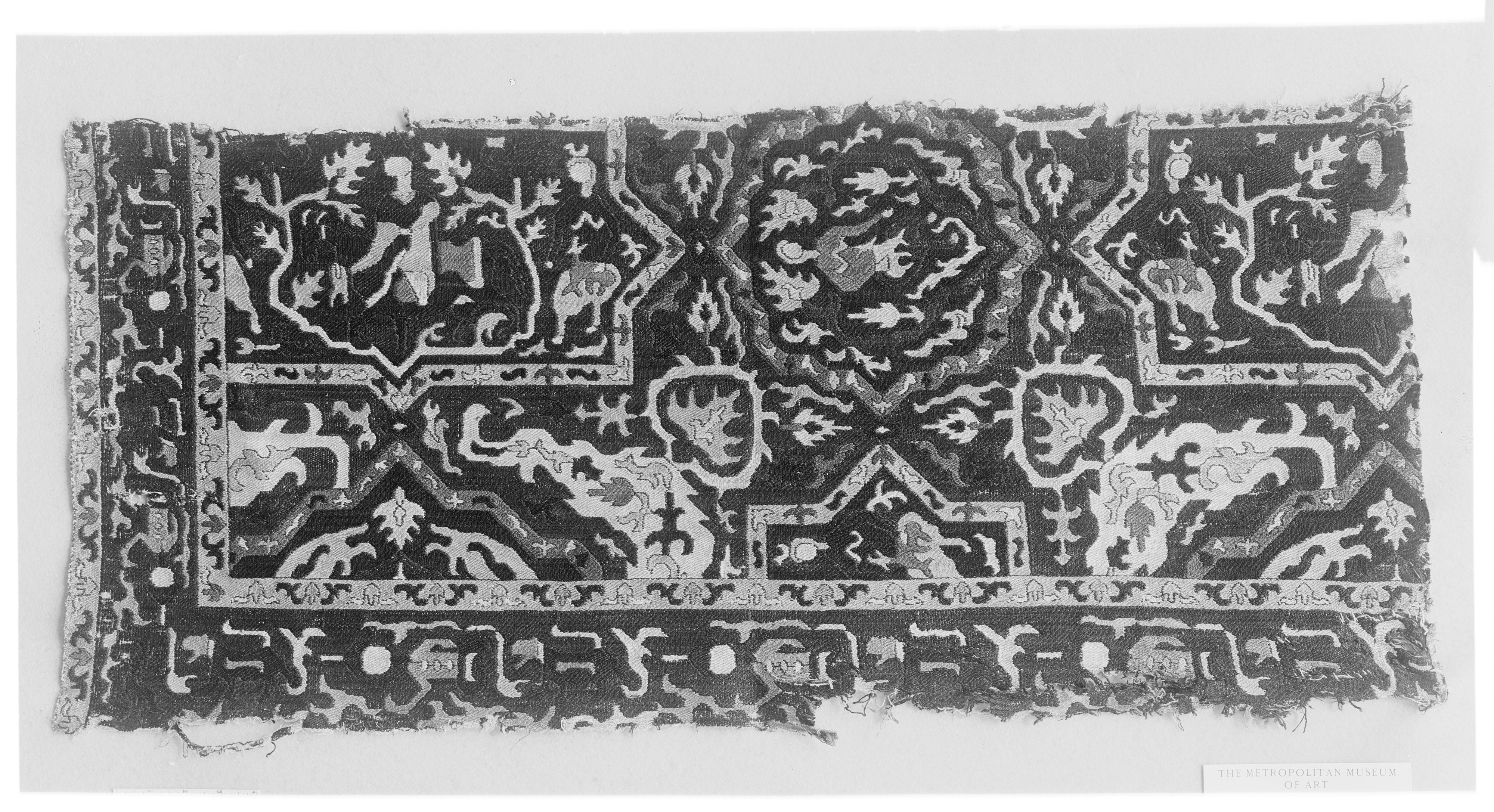
Deconstructing the Frontier: A Textile Fragment as Avant-Garde Genesis
The arrival of the Textile Fragment—Origin: Global Frontier at Zoey Fashion Laboratory was not merely an acquisition; it was an archaeological event from a speculative future. This artifact, a complex stratification of silk upon wool, meticulously embroidered, serves as our primary cipher for the SS26 collection. It is a standalone study that rejects narrative nostalgia, instead proposing a radical blueprint for the body’s relationship with space, memory, and protection. Our analysis moves beyond superficial appliqué; we engage in a deep structural interrogation, using this fragment as the foundational axiom from which all futuristic silhouettes and architectural innovations will be derived.
Material Dialectics: The Silk-Wool Stratum
The fragment’s core material contradiction—the ethereal fragility of silk fused to the tectonic memory of wool—establishes the central dialectic for SS26. This is not a layered composite but a forced, embroidered synthesis. The silk does not float; it is anchored, tensioned, and punctured by thread, creating a micro-terrain of puckers, breaches, and reinforced junctions. This informs our structural philosophy: softness must be engineered, and rigidity must be compromised. For SS26, we translate this into bi-material constructions where thermo-formed wool gabardine provides exoskeletal armatures, over which liquid silk georgette is surgically drawn and pinned, creating landscapes of controlled collapse. The embroidery is not decoration; it is a functional system of structural integrity, a map of stress points that will be scaled into visible seam networks and external corsetry, tracing new anatomical meridians.
Silhouette as Derived Topography
The fragment’s irregular, non-rectilinear border is our key to silhouette innovation. It suggests a form that is non-isotropic, expanding and contracting in relation to unseen forces. SS26 silhouettes will be developed through a process of topological derivation. Imagine the body as a malleable plane; the fragment’s outline is mapped onto it, not as a pattern, but as a set of gravitational rules. This gives rise to our three core silhouette families:
The Asymmetric Vortex: Garments that spiral around the torso, originating from a single, fragment-inspired point of rupture. One shoulder ascends into a wool-structured cowl, while the opposite hip is carved away, the silk cascading in a precipitous drop.
The Peripheral Expansion: Here, the silhouette extrudes outward at seemingly illogical points—the scapula, the lateral thigh—creating prosthetic volumes that are independent of the body’s core. These are not padding but lightweight, wool-framed cantilevers, sheathed in silk, that redefine the wearer’s spatial footprint.
The Perforated Cylinder: Interpreting the fragment’s embroidered apertures, we construct columnar dresses and suits that are systematically voided. These are not mere cut-outs but architectural negative spaces, framed with embroidered-chain piping, which reveal glimpses of layered under-structures or the body itself, challenging notions of exposure and enclosure.
Structural Innovation: The Exo-Endoskeleton
The fragment’s most profound instruction is its lack of a stable substrate. This dismantles the traditional dichotomy of inner structure and outer surface. For SS26, we pioneer the Exo-Endoskeleton. This is a wearable, hybrid infrastructure inspired by the embroidered threads that bind silk to wool. Delicate, resin-coated cords and flexible titanium wire will be routed externally over the garment’s surface, tracing biomechanical pathways (inspired by the fragment’s stitch maps). These cords then penetrate the fabric matrix at key points, connecting to a minimal internal harness. The result is a garment whose tension, drape, and shape can be modulated by the wearer—a responsive, kinetic architecture. A sleeve’s volume, the flare of a trouser leg, or the pitch of a collar becomes adjustable, transforming static couture into interactive design.
Contextualization: The Standalone Study as Collective Future
Positioned as a standalone study, this fragment liberates us from the tyranny of thematic collections. It is a pure, investigative object. For SS26, this philosophy manifests in a collection of autonomous yet conversant garments. Each piece is a solved equation derived from the fragment’s variables, capable of standing alone as a definitive statement on form and material. Yet, when viewed collectively, they form a coherent discourse on post-frontier aesthetics—where the only territory left to explore is the interface between the body and its fabricated second skin. The "Global Frontier" is not a place, but a condition of perpetual innovation.
In conclusion, the Textile Fragment is Zoey Fashion Laboratory’s Rosetta Stone for SS26. It provides the genetic code for a collection that is rigorously intellectual yet profoundly corporeal. We are not creating clothes that reference the future; we are engineering wearable propositions for how the dressed body will occupy, interact with, and redefine the space around it. The silhouette is fractured and reconstituted. Structure is exposed and made interactive. Material is forced into eloquent conflict. This is the definitive avant-garde path forward: a future built from the ruins of a fragment yet to be.