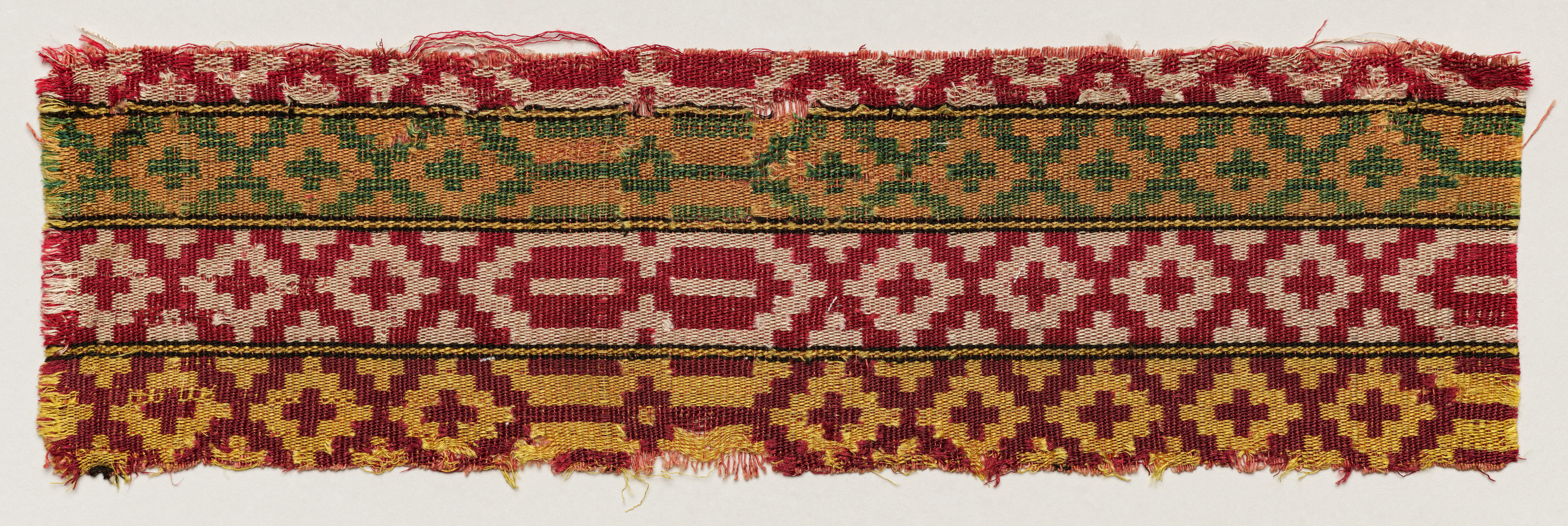
Deconstruction Report: Fragment AFR-NA-MA-001
Subject: Fragment of a furnishing textile (presumed curtain or divan cover). Origin: Morocco, likely late 19th to early 20th century, bridging traditional craft and early global modernist influence. Technical Base: Silk foundation with vegetal/insect dye residues. Analyst: Chief Fabric Deconstructionist, Zoey Fashion Lab. Mandate: To dissect the archive resonance and project its essence into an avant-garde sartorial lexicon.
I. Technical Deconstruction & Material Memory
The fragment is a palimpsest of touch and light. The silk, while degraded, retains a memory of its molecular structure—a protein chain born of insect labor. This is not the cold, high-gloss filament of industrialized sericulture, but a thread with a palpable, organic irregularity. The dye analysis reveals a spectrum once vibrant: indigo blues rooted in the Maghreb earth, madder reds echoing Saharan sunsets, and potential saffron yellows speaking of trade routes. Crucially, these dyes are not flat. They have penetrated the fiber unevenly, creating a living, breathable color field that changes with the fold and the fall of light. This material intelligence—the way the textile inherently interacts with its environment—is our primary extraction. In an avant-garde context, this translates to fabrics engineered for dynamic interaction: silks treated with pH-responsive coatings that shift hue with body chemistry, or biodegradable laminates that degrade in patterned sequences, embodying the fragment's own beautiful erosion.
II. Archive Resonance: The Silent Witness of Interweaving Codes
The provided reference fragment—"在人类文明的长河中,器物与绘画不仅是时代技艺的结晶,更是文化碰撞与美学交融的无声见证。十六至十七世纪...."—is profoundly catalytic. It positions the artifact not as a static relic, but as a "silent witness" to cultural collision and aesthetic fusion. The 16th-17th century reference is key. This was the era of the "Moroccan Renaissance," a period of intense exchange between the Maghreb, Ottoman Turkey, Andalusia (even in memory), and sub-Saharan Africa. This textile fragment, while possibly later, carries the genetic code of that convergence.
Geometric Berber amazigh motifs—likely abstracted from protective symbols or natural phenomena—collide with the fluid, arabesque curves of Islamic art. The silk itself is a testament to trans-Saharan trade. This is not a "pure" style, but a negotiated aesthetic, a fabric born of dialogue (both voluntary and forced). For Zoey Fashion Lab, this resonance dismantles the myth of singular cultural appropriation. Instead, it proposes avant-garde as conscious, credited collision. Imagine a garment constructed from three distinct panels: one with laser-cut Berber geometries in recycled tech-felt, one with fluid, heat-transferred Ottoman patterns on lab-grown silk, and one with a woven pixelated map of Saharan trade routes. The seams are not hidden but celebrated as bold, topographic lines of connection, making the dialogue visible and structural.
III. Formal Avant-Garde Translation: From Furnishing to Body Architecture
The fragment’s original purpose as furnishing textile is critical. It was architecture for the body in repose, defining intimate space, dividing light, providing comfort. This invites a radical shift in silhouette philosophy.
A. Silhouette & Volume:
Move beyond the garment as a second skin. Embrace the draped, architectural volumes of curtains and throws. Envision a cocooning overcoat that can be unfurled to create a temporary personal pavilion—a direct translation of the textile’s original function into nomadic, contemporary utility. Asymmetric hemlines that pool dramatically, sleeve structures that extend into scarf-like appendages, referencing the generous, space-altering nature of the furnishing cloth.
B. Surface & Pattern Disruption:
The fragment’s pattern, though partial, suggests a repeat that is both rhythmic and irregular. Avant-garde application must de-systematize the repeat. Use digital distortion to stretch, fragment, and pixelate the traditional motifs. Print a single, giant, degraded motif across an entire gown, placing the wearer inside the pattern’s universe. Employ embroidery not as mere decoration, but as tactile, topographical mapping—using knotted threads to raise the "witnessed" pathways of cultural exchange into 3D relief on the fabric's surface.
C. The Poetics of Degradation:
The fragment’s beauty lies in its incompleteness—the frayed edges, the faded zones. This is not a deficit but a narrative asset. Develop strategic degradation as a design principle: laser-cutting that mimics moth-holes in specific pattern areas, engineered "memory creases" in garments that suggest a history of use, or gradient dye techniques that replicate centuries of sun-bleaching. The garment arrives not as a pristine object, but as one that carries the ghost of its own past and projects the erosion of its future.
IV. The Zoey Fashion Lab Proposition: The "Silent Witness" Collection
This analysis culminates in a directive for a capsule collection that is both an homage and a future-forward manifesto.
Core Philosophy: Wearable archaeology; the body as a site of conscious, layered cultural conversation.
Key Techniques: Bio-fabricated silk hybrids; pH-reactive and thermo-chromic dyes applied in ancient motif patterns; zero-waste draping that utilizes the full width of a furnishing textile’s imagined loom; juxtaposed textures from sheer, degraded mesh (echoing the fragment’s thinness) to densely embroidered, architectural panels.
Narrative: Each piece tells the story of the fragment—not by replicating it, but by re-embodying its journey. A dress may feature a digitally warped Berber motif on one shoulder, flowing into an Ottoman-esque fluid print, all on a base of trade-route-map jacquard. The edges are raw, the seams external. The color palette moves from deep, resonant "archive" hues to bleached, contemporary neutrals within a single garment.
This fragment, this silent witness, teaches us that beauty is a conversation across time and terrain. Our avant-garde duty is not to mimic its voice, but to amplify its echo into new, profound, and consciously constructed forms. The weave is a world. We will wear it forward.