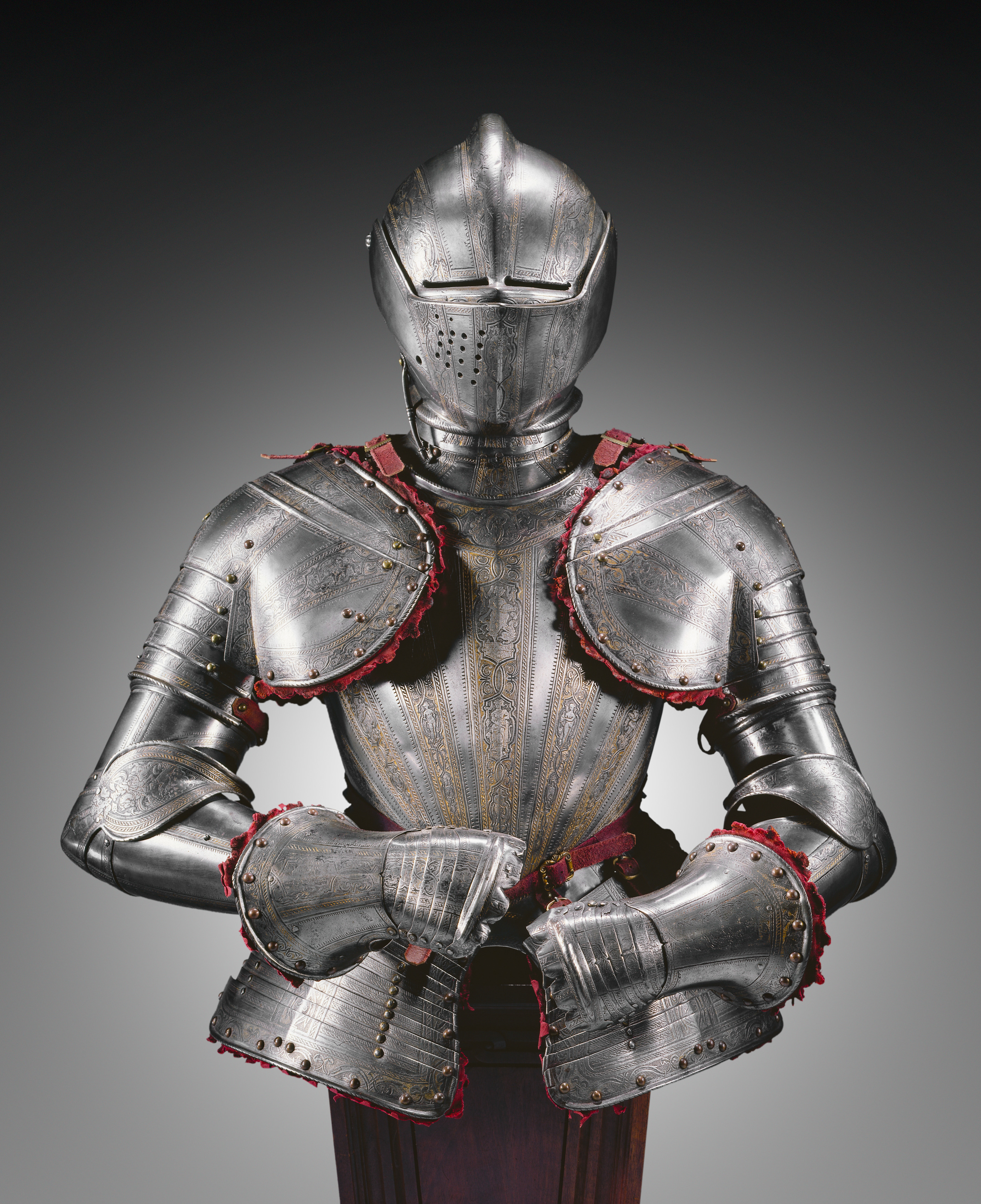
Strategic Analysis: Half Armor for the Foot Tournament
Project Designation: "Exoskeletal Strand"
Origin Point: Milan, Italy
Core Directive: To deconstruct and re-synthesize the martial archetype of the Renaissance foot tournament into a functional avant-garde fashion statement, establishing a new structural DNA for Zoey Fashion Lab.
I. Deconstruction of Origin: The Milanese Codex
The artifact originates from Milan, a city historically synonymous with both supreme armor-crafting and relentless fashion innovation. This is not a coincidence but a foundational data point. The "Half Armor" specifically denotes a pragmatic, mobile defense for the foot tournament—a lower-body-focused contest of skill. Our analysis begins by stripping this object to its core contradictions: brutality versus ceremony, restraint versus mobility, protection versus display. The original was engineered for impact, yet etched and gilded for heraldic identification and status. This dual-purpose nature is the first strand of the old DNA we isolate.
The materials—etched and gilded steel, brass rivets, leather, velvet—form a precise material hierarchy. Steel performs the core function; brass rivets are the functional joints; leather provides articulation and comfort; velvet (likely at points of contact with skin or inner garments) introduces luxury and insulation. This is a biomechanical system where every material has a load-bearing purpose, either physical or social. The deconstruction process reveals not a costume, but an exoskeleton for social combat.
II. Technical Translation: Forging the New DNA Strand
The reference to a "New DNA Strand" is not metaphorical; it is our technical blueprint. We propose treating the historical armor's components as genetic base pairs to be spliced and re-sequenced for a contemporary phenotype.
A. Material Re-coding:
Etched & Gilded Steel: This becomes our foundational textile. We translate etching into laser-cut patterns on technical fabrics—neoprene, coated scuba, or laminated leather—creating perforated motifs that reference Milanese damascene but allow for breathability and movement. Gilding is transposed into strategic applications of metallic foil, heat-transfer films, or fine chains integrated into seams, highlighting "impact zones" not for swords, but for visual attention.
Brass Rivets: Their functional genetics are preserved but expressed differently. Rivets become signature hardware: magnetic closures, articulated joint caps on elbows or knees, or purely decorative studs mapping pressure points of the body. They define a visual rhythm and a tactile language across the collection.
Leather & Velvet Fittings: This pairing is the code for contrasting tactility and internal ergonomics. We interpret it as the constant dialogue between structure and suppleness. Rigid leather panels might be inset with lush velvet on reverse, creating a reversible narrative of armor and lining. Velvet emerges on collar stands, cuff interiors, or as harness straps against technical fabrics, a constant reminder of the body within the shell.
III. Structural Synthesis: The Avant-Garde Manifesto
The "Avant-garde" style mandate requires we move beyond pastiche into prophecy. The "Half Armor" concept, focused on the lower body, directly informs a radical silhouette strategy. We propose collections built on the principle of the "protected core and liberated extremity," or vice-versa.
Imagine structured, hip-defining cuirasses in molded leather or thermoformed polymer flowing into fluid, wide-leg trousers of tech-silk (the modern velvet). Or, conversely, a delicate velvet top secured by a minimalist, riveted brass harness that descends into rigid, articulated leg pieces resembling greaves. Footwear is critical—it is the "tournament ground." Boots become integral, featuring brass-capped toes, articulated ankle guards, and lacing systems derived from gambeson ties.
The "half" nature dictates asymmetry and deliberate exposure. A single armored sleeve or leg guard opposes bare skin or soft drape. This creates narrative tension—what is protected, what is vulnerable? It speaks to a contemporary state of being: digitally armored yet emotionally exposed, professionally fortified yet personally fluid.
IV. The Zoey Fashion Lab Expression: "Exoskeletal Strand" Collection
This analysis culminates in a defined aesthetic and philosophical output for ZFL. The New DNA Strand yields a design language characterized by:
1. Biomechanical Elegance: Seams follow muscle groups and points of articulation, making the body's engineering visible. Panels are layered like plate armor, but with precision-tailored gaps for movement.
2. Ceremonial Utility: Every element, no matter how decorative, suggests a function. A gilded seam is also a reinforced stress point. A velvet-lined collar is also a protective barrier against the elements.
3. Historical Ghosting: The references are spectral, not literal. The silhouette of a pauldron might appear in a sharp shoulder rosette; the curve of a sabaton might echo in a shoe's sculpted toe.
This collection does not dress the individual for battle in a field, but for the contemporary tournament: the urban landscape, the social arena, the boardroom negotiation. It provides psychological armor through deliberate construction. The wearer is encased in a narrative of resilience, history, and innovation—a direct descendant of the Milanese armorer's client, now equipped for 21st-century challenges.
Conclusion: The "Half Armor for the Foot Tournament" is a complete genetic sequence for ZFL's avant-garde evolution. By deconstructing its material hierarchy, social function, and inherent contradictions, we have extracted a viable New DNA Strand. This strand codes for structured yet fluid forms, technical yet luxurious material hybrids, and a powerful asymmetry that speaks to modern complexity. The mandate is clear: forge not replicas, but descendants. Let the collection be a exoskeleton for a new era, etched not with family crests, but with the unmistakable signature of Zoey Fashion Lab.