Deconstructing Solitude: The Wutong Tree as Architectural Blueprint
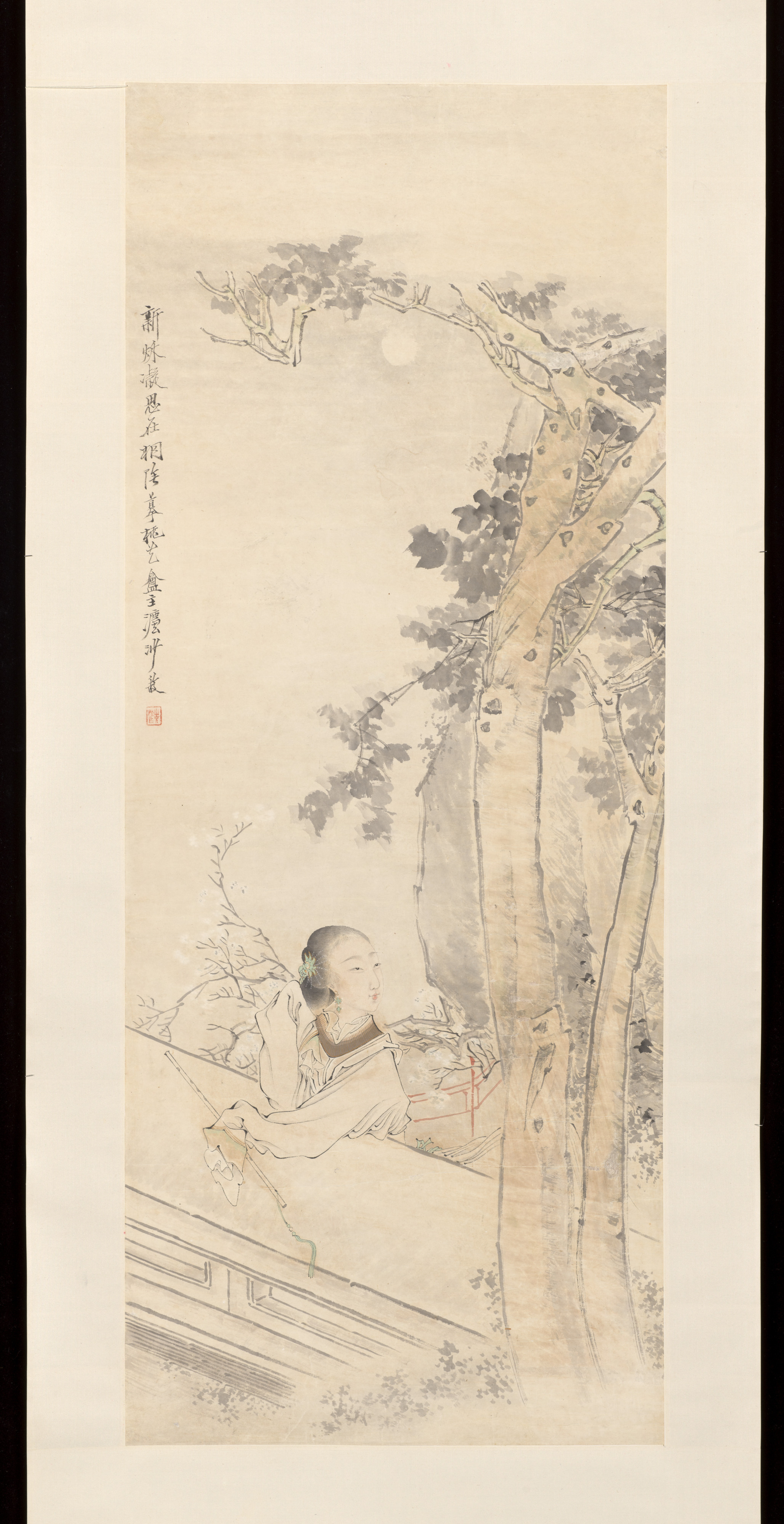
The classical Chinese hanging scroll, depicting a woman lost in thought beneath a wutong tree, presents not a static scene of reverie but a dynamic spatial equation. For Zoey Fashion Laboratory’s SS26, this is our foundational algorithm. The wutong, with its distinctive, broad, palmate leaves and textured bark, is not merely foliage but a complex, layered structural system. The woman’s pensive stillness is not passivity; it is a charged field of potential energy, a human form in dialogue with the void. Our avant-garde translation begins by inverting the relationship: the garment becomes the architectural environment, and the body within becomes the contemplative core. We move beyond literal representation into the realm of inhabited sculpture, where the emotional and philosophical weight of solitude is given a futuristic, wearable form.
Silhouette as Psychic Topography: From Flowing Robes to Asymmetric Volumes
The traditional flowing robes in the scroll suggest a soft merging with the natural setting. SS26 subverts this into a silhouette of calculated dissonance and protected introspection. The core silhouette is built on a principle of "asymmetric containment." Imagine a gown where one shoulder is encased in a rigid, architectural pod-like structure, echoing the gnarled form of the wutong trunk, crafted from a biotech resin fused with powdered ink pigment. This structure extends down the torso in a single, sweeping plane, while the opposite side of the garment dissolves into a cascade of staggered, laser-cut silk organza layers, mimicking the fractal arrangement of the leaves. The silhouette does not follow the body; it defines a new space around it. A high, sculpted neckline on the structured side shields the profile, creating a sense of inward focus, while the fluid side allows for a revelation of movement, symbolizing the outward drift of thought. This is not a garment for blending in, but for constructing a personal, portable sanctuary.
Structural Innovation: The Leaf as Modular Exoskeleton
The wutong leaf is our primary unit of construction. We reject flat appliqué in favor of a modular, kinetic exoskeleton. Utilizing a proprietary, lightweight alloy with a matte, stone-like finish, we engineer individual leaf forms that are attached to a hidden substructure via magnetic articulation points. These "leaves" can be manually arranged by the wearer, allowing the garment’s texture and density to be configured—clustered densely on one shoulder like a heavy thought, or splayed sparsely down a leg like a fading memory. This introduces a performative, interactive element to the couture, where the wearer completes the garment through their own gesture, echoing the original subject’s active contemplation. In some pieces, this system is rendered in translucent, pigmented polymers that overlap to create new depths of color, directly referencing the ink wash gradients of the scroll.
Material Alchemy: Translating Ink and Paper into Future Fabrics
The materiality of the scroll—the absorbent paper, the seep of ink, the slight granulation of mineral pigments—demands a radical re-interpretation. We pioneer a suite of engineered textiles that behave as emotional interfaces. "Liquid Paper" is a technical silk, treated with a temperature-sensitive coating that, when touched by body heat or external air currents, reveals subtle, cloud-like patterns of grey and sepia, mimicking the unpredictable bloom of ink on paper. For the "void" spaces around the figure, we develop a matte, non-reflective jacquard weave with an almost pixelated texture, creating a visual silence that makes the garment’s structural elements appear to float. Most critically, the deep blacks are achieved not with dye, but through a nano-scale etching process on recycled carbon fiber mesh, capturing the absolute, luminous depth of masterful inkwork. This alchemy transforms passive materials into active participants in the garment’s narrative.
Conceptual Architecture: Wearable Space and the Philosophy of Kong (空)
Avant-garde couture at Zoey is never purely formal; it is conceptual architecture. This collection engages deeply with the Chinese philosophical concept of Kong (空), often translated as emptiness or void. In the scroll, the empty space is as significant as the ink strokes. Our garments architect this void. We create negative space through strategic cut-outs that frame the skin, not for sensuality, but as a deliberate aperture of calm. A rigid, torso-defining cage might abruptly terminate to reveal a swath of bare back, a modern interpretation of the untouched paper ground. The interplay between the hard, exoskeletal leaf structures and these vast, empty zones creates a rhythm of presence and absence, material and immaterial, thought and the space between thoughts. The wearer does not simply don an outfit; they inhabit a constructed atmosphere, a three-dimensional poem on solitude and perception.
SS26, therefore, is a definitive step beyond deconstruction. It is aesthetic transplantation. We have taken the genetic code of a centuries-old artistic moment—its mood, its composition, its cultural texture—and spliced it with the DNA of futuristic material science and structural engineering. The result is a collection that is profoundly contemplative yet aggressively innovative. It offers not a costume of the past, but a speculative shelter for the modern psyche: a place, like the shade of that wutong tree, to be gloriously, thoughtfully, and architecturally lost.