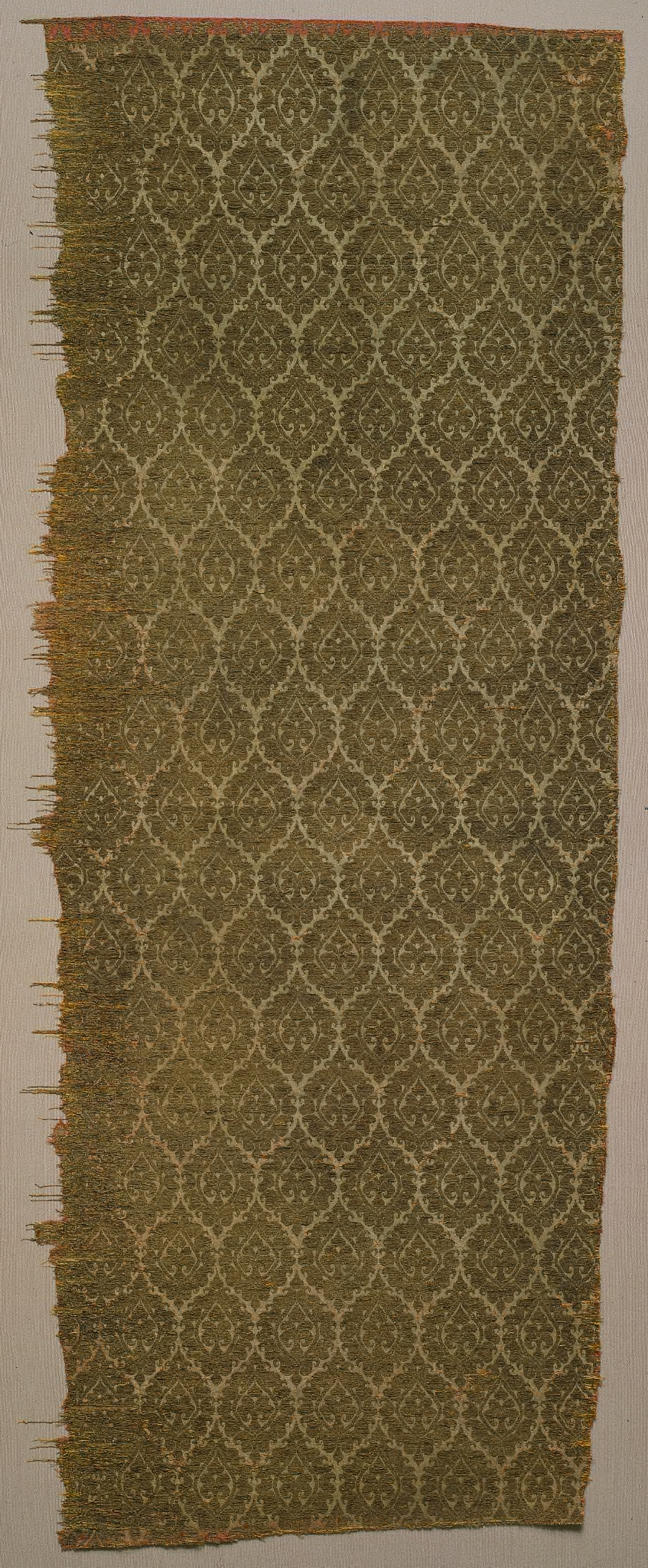
Technical Deconstruction: The Il-khanid Palmette Textile
The provided artifact is a masterclass in convergent textile technology, representing a zenith of both material science and symbolic communication in the 13th-14th century Il-khanid world. Our analysis begins at the structural level. The foundation is a silk tabby (plain weave), a deliberate choice that provides a stable, neutral canvas. The virtuosity lies in the supplementary weft technique, where additional threads—in this case, gold—are woven into the ground fabric to create the pattern without disrupting its integrity. This is not embroidery; it is integral, engineered opulence. The "gold thread" would likely have been silver-gilt strip wound around a silk core, a technology that produced unparalleled luminosity but required immense skill to weave without breaking. The resulting fabric is a study in calculated contrast: the matte, organic drape of silk against the rigid, reflective brilliance of metal. It is a textile designed to move and catch light, transforming the wearer into a dynamic, luminous entity.
The "New DNA Strand": Decoding the Palmette Motif
The reference to a "New DNA Strand" is a potent metaphor for our avant-garde approach. The palmette itself is a genetic chimera. Its core DNA is a helix of cultural histories: a primordial lotus from Buddhist art, migrating west via the Silk Road, fused with the acanthus leaf of Greco-Roman tradition, and finally abstracted and perfected within the Islamic visual lexicon. In the Il-khanid context, post-Mongol unification, this motif becomes a symbol of synthesized authority and cosmopolitan identity.
For Zoey Fashion Lab, we do not merely replicate this pattern. We sequence its genetic code and splice it with contemporary genomics. Imagine the repeating palmette scroll not as a static, historical artifact, but as a visualization of a protein string or a CRISPR sequence. The symmetry and rhythm inherent in the original—a metaphor for cosmic order and infinity—are reinterpreted as the code of life itself. The "new DNA strand" is the pattern of our own era: digital, biological, and data-driven. We extract the principle of modular, infinite repeat and re-express it using algorithms that can mutate, adapt, and respond in real-time.
Avant-Garde Translation: From Il-khanid Court to Future Construct
The directive for an avant-garde style necessitates a radical, conceptual leap while honoring the original's technical and symbolic ambition. We move from regal adornment to speculative embodiment.
Material Re-coding
Silk and gilt thread are translated into advanced material dialogues. The silk tabby ground becomes biologically fabricated spider silk or lab-grown cellulose leather, offering sustainability and unprecedented tensile properties. The supplementary gold weft is reimagined as conductive luminescent yarns (woven with micro-LEDs or electroluminescent wire) or metallic memory alloys that change shape with temperature. The fabric itself becomes an interactive interface. The "supplementary weft" is no longer just decorative; it is a functional layer of circuitry, data transmission lines, or environmental sensors woven directly into the garment's structure.
Form and Function: The Garment as Architecture
Il-khanid textiles often adorned robes of status, defining the wearer's space in a social hierarchy. Our avant-garde interpretation defines physical and digital space. We propose a modular garment system based on the palmette's form. Individual, rigid or semi-rigid palmette shapes, fabricated from 3D-printed biopolymers infused with the smart yarns, interlock to create a wearable exoskeleton. This "textile" is dynamic: it can reconfigure, with panels that shift opacity, emit light, or display data based on biometric or environmental input. The wearer is cloaked in a responsive, architectural second skin—a contemporary emblem of power defined not by static wealth, but by adaptive intelligence and connectivity.
Narrative and Identity
The original textile communicated Mongol imperial power fused with Islamic high culture. Our deconstruction communicates a new identity: the cyborg-nomad. This entity exists at the nexus of the biological and the digital, traversing physical and virtual landscapes. The garment's responsive patterns visualize this hybridity. As the wearer's heartbeat or stress levels change, the palmette "DNA strand" glows, pulses, or alters its scroll pattern. In a networked environment, it could display information streams or interact with other garments. It is status through symbiosis with technology, a direct parallel to the original's demonstration of symbiosis with divine order and earthly dominion.
Conclusion: The Synthesis of Epochs
For Zoey Fashion Lab, this Il-khanid textile is not an archive to be copied, but a prototype to be reverse-engineered and upgraded. We have deconstructed its three core components: 1) its technical composite (silk tabby + supplementary metal weft), 2) its symbolic composite (the palmette as cultural DNA), and 3) its social function (a wearable display of synthesized authority).
Our avant-garde proposal synthesizes these into a new paradigm: Technical Composite 2.0: Bio-fabricated grounds + smart supplementary wefts. Symbolic Composite 2.0: The palmette as data-driven life code. Social Function 2.0: The garment as a responsive, architectural interface for the cyborg-nomad.
This analysis confirms that the most profound avant-garde statements are born from deep archaeological inquiry. By treating the past as a lab, we have extracted the core principles of a masterpiece and used them to engineer a future-facing fashion proposition that is equally ambitious, complex, and emblematic of its time. The project moves from preserving a cultural strand to weaving it into the very fabric of what comes next.