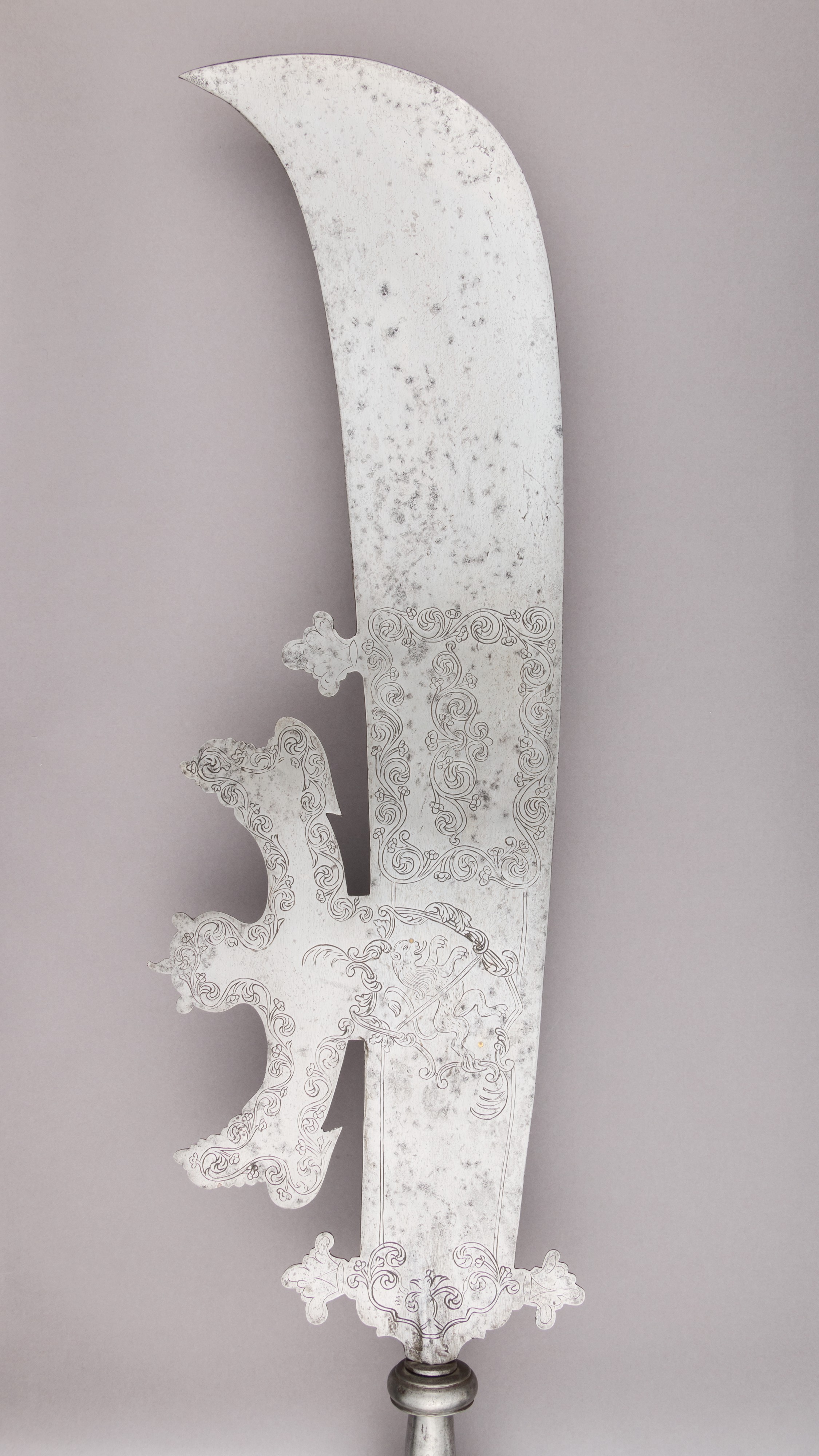
Deconstructing the Arsenal: Fauchard as Avant-Garde Genesis
Within the hallowed, clinical atelier of Zoey Fashion Laboratory, we do not merely design garments; we engineer sartorial propositions. For the SS26 collection, our gaze turns not to the organic or the digital, but to the historical armature of conflict, re-forged into a lexicon of protection and poise. The subject of our standalone study is the Fauchard—a 15th-century Italian polearm characterized by its curved, ax-like blade mounted on a substantial ash wood haft, often augmented with brass fittings. This is not an exercise in historical reenactment, but a radical transposition: from a tool of physical demarcation to a blueprint for architectural wearability. We dissect its materiality (steel, wood, brass, silk) not as literal components, but as ideological codes for a new silhouette philosophy.
Material Semiotics: From Battlefield to Bodyscape
The Fauchard’s material palette provides our foundational syntax. Steel is reinterpreted not as plate, but as exo-skeletal articulation. We employ tempered steel ribbons, cold-rolled to a supple rigidity, which are then laminated between layers of technical silk. This creates articulated panels that mimic the blade’s lethal curve, now manifesting as shoulder cantilevers, spinal corsetry, and hip-deflecting greaves. The steel provides memory and defiance, creating a silhouette that appears both kinetically charged and statically monumental.
The ash wood of the haft translates into the principle of core stability and organic contrast. Thermally molded and laminated ash veneers are integrated as structural spines within garments—a rigid, graceful line running the posterior of a coat, or forming the internal architecture of a sleeve. This introduces a warmth and textural fracture against the cold steel, a reminder of the body’s organic core within its engineered shell. Brass, the connective tissue of the original weapon, becomes our element of luxe junction and functional detailing It appears as pressurized grommets, as telescoping hinge-points at joints, and as thin, foil-like insets that catch light like aged armor, highlighting points of articulation and stress.
Finally, silk—the most profound transposition. Here, it is not mere luxury, but the antithetical membrane. We utilize heavyweight technical silk, often bonded to a polymer mesh, to create zones of fluidity and vulnerability. It billows from steel-edged apertures, drapes in tension against wooden spines, and is sometimes chemically treated to a semi-rigid state, blurring the line between textile and armor. This represents the body’s own fragile system, protected yet perpetually exposed.
Silhouette Innovation: The Polearm Posture
The SS26 silhouette, codenamed “Polearm Posture,” is derived from the Fauchard’s operational geometry. The weapon’s design necessitates a wide, grounded stance and sweeping, rotational movement. Our garments architect the body to echo this potential energy. Silhouettes are asymmetrically biased, with one shoulder elevated and extended by steel-reinforced internal structuring, creating a sense of poised off-balance. Hems are not uniform; they sweep dramatically, longer in the back or sharply angled at the front, tracing the arc of a hypothetical strike.
Key to this is the concept of the “leveraged volume.” Through internal harnesses built from ash wood and elasticized brass-linked chains, we suspend sections of silk-steel composite fabric away from the body. This creates negative space—cavities and tunnels of air around the torso, thighs, or arms—that moves independently of the wearer’s gait. The silhouette thus becomes a dynamic ecosystem, with the body as the central haft and the garments as the sweeping, protective blade in motion.
Structural Innovations: The Haft and The Edge
Our technical breakthroughs for SS26 are direct deconstructions of the Fauchard’s functional anatomy. From the haft, we derive the “Central Tension Spine” (CTS). This is a patented internal system: a flexible carbon fiber rod, sheathed in molded ash wood segments, that runs vertically through a garment. It is anchored at the shoulders and hips, but floats between, allowing the wearer to manually adjust the garment’s dorsal curvature—from a rigid, upright posture to a relaxed, slight arc. The wearer becomes the architect of their own silhouette’s tension.
From the curved blade, we innovate the “Non-Newtonian Drape.” By treating specific zones of our technical silk with a shear-thickening fluid suspended between micro-layers, we create areas that remain fluid and supple during slow movement but rigidify instantaneously upon impact or rapid motion. This mimics the blade’s dual nature: inert yet lethally responsive. A skirt may flow gracefully, then snap into a rigid, sculptural form in the wind, embodying a biomimetic defense mechanism.
Conclusion: The Armature of Autonomy
Zoey Fashion Laboratory’s Fauchard study for SS26 is a definitive move beyond retro-futurism into archaeo-futurism. We have mined the past not for aesthetic motifs, but for embedded principles of power, protection, and kinematics. The resulting collection proposes a wardrobe not of clothes, but of wearable architectures—systems that engage in a dynamic dialogue with the body, enhancing its presence and potential energy. The steel, wood, brass, and silk are no longer mere materials; they are the constituents of a new sartorial philosophy where the silhouette is both shield and statement, a poised and potent declaration of autonomy for the future human form. This is not fashion as decoration, but fashion as strategic exoskeleton, forever captured in the moment between a defensive stance and a graceful, sweeping evolution.