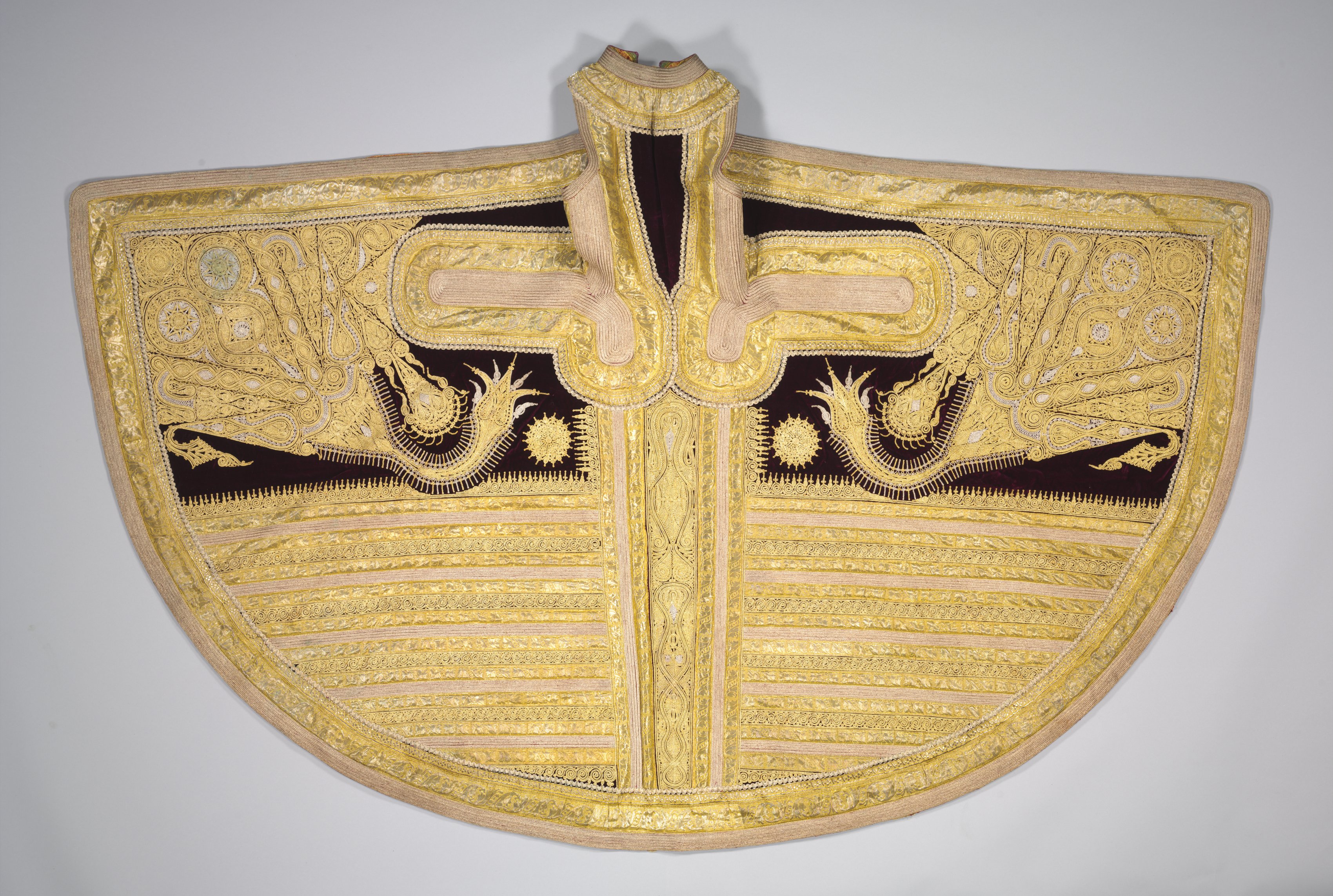
Technical Deconstruction & Material Resonance
The garment in question is a complex artifact of cultural confluence and technical mastery. Originating from the late 19th-century Ottoman sphere, specifically the Prizren/Shkodër axis, it exists at a historical crossroads. Its foundational structure—silk and velvet—speaks to a luxury trade network, while its decorative regime—gold- and silver-thread bands, cords, and couched embroidery—declares a ceremonial, almost heraldic purpose. Our deconstruction begins not with the needle, but with the hand. The couching technique is paramount: the precious metal threads, too brittle to be pulled through the dense velvet ground, are laid upon the surface and secured by finer, almost invisible silk stitches. This creates a low-relief topography, a tactile narrative of wealth and status that catches light differentially, much like the referenced "cold stone sarcophagus panel." The materials are in dialogue: the absorbent, deep-pile velvet negates light, creating a void, while the metallic embroidery reflects it, creating a luminous, raised script. This is not mere adornment; it is a constructed landscape of shadow and illumination.
Archive Resonance: The Dual Narrative Planes
The provided reference—"一面是光洁银镜上以黄金镶嵌的纷繁棕叶纹,另一面是冰冷石棺板上以浮雕诉说的生命叙事"—offers a profound hermeneutic key. It describes a duality: one side, a polished silver mirror inlaid with gold acanthus leaves; the other, a stone sarcophagus panel narrating life in relief. This perfectly encapsulates the garment's ontological duality.
The velvet ground is the sarcophagus panel: dark, somber, a field of memory. The couched metallic embroidery is the浮雕 (relief), the raised narrative that speaks of a life lived—perhaps the social life, the marital status, the regional identity, or the familial wealth of the wearer. Conversely, the metallic threads themselves, particularly the silver, function as the silver mirror. They are not merely decorative; they are reflective, interactive, and changeable. As the wearer moved, the threads would catch fleeting light, creating a kinetic, shimmering effect—a "polished mirror" that reflected not an image, but a phenomenon of light and presence. The "纷繁棕叶纹" (profuse acanthus leaves) directly correlate to the likely vegetal and arabesque motifs of the Ottoman embroidery style, suggesting an organic, flourishing life narrative against both reflective and absorptive grounds.
Avant-Garde Reconstruction for Zoey Fashion Lab
Moving from deconstruction to reconstruction, this analysis must fuel an avant-garde translation. The core concept is Duality and Reflection. The historical garment communicated fixed status; our contemporary iteration will communicate fluid identity.
Proposed Conceptual Iterations:
1. The Reversed Ground: Imagine a garment where the "velvet" and "metal" exchange properties. We engineer a base fabric from a technical, micro-laser-cut synthetic that has a mirror-like sheen—our silver mirror. Upon this, we "embroider" with voids. Using laser etching, flocking, or a dense, light-absorbing matte polymer appliqué, we create the narrative pattern. The wearer becomes a walking negative: the "embroidery" is dark, absorptive, and tactile (the sarcophagus relief), set upon a field of reflective, fluid light (the mirror). This inverts the historical power dynamic and questions what constitutes the "ground" of identity.
2. Kinetic Couching & The Data Narrative: We retain the couching technique but revolutionize its elements. The "gold and silver threads" become fine, flexible electroluminescent wires or fiber optics, couched onto a sheer, dark silk-georgette ground (the modern velvet). The securing stitches are not merely functional; they are conductive touchpoints. The pattern is not static flora but could be a circuit diagram, a city grid, or a neural network. The light within the threads can pulse, fade, or change color based on biometric feedback or external data streams, transforming the garment from a record of static social status to a real-time interface displaying personal or environmental data—a true "life narrative" in dynamic, illuminated relief.
3. Deconstructed Ceremonial: We dissect the garment's ceremonial form. Instead of a dress or jacket, the gold bands and cords become a modular harness system. These structural elements, crafted from gilded recycled thermoplastic polyurethane or molded biopolymer, can be attached, detached, and reconfigured over a base slip of dead-matte silk crepe. The wearer assembles their own ceremonial identity each day. One configuration may reference the original Ottoman silhouette; another may form a radically abstract, architectural exoskeleton. This makes the "archive" a kit of parts, privileging process and personal agency over fixed form.
Material & Ethical Sourcing Directive
The avant-garde vision must be grounded in ethical practice. Our "gold thread" should be explored as gilded filaments from upcycled electronic waste or plant-based metallic dyes printed onto recycled polyester yarns. Our "velvet" could be reinvented as a vegan velvet from seaweed fiber (SeaCell™) or a recycled nylon micro-velour, offering a new ethical and sensory depth. The sourcing narrative itself becomes part of the garment's story, a 21st-century response to the 19th-century trade networks that brought silk and metal to the Balkans.
Conclusion: The Living Archive
This late 19th-century garment from the Balkans is not a relic but a resonant system. It is a dialogue between dark and light, stillness and movement, the permanent record (sarcophagus) and the fleeting moment (mirror). For Zoey Fashion Lab, the avant-garde opportunity lies in exploding this duality. By transmuting materials, animating techniques, and destabilizing form, we can create pieces that honor the complexity of the source while propelling its core conversation—how surface narrates identity—into a dynamic, participatory, and critically engaged future. The final design should not resemble the original, but should make the viewer feel the same conceptual tension: between the archival weight of history and the brilliant, reflective flash of the now.