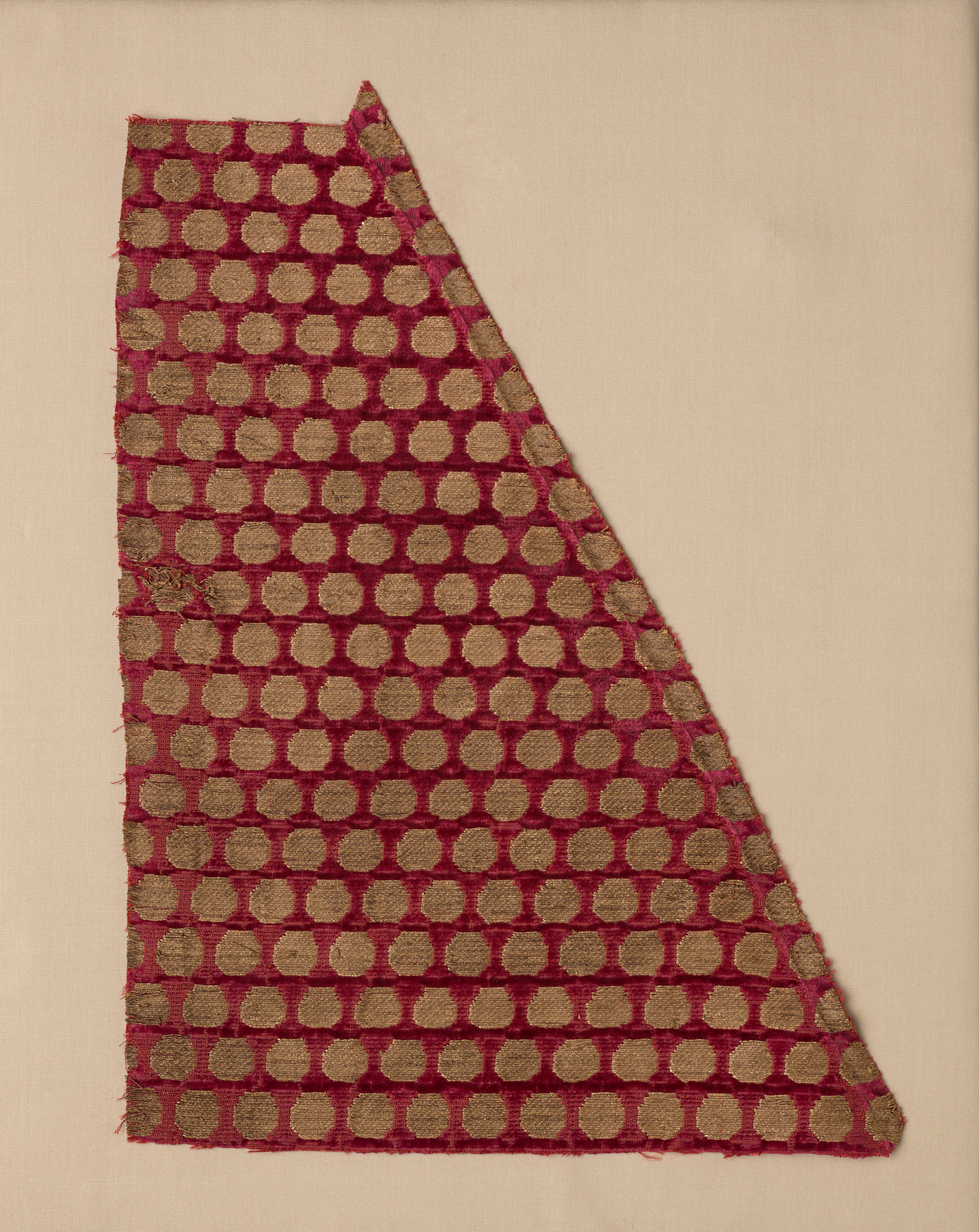
Technical Analysis: Velvet Fragment in Two Pieces
The provided artifact, a velvet fragment in two pieces, represents a pinnacle of medieval Islamic textile artistry and a profound technical challenge. Its stated origin—Iran or Iraq, 14th century—places it within the Ilkhanate period, a time of extraordinary cultural exchange and artistic refinement along the Silk Road. The technical specifications velvet, lancé, silk and Cyprian gold around silk core describe a fabric of immense complexity and luxury. Velvet itself, a pile weave, requires a specialized loom and exceptional skill to produce. The lancé technique indicates a supplementary weft patterning, where additional threads (in this case, the precious metal-wrapped yarns) are "shot" or inserted to create the design against the velvet ground, a method allowing for great curvilinear freedom.
The material composition is paramount. The foundation is pure silk, prized for its strength, sheen, and dye affinity. The metallic thread, described as Cyprian gold around silk core, refers to a fine strip of gold—likely from Cyprus, a noted medieval source—wound spirally around a silk filament. This creates a flexible, luminous yarn that catches light dynamically. The combination results in a textile that was not merely clothing but a display of economic power, technological mastery, and high-status identity. The fragment’s survival, despite its fragility, makes it a direct physical link to a sophisticated workshop tradition.
Deconstructionist Interpretation: The "New DNA Strand" Reference
The reference New DNA Strand is a potent metaphor for our deconstructionist approach at Zoey Fashion Lab. We do not see a static relic; we see a coded sequence of aesthetic and structural information waiting to be sequenced, decoded, and recombined. The two pieces, though separated, contain the complete "genetic" blueprint of the original artifact's construction and intent.
First, we decode the Structural DNA: the warp, weft, pile, and lancé threads. This reveals the foundational logic—the ratio of tension between ground and pattern, the precise angle of the pile cut that dictates light absorption and reflection, the rhythm of the metallic insertion. Second, we isolate the Material DNA: the protein sequence of the silk, the molecular signature of the gold alloy, the mordants that held lost dyes. This speaks to global trade and material science. Finally, we extract the Aesthetic DNA: the fragmentary pattern, likely a scrolling vine or arabesque, embodies a specific philosophy—infinite repeat, geometric harmony underlying organic form, a non-representational spirituality.
Our task is to sequence this triple-helix of information. The "newness" of the strand comes from our act of isolating these codes from their historical context and preparing them for avant-garde recombination. The tear or separation of the fragment is not a tragedy but a provocation, revealing cross-sections and internal geometries that would otherwise remain hidden.
Recombinant Design Strategy: Avant-Garde Manifestation
The directive Style: Avant-garde demands we move beyond pastiche or literal revival. We are not recreating a 14th-century robe. We are using its decoded DNA to engineer a new organism for the contemporary body and mind. The avant-garde impulse is one of radical questioning and reinvention, perfectly aligned with deconstruction.
Proposed Transformations:
1. Material Transmutation: The core material concept—a soft, tactile ground juxtaposed with a hard, luminous line—is our starting point. We will replace the silk velvet with a technically advanced ground: perhaps a recycled polyester velvet engineered for chromatic depth, or a plant-based vegan suede. The "Cyprian gold" thread will be reinterpreted. One avenue is sustainable metallics—upcycled aluminum foil laminated onto organic thread, or a yarn coated with a mineral-based, light-reflective ceramic glaze. Another is a complete conceptual swap: the gold line becomes a trail of embedded LED fibers, or a piping of transparent silicone filled with bioluminescent algae culture. The material dialogue shifts from silk-and-gold to bio-tech-and-recyclate.
2. Structural Explosion: The lancé technique, where pattern floats on the surface, will be exploded into three dimensions. Using the decoded pattern rhythm, we will create laser-cut appliqués from the new ground material, applying them in layered, topographic formations onto a base garment. The "pile" becomes exaggerated tufts, frayed edges, or pneumatic pods that inflate/deflate. The two separate fragments inspire a design of intentional fragmentation—a garment system of detachable panels, connected by magnetic closures or technical straps, allowing the wearer to reconfigure the silhouette. The garment itself exists in "two pieces," in constant dialogue.
3. Aesthetic Recoding: The original pattern, likely continuous and flowing, will be subjected to digital glitch, pixelation, or algorithmic dispersion. Using the "New DNA Strand" as data, we can generate a new, non-repeating pattern through code, perhaps one that responds to environmental data like sound or air quality. The luxurious, singular object of the past becomes a dynamic, interactive interface.
Final Concept Outline: The "Ilkhanate Sequence" Collection
For Zoey Fashion Lab, this analysis culminates in a proposed capsule: The Ilkhanate Sequence. It features garments that are maps of their own deconstruction.
• Look 01: The Strand Gown. A minimalist sheath dress in engineered black velvet, with a single, continuous "lancé" line of recycled copper fiber tracing an abstracted vine from shoulder to hem, physically removable via a zip-track system.
• Look 02: The Fragment Jacket. A structured blazer composed of two distinct, interlocking pieces—one in shearling, one in technical satin—connected by a harness of gold-anodized hardware. The internal lining prints a high-resolution scan of the original fragment's verso.
• Look 03: The Reactive Cape. A cape of photovoltaic velvet whose surface, embedded with micro-prisms, projects a slowly evolving, light-based interpretation of the original pattern onto the wearer's surroundings.
This approach honors the fragment not by replicating its form, but by resurrecting its innovative spirit. We transplant its DNA into the ecosystem of 21st-century fashion, creating pieces that are equally conversant in deep history and speculative future. The 14th-century artisan sought to capture divine beauty in silk and gold. Zoey Fashion Lab's avant-garde mission is to capture the beauty of transhistorical dialogue, material intelligence, and conscious innovation.