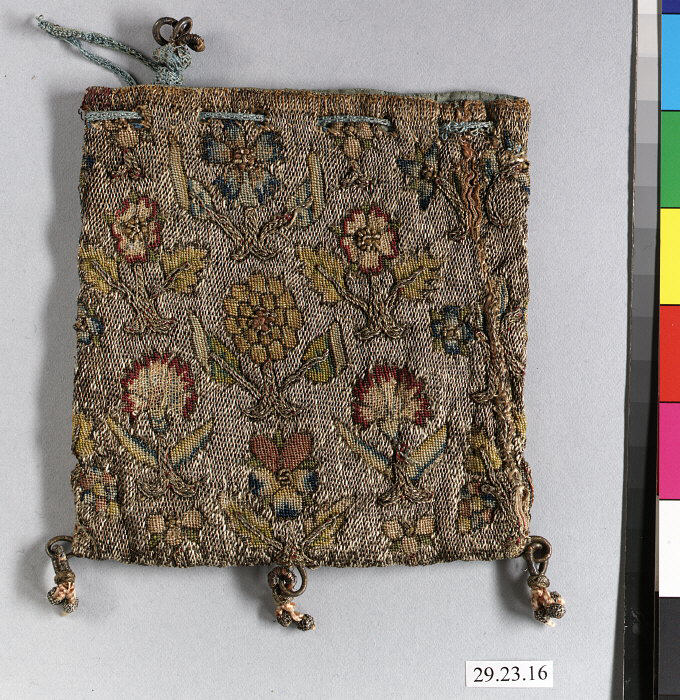
Deconstructing the Vessel: The 'Global Frontier' Bag as Architectural Proposition
In the lexicon of contemporary avant-garde practice, the handbag has long transcended its utilitarian genesis to become a site of profound architectural and sociocultural inquiry. For Zoey Fashion Laboratory's SS26 standalone study, the subject is not merely a 'bag' but a nomadic architecture for the corporeal self. Originating from the conceptual 'Global Frontier'—a non-place denoting perpetual transition and hybrid identity—this piece leverages the paradoxical materiality of silk and metal thread on canvas to interrogate the very principles of structure, protection, and portability. This analysis posits the creation not as an accessory, but as a wearable manifesto on post-territorial existence.
Material Dialectics: The Soft Armor of Silk and Metal
The foundational innovation resides in its deliberate material contradiction. Canvas, a substrate of historical journeying and labor, is here transformed through a meticulous, labor-intensive fusion of dueling elements. The silk, representing organic fluidity and ephemeral memory, is not appliquéd but woven integrally with a conductive, high-tensile metal thread. This creates a textile that is simultaneously pliant and rigid, capable of holding radical form while draping with biological irregularity. The surface becomes a topographical map: areas of dense metallic embroidery act as exoskeletal reinforcement, while expanses of raw, silk-washed canvas suggest vulnerability. This is soft armor for a frontier not of conflict, but of constant cognitive and cultural negotiation. The material whispers of both the cocoon and the circuit board, establishing a tactile language for SS26 that is profoundly biomimetic yet undeniably techno-logical.
Structural Innovation: The Non-Binary Silhouette
Moving beyond the established tropes of deconstruction, this study engages in volumetric displacement and load-bearing paradox. The silhouette refuses a singular reading. It is neither strictly geometric nor fluidly organic; it exists in a state of engineered ambiguity. Through a patented internal armature—a lightweight, reticulated cage of shape-memory alloy—the bag can be manipulated by the wearer into multiple, distinct architectural states: a compressed, angular form that echoes folded aerospace origami; an expanded, voluminous vessel reminiscent of a dilated seed pod; or a slung, elongated silhouette that interacts dynamically with the body's gait.
This interactivity dismantles the passive relationship between object and user. The closure systems are reimagined as kinetic tension points, utilizing magnetic repulsion and silk-cord lacing derived from parachute rigging, allowing the aperture to gape open as a deliberate design feature or seal with hermetic precision. The handles are eliminated in their traditional sense, replaced by a system of canvas-and-metal straps that can be reconfigured as a cross-body harness, a handheld loop, or even anchored to a garment's existing structure, proposing a future of fully integrated wearable ecosystems.
The SS26 Futuristic Context: Portability as Performance
Within the speculative narrative of SS26, where digital and physical selves are in constant, fluid dialogue, this bag operates as a biomorphic interface. Its canvas, treated with a subtle, reactive coating, can register environmental changes or biometric data through shifts in texture or the low-level luminescence of its metal threads. It is a vessel designed not for possessions alone, but for experience and data—a "psychic cache." Its form-factor evolution speaks directly to the collection's broader themes of adaptive identity. On the frontier, one's tools must be multifunctional and resilient; this object answers that call not with brute strength, but with intelligent, responsive morphology.
Conceptual Genesis: The Standalone Study as Critical Object
As a standalone avant-garde study, its power is magnified by its autonomy. It is not subservient to a matching ensemble; it is the protagonist. This allows for a purer, more radical focus on its architectural proposition. It challenges the industry's seasonal churn by presenting an object designed for longevity through transformation, not through timeless classicism. The 'Global Frontier' bag is a speculative prototype for a new category of wearables—one where emotional resonance is built through structural honesty and interactive potential, rather than through branded semiotics. It asks the critical question: in a dematerializing world, what is the future function of a container? Its answer is to become a scaffold for the self, a portable habitat that is as mutable and complex as the identity of its bearer.
In conclusion, Zoey Fashion Laboratory's study transcends accessory design to enter the realm of critical design art. It is a masterful synthesis of opposing materialities, a pioneering exploration of user-defined silhouette, and a profound commentary on contemporary nomadism. It does not predict the future of bags; it architects a future for the embodied human experience, offering a canvas of silk and metal upon which the wearer inscribes their own journey across ever-shifting frontiers. This is not a product for SS26; it is a proposition for a new way of carrying, and consequently, a new way of being.