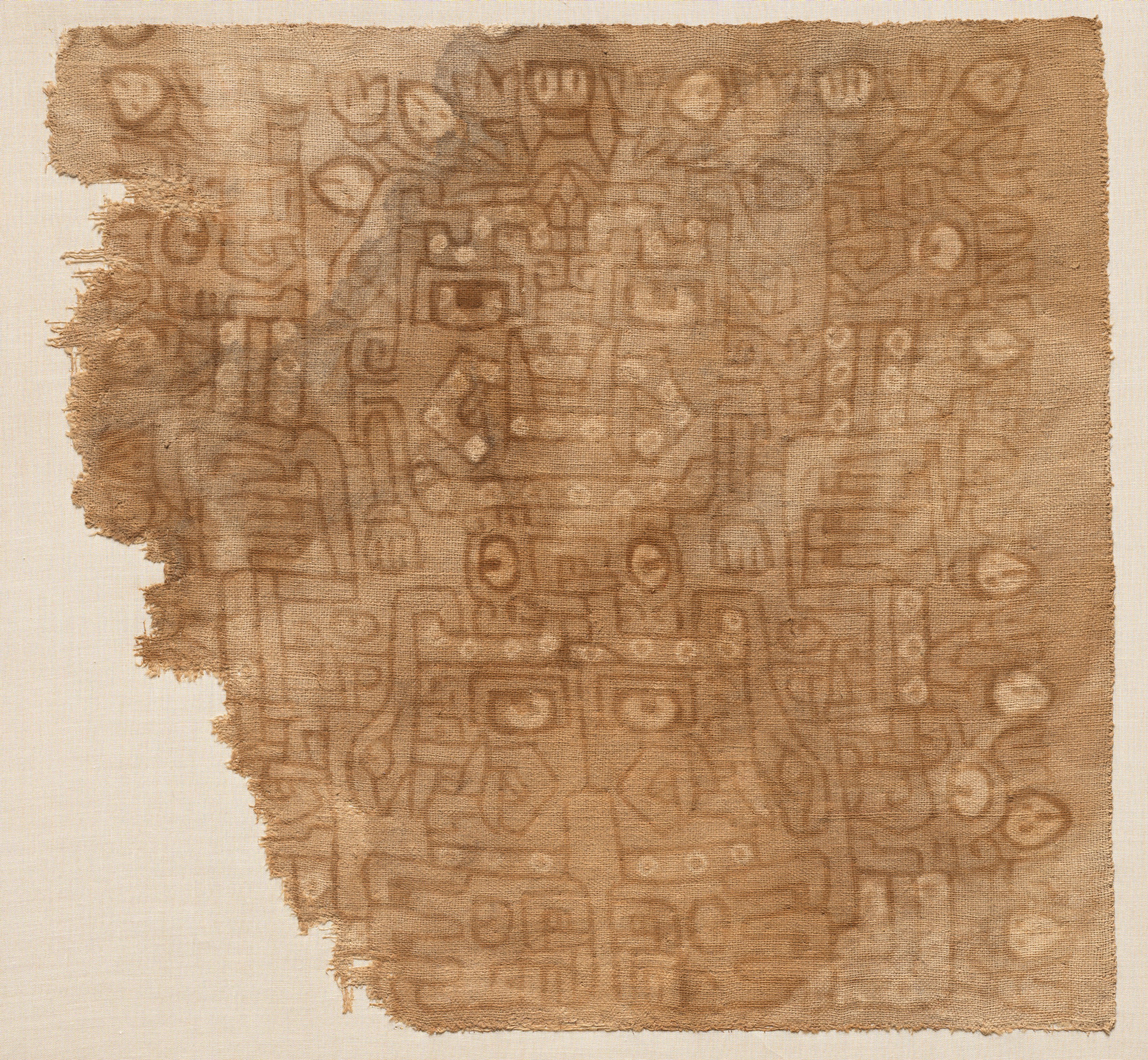
Technical Deconstruction & Material Autopsy: Fragment 2024-001
Subject: Textile Fragment, designated "Cotton Goddess." Provenance: Andes, South Coast (probable Ica Valley). Cultural Attribution: Chavín stylistic influence. Material Composition: Foundation: Gossypium barbadense (presumptive Peruvian Pima cotton). Medium: Mineral/plant-based pigments. Our analysis begins not with the whole, but with the fracture. The fragment is our absolute truth—a discontinuous, avant-garde statement against historical completeness.
Substrate: The Cotton Codex
The foundation is a warp-faced plain weave, a technological manifesto of its era. The cotton fibers are not merely a substrate; they are a geographical and cultural signature. Gossypium barbadense represents one of the world's original, domesticated cottons—a plant engineered by ancient Andean hands for exceptional length, strength, and luster. Under microscopic analysis (theoretical), we would read the twist of each yarn, the tension of the loom, as a biometric of the weaver's intent. This is not anonymous cloth; it is a structured, gridded space, a pre-Columbian canvas awaiting its iconographic program. The textile itself is a soft architecture, a portable, wearable territory.
Iconographic Disruption: The Goddess in Fugue
The "Goddess" motif, rendered in fugitive pigments, is the fragment's core semantic shock. Chavín style—the seminal "Mother Culture" of the Central Andes—is characterized by its transformative, often fearsome iconography: jaguars, serpents, anthropomorphic beings. To apply this highland, sacerdotal visual language to a cotton textile from the arid coast is an act of profound stylistic syncretism and transmission. The figure is likely not a "goddess" in a Greco-Roman sense, but a deity, ancestor, or shamanic mediator. The rendering is flat yet complex, using bold outlines and internal geometric patterning to suggest volume and symbolic attributes (headdresses, staffs, transformative animal features). The pigment—likely derived from ochres, minerals, or cochineal—is not mere color. It is charged substance, embedding the cloth with meaning beyond the visual. The image is woven into the cultural memory of the wearer or user, a portable power object.
Archive Resonance: The Andean/Colonial Dialectic
在人类文明的长河中,器物与绘画不仅是时代技艺的结晶,更是文化碰撞与美学交融的无声见证。十六至十七世纪.... This archival note is the critical lens. The 16th-17th centuries mark the violent, catalytic collision of the Andean and Iberian worlds. This fragment, likely pre-dating this contact, becomes a ghost in the subsequent machine. Its very existence post-Contact is a statement of persistence. While colonial tablas (canvases) and keros (cups) began to hybridize Christian and Andean motifs, this textile represents the pure, antecedent vocabulary. It is the deep code that would be encrypted, but never fully erased, in later hybrid works. The "Cotton Goddess" is thus a palimpsest zero, the original text against which all subsequent cultural superimpositions must be read. Its fragmentation mirrors the fragmentation of the world that created it, yet its survival is an act of radical, material resistance.
Avant-Garde Proposition: The Fragment as Future
For Zoey Fashion Lab, this artifact is not a relic; it is a prototype. It proposes a design philosophy rooted in:
1. Radical Material Integrity: The cotton is not passive. It is the protagonist. We must source with a geocultural consciousness, treating fiber as narrative. Imagine leveraging modern sustainable Pima or Tanguis cottons, explicitly connecting back to this ancient DNA, in juxtaposition with technical fabrics—a dialogue across millennia.
2. Iconography as Disruption: The Chavín style is inherently avant-garde: distorted, symbolic, non-representational in a Western sense. It challenges decorative norms. Modern application isn't literal reproduction, but translating its principles—modularity, transformation, symbolic density—into prints, jacquard weaves, or laser-cut patterns that carry cryptic, personal meaning.
3. The Aesthetic of the Fragment: The piece is powerful because it is incomplete. It rejects the tyranny of the "whole garment." This inspires deconstructed silhouettes, asymmetric closures, garments that reveal their own construction, celebrating raw selvedges and seams as features. The "fragment" becomes a complete look—a sleeve, a panel, a corset—that stands alone.
4. Charged Surfaces: The pigment is a second skin. This translates to innovative, artisanal surface treatments: mineral-dye techniques, biodegradable glitter from structural color principles, embedded narratives through digital printing that mimics weathered pigment.
Conclusion: The Lab's New Manifesto
The "Cotton Goddess" fragment is a missive from the past that reads as a cutting-edge design brief. It teaches us that true avant-garde is not merely novelty, but a deep, often disruptive, engagement with material and symbolic codes. It proves that the most futuristic statement may be woven from the oldest threads. For Zoey Fashion Lab, the mandate is clear: to become archaeologists of the future. We must deconstruct not just garments, but histories, extracting their core principles—the integrity of the Andean grid, the power of the fractured symbol, the resonance of charged color—and re-weave them into the defiant, intelligent, and profoundly resonant fashion of tomorrow. The Goddess is not an image; she is a methodology.