Deconstructing the Golden Flora: From Xinjiang Plaque to SS26 Structural Syntax
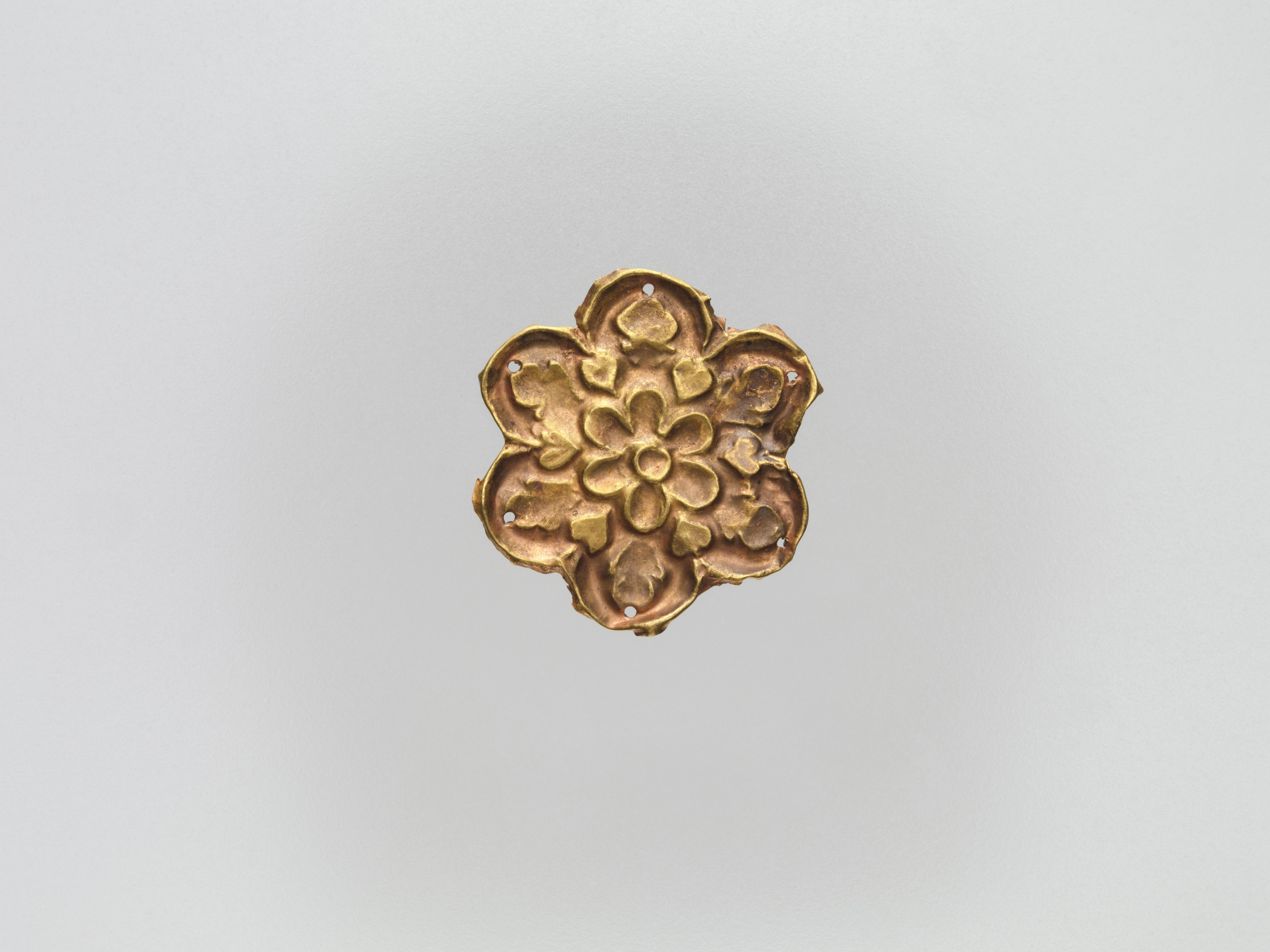
The Flower-Shaped Clothing Plaque, a singular artifact of gold from China's Xinjiang Autonomous Region, is not merely an adornment; it is a primordial blueprint for structural intent. Recovered from the nexus of the Silk Road, it embodies a confluence of dialogues—between the nomadic and the settled, the ornamental and the talismanic, the organic form and the imposed geometry. For Zoey Fashion Laboratory’s SS26, this plaque serves as our core computational seed. Its very existence as a “clothing plaque” proposes a radical premise: that structure, not fabric, is the primary epidermis. It is an exoskeletal node, a hardwear point of attachment that dictates drape, tension, and bodily articulation from a fixed, non-negotiable locus. Our analysis deconstructs this premise into three core avant-garde directives: the Exoskeletal Node, the Binary Surface Narrative, and the Algorithmic Flora.
Directive I: The Exoskeletal Node & The Structural Field
The plaque’s primary function was to anchor, to secure, to impose order upon pliable textiles. SS26 transposes this concept from historical fastening to futuristic architecture. We envision not singular plaques, but kinetic exoskeletal networks fabricated from carbon-fiber-infused bio-resins, plated in matte lunar gold. These networks form a lightweight, articulated cage that exists in the negative space between body and garment. The “clothing” itself—sheers of recycled silica membrane or fluid, non-woven titanium wool—is suspended from, or slotted through, this nodal field. Silhouettes are born from the tension between rigid point and fluid plane. A gown becomes a “tension-field manifestation,” where fabric pools at gravitational nodes defined by the exostructure, creating unexpected volumes and voids that challenge the body’s traditional silhouette. This creates a living, breathing architecture where movement alters the structural relationship, a direct evolution from the plaque’s static anchorage.
Directive II: Binary Surface & The Dialectical Silhouette
The provided archive node—“一面是光洁银镜上以黄金镶嵌的纷繁棕叶纹,另一面是冰冷石棺板上以浮雕诉说的生命叙事” (One side is intricate palmette patterns inlaid in gold on a smooth silver mirror, the other is a life narrative told in relief on a cold stone coffin panel)—presents a profound dialectic. It is the dichotomy of surface: reflective/absorptive, ornate/narrative, fleeting/eternal. SS26 materializes this binary as the Dialectical Silhouette. Each garment embodies two contradictory states. Imagine a jacket whose exterior is a flawless, mirror-polished electroluminescent silver, programmed to display algorithmic interpretations of the plaque’s floral motif. Its interior, however, is a “cold relief”—a textured, 3D-printed topography based on biometric data or cellular structures, a personal “life narrative” in tactile form. The silhouette itself transforms as it interacts with the wearer: a sharp, reflective carapace can be shed or inverted to reveal a soft, narrative-driven topography, making the act of dressing a performative dialogue between the external gaze and the internal self.
Directive III: Algorithmic Flora & Morphogenetic Growth
The plaque’s flower is a stylized, symbolic representation—nature filtered through culture and craft. SS26 pushes beyond representation into generative morphogenesis. Using the plaque’s radial symmetry and petal array as a seed algorithm, we will grow garments through computational design. Techniques like parametric modeling and additive manufacturing will create textures and forms that mimic organic growth patterns but are constructed from entirely synthetic, futuristic material composites. Imagine a dress that appears to have crystallized onto the body, its “petals” formed from interlocking, laser-sintered polyamide units that bloom from the exoskeletal nodes mentioned in Directive I. This is not a print of a flower; it is the realization of floral logic as a structural principle. Color is treated as a property of materiality—the deep, muted gold of the artifact reinterpreted as a vapor deposition on recycled aluminum foil chiffon, or as a shifting hue in thermo-chromic polymers responsive to body heat and ambient light.
In conclusion, the Xinjiang Flower-Shaped Clothing Plaque is a vessel of immense conceptual density for the avant-garde. For Zoey Fashion Laboratory’s SS26, it provides the foundational code: Structure as Primary, Surface as Dialectic, and Form as Generative Logic. The collection will manifest as a series of wearable hypotheses—architectural propositions that question where the body ends and the garment begins. It moves beyond deconstruction into a state of synthetic reconstruction, where ancient artifacts are not referenced aesthetically but are mined for their embedded operational logic. The result will be a collection that exists at the precise intersection of archaeology and astrophysics—garments that feel both excavated from a long-lost civilization and engineered for a landscape not yet known. This is not fashion as decoration, but fashion as speculative anthropology, building future relics in the present tense.